
@SignOfficial in 2026, I do not just see another Web3 project trying to stay relevant. I see a much bigger infrastructure story forming around trust, verification, and distribution. In its latest documentation, S.I.G.N. is described as sovereign-grade digital infrastructure for national systems of money, identity, and capital, while Sign Protocol acts as the shared evidence layer used across those deployments. That matters because modern economies do not just need transactions. They need reliable proof of eligibility, approval, compliance, and execution that can be verified later.
What makes this more interesting to me is how Sign connects credential verification with real distribution logic. The official docs position TokenTable as the allocation, vesting, and distribution engine for benefits, grants, incentives, tokenized assets, ecosystem distributions, and regulated programs. In simple words, Sign is not only focused on proving who someone is or what they are eligible for, but also on managing who gets what, when, and under which rules in a deterministic and auditable way. That gives @SignOfficial and $SIGN a much stronger infrastructure narrative than projects that only talk about identity without solving distribution.
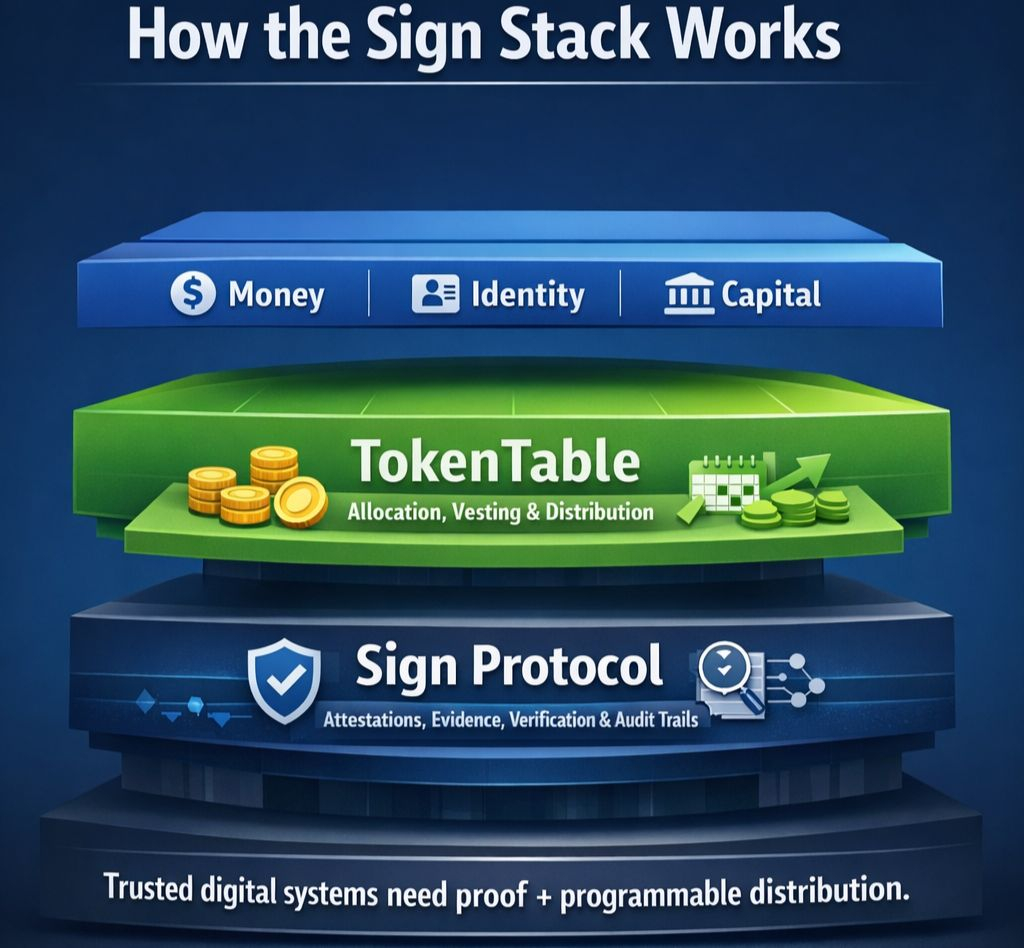
Another reason I think @SignOfficial stands out is that the protocol is framed as infrastructure, not just an app. The docs explain that Sign Protocol standardizes schemas, issues verifiable attestations, supports public, private, and hybrid records, and enables selective disclosure with privacy-preserving verification. That means it can support systems where trust cannot depend on a single database or one institution saying “just believe us.” Instead, records can be structured, signed, queried, and audited in a repeatable way. For regions focused on digital transformation and stronger economic coordination, this is exactly the kind of infrastructure that could matter more over time.
For me, the Middle East growth angle is especially compelling. If economic growth increasingly depends on trusted digital identity, compliant capital programs, and more efficient value distribution, then infrastructure that combines credential verification + evidence + programmable allocation becomes very powerful. That is why I think @SignOfficial has a serious long-term narrative. It is aiming at a layer that sits underneath digital services, token distribution, institutional coordination, and future sovereign-scale systems. That is a much bigger vision than most people realize when they first hear the name $SIGN. @SignOfficial $SIGN
#SignDigitalSovereignInfra @SignOfficial $SIGN
