


I’ve been thinking about this in a slightly different way, and it doesn’t feel like most systems are failing… it feels like they’re just too neutral. They don’t really take sides, they don’t interpret deeply, they don’t try to understand anything beyond what’s directly in front of them. And at first, that sounds like a good thing. Neutral systems are supposed to be fair, right?
But the more I look at it, the more that neutrality starts to feel like a limitation.
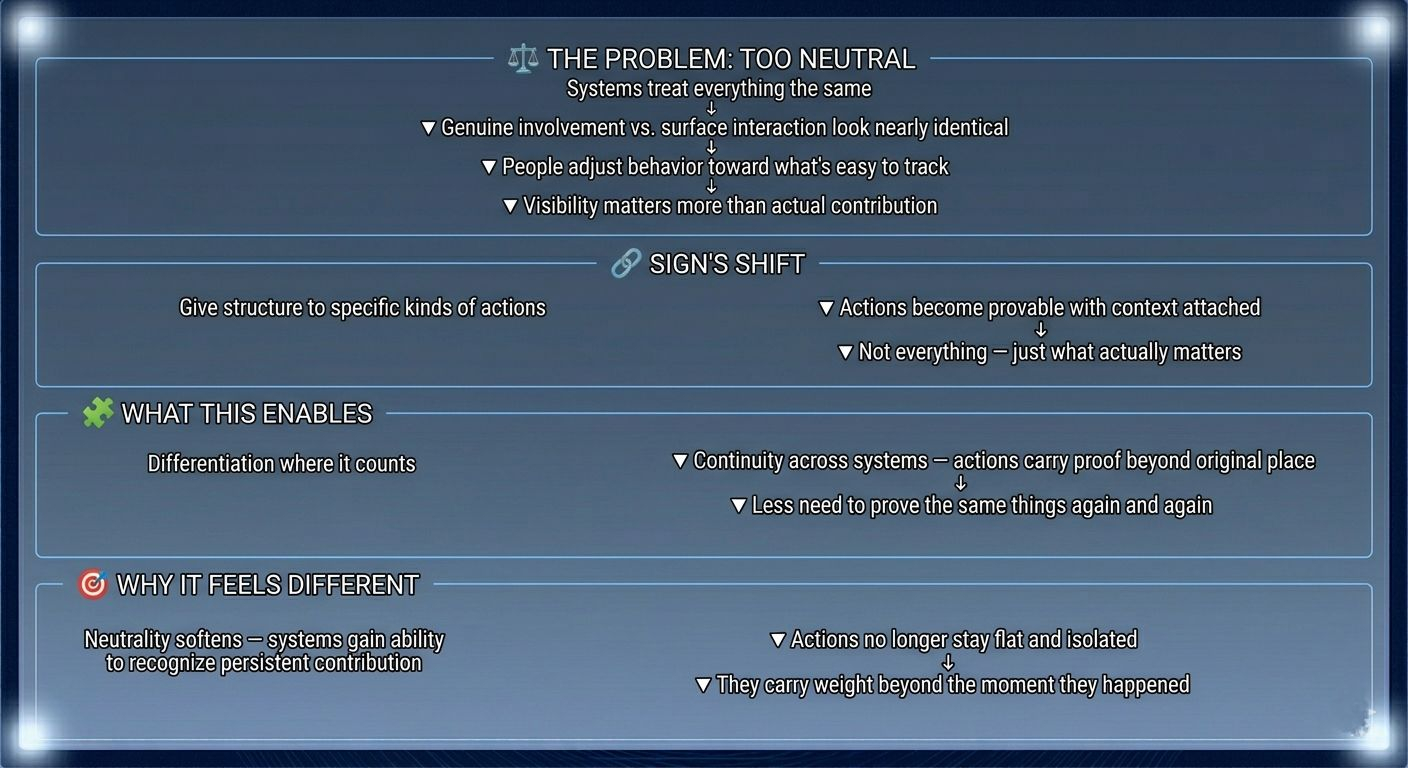
Because when a system treats everything the same, it also treats different things the same. And that’s where things get a bit off. Someone who’s genuinely involved, spending time, contributing, figuring things out ends up being processed in almost the same way as someone who just shows up, interacts once or twice, and leaves. Not identical, but not different enough either.
It’s like the system is saying, “I see both of you, but I don’t really know how to tell you apart.”
And honestly, that’s not because the system is broken. It’s because it was never designed to go beyond basic validation. It checks if something happened, confirms it, and moves on. No deeper layer. No context. No sense of what that action actually represents.
Over time, that creates this quiet imbalance.
People who understand how systems work start adjusting their behavior around what gets noticed. You don’t even realize you’re doing it. You just start leaning toward actions that are easier to track, easier to count, easier to qualify. And slowly, the system begins rewarding visibility more than actual contribution.
That’s the part that feels subtle, but important.
Because once everything becomes about what’s visible to the system, the meaning behind actions starts fading out. It’s still there in reality, but the system doesn’t really see it so it stops mattering as much in outcomes.
This is where SIGN feels like it’s coming from a slightly different mindset.
Instead of trying to make systems “smarter” in a general sense, it focuses on giving structure to specific kinds of actions. So certain things don’t just exist as activity they exist as something that can be proven with context attached to them.
Not everything, just the parts that actually matter.
And I think that’s what makes it interesting. It’s not trying to interpret everything automatically. It’s just making sure that when something is important, the system has a way to recognize it properly.
So instead of everything being neutral, there’s at least some differentiation where it counts.
Another thing I’ve been noticing is how this changes the feeling of interacting with systems over time. Right now, a lot of interactions feel temporary. You do something, it gets recorded, and then it just sits there. It doesn’t really build into anything unless the platform specifically tracks it in its own way.
There’s no real sense of continuity across different environments.
With something like SIGN, that starts to shift a bit. Not in a loud way, but in a quiet structural way. Actions don’t just stay where they happened they can carry some form of proof with them. So it’s less about starting over every time, and more about building on what already exists.
That doesn’t mean everything becomes permanent or universally recognized. Context still matters. But at least the system isn’t completely blind outside its own boundaries.
And I think that’s where the “neutrality” starts to soften.
Because instead of treating every new interaction as if it exists in isolation, there’s some continuity. Some recognition that what happened before might still matter now.
It also reduces this constant need to prove the same things again and again. Which, if you really think about it, is something we’ve all just accepted as normal. New platform, new process, new verification repeat.
But it doesn’t really have to be that way.
If something can be proven once in a structured way, there’s no real reason it should lose all meaning the moment you step into a different environment.
And that’s probably the part that stands out the most to me.
Not the technology itself, not the terminology but the fact that it addresses something that feels unnecessarily repetitive in the current system.
It doesn’t try to replace everything. It doesn’t try to control how systems behave. It just adds a layer where actions don’t have to stay flat and isolated.
They can carry a bit more weight.
And maybe that’s what was missing.
Not more data, not more tracking just a better way to make certain actions mean something beyond the moment they happened.
#signdigitalsovereigninfra @SignOfficial $SIGN
