
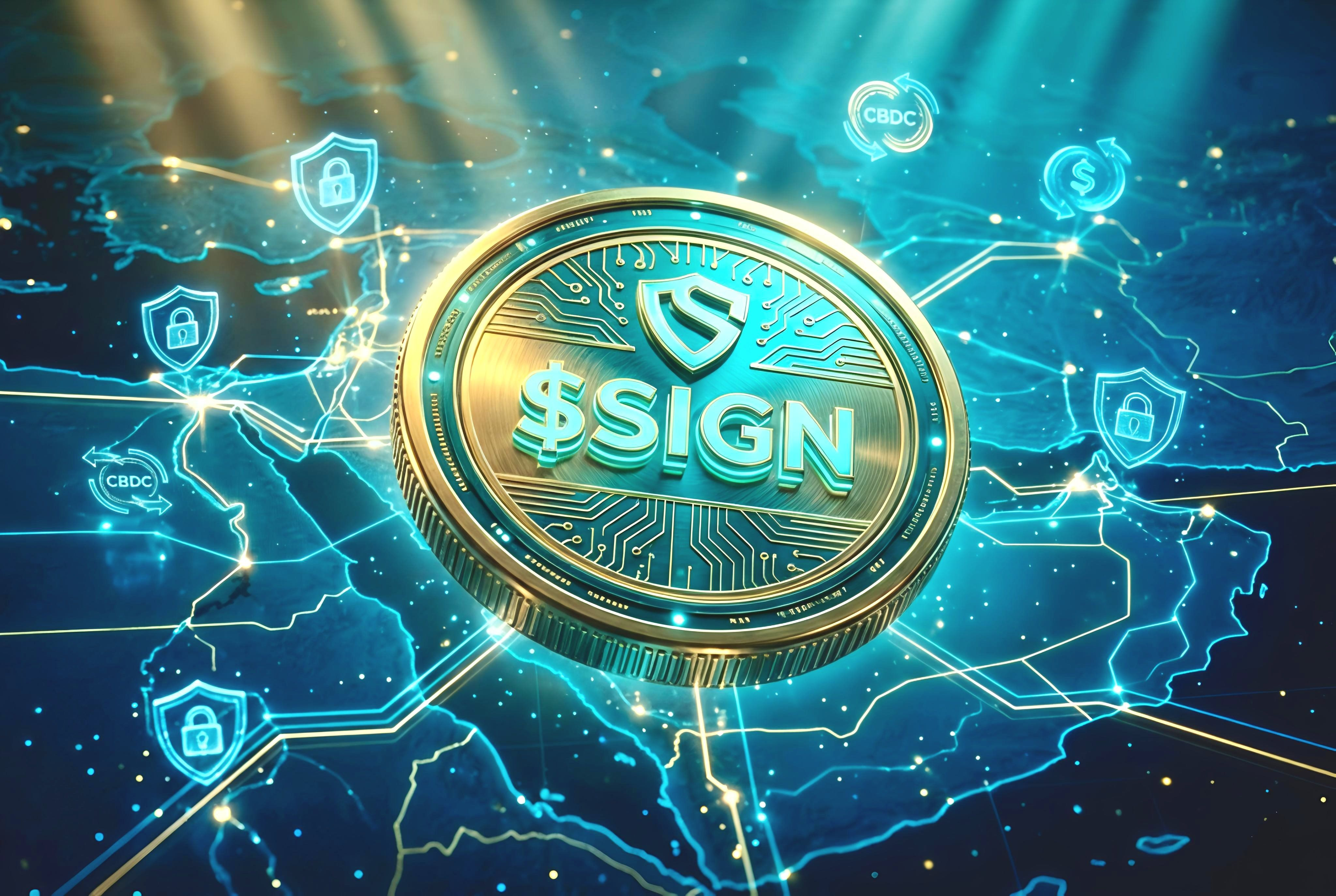
Two days ago, a quiet but telling observation surfaced around the token known as $SIGN. For many, it was easy to overlook—another token among thousands, another project claiming to reshape digital infrastructure. Yet beneath the surface, $SIGN gestures toward something more ambitious: a reconfiguration of how trust, identity, and value circulate in a world increasingly mediated by code.
To understand $SIGN is not merely to analyze a token. It is to examine a proposition—one that asks whether the next phase of the internet will be governed by centralized platforms, or by a federated mesh of interoperable systems where users, institutions, and even nations reclaim control over their digital existence.
This is not a trivial question. It is foundational.
The Problem Beneath the Protocol
Modern digital infrastructure rests on an uneasy compromise. Platforms promise efficiency, accessibility, and scale, but in exchange, they demand custody—of data, identity, and often capital. Whether in finance, social media, or enterprise systems, the pattern is familiar: centralized intermediaries act as gatekeepers of trust.
Blockchain technology emerged as a response to this imbalance, offering decentralization as a corrective force. Yet even within crypto, new forms of centralization have quietly reappeared. Exchanges hold custody. Protocols depend on opaque governance. Identity remains fragmented across wallets and chains.
The result is a paradox. We have decentralized ledgers, but not fully decentralized systems of trust.
$SIGN positions itself within this gap.
A Federated Approach to Trust
At its conceptual core, $SIGN is not just a utility token; it is part of a broader infrastructure designed to enable verifiable credentials and programmable distribution systems. If traditional blockchains function as immutable record-keepers, systems like $SIGN aim to act as coordinators of meaning—binding identity, credentials, and value into a coherent framework.
One way to understand this is through the metaphor of federation. Instead of a single authority dictating truth, multiple entities—governments, organizations, communities—can issue credentials that are cryptographically verifiable yet independently controlled. These credentials can then be used across a mesh of chains, forming an interoperable layer of trust.
In this model, identity is no longer a static profile stored on a server. It becomes a dynamic construct, composed of attestations that can be selectively revealed, verified, and revoked.
The implications are significant. A university could issue a degree as a verifiable credential. A government could distribute aid directly to authenticated citizens. A DAO could allocate tokens based on provable contributions rather than speculative behavior.
$SIGN, in this sense, is less a product and more a protocol for coordination.
Token as Mechanism, Not Just Asset
The role of the $SIGN token itself is subtle but important. In many blockchain systems, tokens serve as incentives or governance instruments. Here, the token appears to function as both a coordination mechanism and a medium for aligning participants within the network.
It underpins processes such as credential issuance, verification, and distribution. It may also play a role in governance, ensuring that no single entity dominates the system. Ideally, it becomes the connective tissue that binds together a decentralized yet structured ecosystem.
However, this raises an immediate tension.
Tokens, by their nature, are subject to speculation. Markets introduce volatility, and volatility can distort incentives. A system designed for long-term trust may find itself influenced by short-term price movements.
The question, then, is whether $SIGN can maintain its functional integrity in the face of financialization. Can a token designed to anchor trust avoid becoming just another tradable asset detached from its underlying purpose?
History offers mixed answers.
The Promise of Digital Sovereignty
One of the more compelling narratives surrounding $SIGN is its alignment with the idea of digital sovereignty. In a world where data flows across borders but governance remains largely national, there is a growing demand for systems that allow states and institutions to maintain control without sacrificing interoperability.
$SIGN’s infrastructure suggests a model where sovereign entities can issue and manage credentials within their own frameworks, while still participating in a global network. It is not about dissolving borders, but about redefining how they function in the digital realm.
This approach resonates particularly in regions where dependence on foreign digital infrastructure is seen as a strategic vulnerability. A sovereign database, backed by cryptographic guarantees rather than centralized servers, offers an alternative path.
Yet sovereignty is a double-edged concept.
On one hand, it empowers local control and reduces reliance on external actors. On the other, it can entrench fragmentation if not carefully designed. A network of sovereign systems must still find ways to interoperate, or risk becoming a patchwork of isolated silos.
$SIGN’s success may depend on how well it navigates this balance—between autonomy and connectivity, independence and integration.
Real-World Applications: Between Vision and Reality
The practical applications of $SIGN’s model are both broad and ambitious. Credential verification alone touches multiple sectors: education, employment, healthcare, and governance. Token distribution systems could reshape how incentives are structured in both public and private domains.
Consider humanitarian aid. Traditional systems often struggle with inefficiency and corruption. Funds pass through multiple intermediaries, and verifying recipients can be challenging. A credential-based system could, in theory, enable direct, transparent distribution to verified individuals.
Or consider digital identity. Billions of people lack formal identification, limiting their access to financial services and economic opportunities. A decentralized credential system could provide an alternative, allowing individuals to build verifiable identities independent of centralized authorities.
These use cases are compelling, but they are not trivial to implement.
They require not just technology, but adoption. Institutions must be willing to issue credentials. Users must trust the system. Regulators must understand and accept its implications.
This is where many blockchain projects encounter friction—not in their technical design, but in their integration with the real world.
Skepticism and Structural Challenges
For all its promise, $SIGN is not immune to critique.
One concern lies in complexity. Systems that attempt to unify identity, credentials, and value distribution risk becoming overly intricate. Complexity can hinder adoption, particularly among non-technical users. If the system is difficult to understand, it may struggle to gain traction beyond niche communities.
Another challenge is governance. Decentralization does not eliminate power; it redistributes it. The question becomes: who controls the parameters of the system? How are disputes resolved? What mechanisms prevent capture by well-resourced actors?
There is also the issue of trust itself. Ironically, systems designed to eliminate the need for trust must still establish it in their early stages. Users must विश्वास the protocol, the developers, and the broader ecosystem.
Finally, there is competition. The space of decentralized identity and credential systems is increasingly crowded. Multiple projects are exploring similar ideas, each with its own approach. Differentiation will be crucial.
$SIGN must not only articulate a compelling vision, but also demonstrate execution.
A Mesh of Chains, or a Fragmented Future?
The broader context in which $SIGN operates is one of rapid evolution. Blockchain ecosystems are diversifying, with new chains, layers, and protocols emerging at an accelerating pace. Interoperability is no longer optional; it is essential.
In this environment, the idea of a “mesh of chains” becomes particularly relevant. Rather than a single dominant network, the future may consist of multiple interconnected systems, each optimized for specific functions.
$SIGN’s emphasis on credentials and distribution positions it as a potential connective layer within this mesh. It does not seek to replace existing blockchains, but to enhance their utility by providing a shared framework for trust.
Yet this vision depends on coordination. Without shared standards, interoperability remains limited. Without incentives, collaboration falters.
The challenge is not just technical, but social.
Toward an Internet of Value
The phrase “internet of value” has been used frequently in crypto discourse, often without precise definition. At its best, it suggests a system where value can move as freely and seamlessly as information does today.
For this vision to materialize, several components must align: secure infrastructure, interoperable protocols, and reliable systems of identity and trust. $SIGN’s contribution lies primarily in the latter.
By enabling verifiable credentials and programmable distribution, it attempts to create a foundation upon which more complex systems can be built. It is, in a sense, a blueprint—one that outlines how different layers of the digital economy might interact.
But blueprints are not buildings.
They require execution, iteration, and, above all, adoption.
A Philosophical Closing: Trust in the Age of Code
At its deepest level, the story of $SIGN is not about technology alone. It is about trust.
For centuries, trust has been mediated by institutions—governments, banks, universities. These entities provide guarantees, but they also concentrate power. Blockchain technology introduced the idea that trust could be embedded in code, reducing reliance on intermediaries.
Yet code is not a panacea. It can enforce rules, but it cannot fully capture human nuance. It can verify credentials, but it cannot determine their meaning. Trust, in the human sense, remains relational.
Projects like $SIGN exist at this intersection. They attempt to translate trust into a programmable form, while acknowledging that it cannot be entirely abstracted.
Perhaps the future is not one where institutions disappear, nor one where code replaces human judgment. Instead, it may be a hybrid—a system where trust is distributed, verifiable, and yet still anchored in human context.
In such a world, tokens like $SIGN are not merely financial instruments. They are signals—markers of participation in a broader experiment to redefine how we coordinate, verify, and believe.
Whether that experiment succeeds remains uncertain.
But its direction is unmistakable.
@SignOfficial $SIGN #SignDigitalSovereignInfra