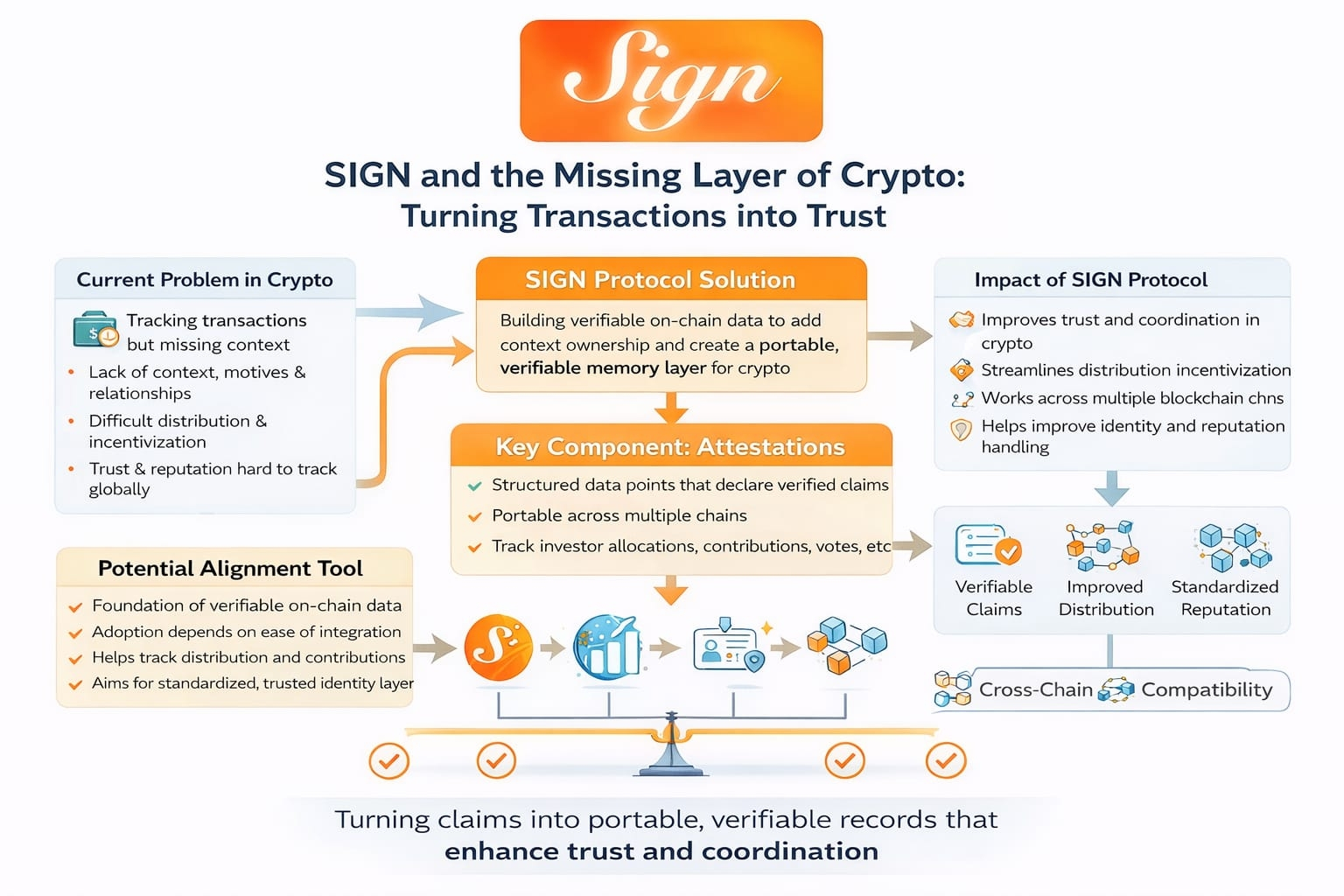
Crypto does a good job with transaction records,but it’s always lacked context.Wallets can track funds moving from place to place,but you don’t get the story behind those moves no clear sense of motives, conditions,or relationships between the parties involved.As crypto moves past pure speculation and into actual coordination funding teams, distributing incentives, proving contributions the absence of this layer starts to feel less like a gap and more like a wall.That’s where SIGN and Sign Protocol come in,aiming to bridge this problem by turning claims, credentials,and agreements into verifiable,on chain records anyone can trust.
At the heart of SIGN, you have a system built around attestations.These are structured data points that declare something happened,or something is true,coming from a source you can actually verify.It can be as basic as confirming someone participated in a campaign,or as detailed as tracking investor allocations,contributor reputation,or governance votes.The key shift isn’t just about moving messages or signatures on chain it’s about making these attestations portable, composable,and usable across multiple chains. Sign Protocol isn’t your standard identity solution.It’s more like a memory layer,helping crypto hold onto shared history and context.
Why does this matter now?Because the space has gotten big.Crypto networks aren’t tiny circles anymore.Trust isn’t local,reputation isn’t tracked by a handful of people,and money moves globally, sometimes across several chains at once. Distribution who gets which tokens,under what conditions,and when has quietly turned into one of the toughest problems out there. Projects like TokenTable show that the Sign ecosystem sees this challenge and treats distribution as core infrastructure,not a side effect.Attestations define what’s true; distribution systems determine how value shifts according to that truth.
As for the SIGN token itself,it looks more like an alignment mechanism than another fee token or speculative instrument. Its purpose probably ties to incentivizing participation,securing parts of the network, and helping coordinate the broader ecosystem. But its utility isn’t fully defined yet,and that’s both exciting and risky. If users don’t actively need attestations and robust distribution services,SIGN loses its connection to real economic activity.
There’s plenty to like in this setup.Building a foundation of verifiable data taps into the larger trend of improving on chain identity and reputation.The multi chain design matches the reality of an increasingly fragmented ecosystem.Focusing on distribution infrastructure addresses a genuine choke point that most growing projects hit sooner or later.Still, there are open questions.Attestations only matter if enough people use them,and adoption hinges on whether developers see SIGN as easier and more reliable than what’s already out there.Standardization is a big concern too competing frameworks might spring up, splitting the trust layer SIGN wants to unify.
For builders,SIGN offers less technical headache:instead of rolling out custom solutions for tracking who contributed what or who gets allocated which tokens,they use a shared system.For investors,the real question is whether this layer becomes essential or just remains optional.Infrastructure tokens only hit their stride when they’re everywhere but unnoticedsomething foundational you rely on,even if you never think about it.
What’s really happening here is a shift in what people want crypto to prove.It’s not just about owning assets anymore.The market’s drifting toward proving context ownership is about what you have, attestations are about what you’ve done.That matters when capital, governance,and incentives depend on more than just account balances.
In practice,you should judge systems like SIGN on integration,not hype. If it becomes the plumbing for projects to distribute tokens,verify contributions,and coordinate across chains,it’ll earn its place.If not,it could become another technically impressive system that never achieves gravity.The big question for the next phase of crypto isn’t just whether trust can be decentralized,but whether it can be standardized and if tokens tied to such infrastructure can actually drive sustained demand in the real world.