A manager of a sovereign fund in Abu Dhabi once privately complained: holding tens of billions of US dollars wanting to invest in global Web3 developers, but finding the money trapped on "chain islands."
Ethereum is one island, Solana is another, and Sui and Aptos are other islands. Each island is separated by sea; to send money to developers on different islands, either one has to build a finance department on each island (which is explosively costly), or one has to place the money on a "cross-chain bridge" (but the bridge could break at any time or be hacked).
The more headache-inducing issue is geopolitics: if all funds are placed on a chain dominated by a single country, if one day sanctions come down, the entire funding channel could be instantly frozen.
At this time, $SIGN (@SignOfficial ) is building a cross-chain token distribution network, which has become the "digital underwater tunnel" connecting these islands.
What is "cross-chain distribution"?
In the past, when you traveled abroad, you needed to go to the bank to exchange yen, euros, and dollars, with each wallet stuffed to the brim.
Cross-chain distribution is like a "globally accepted bank card": automatically helping you exchange currencies behind the scenes. When you swipe on one end, the developer on the other end receives the token of their respective chain.
For the Middle East Fund, this means they can use a single system to simultaneously allocate funds to developers on different global chains. There is no need to maintain technical teams on every chain, nor are they forced to "take sides".
Why does the Middle East urgently need "multi-chain neutrality" now?
The current blockchain world is becoming increasingly fragmented. In a geopolitically sensitive area like the Middle East, the phrase most trusted by sovereign funds is: "Don't put all your eggs in one basket."
1. Anti-fragility: If all ecological funds stubbornly stick to a single chain, once that chain faces geopolitical sanctions, the funding channel will be paralyzed.
2. Neutral Hub: SIGN's ambition is to be the "Swiss Bank" of Web3. It does not take sides with any public chain, but provides a neutral transfer channel. No matter where the money comes from or where it goes, it guarantees secure arrival and complies with global regulations.
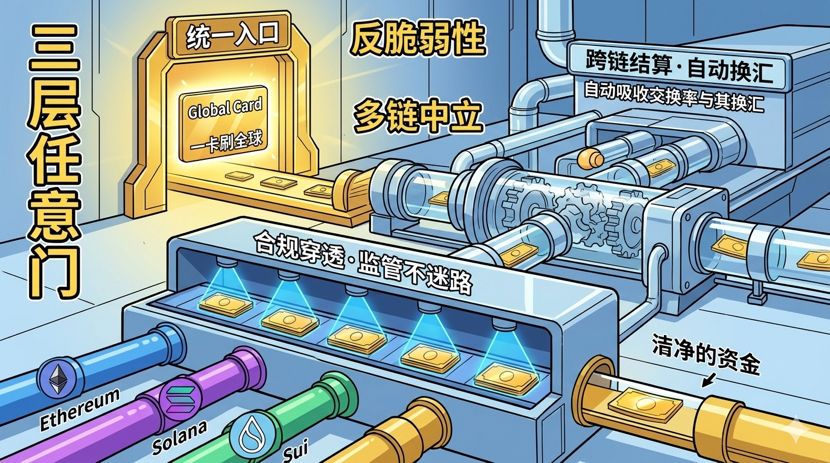
Layer Three "Any Door": Allowing funds to flow smoothly across chains
Layer One: Unified Entry (One card for global use)
Project parties only need to connect $SIGN once to reach users across all chains. There is no need to worry about underlying code, it's as simple as using Alipay.
Layer Two: Cross-chain Settlement (Automatic Currency Exchange)
The system automatically handles asset conversion between chains. The Middle East Fund pays in native assets, and developers receive tokens of the target chain, with the exchange rate and slippage entirely absorbed by the system.
Layer Three: Compliance Penetration (Regulations don't get lost)
This is what the wealthy value the most. No matter where the money goes, compliance checks are always present. Sending to an Ethereum address requires checking blacklists, while sending to other chains requires checking local regulations.
Splash of cold water: Will cross-chain bridges be "ATMs"?
Although the blueprint is beautiful, a reminder must be made:
The historical lessons of cross-chain bridges being hacked and losing billions are vivid. If $SIGN cannot prove its security is superior to traditional "single-chain storage", the wealthy would rather hire more finance personnel for manual transfers than entrust their money to an unstable "bridge".
When the blockchain world splits into individual "chain islands", cross-chain distribution becomes the lifeline connecting the islands. For Middle Eastern capital that does not want to be "choked" in competition, mastering this tunnel allows money to flow freely to the world.
If you are to receive ecological incentives from the Middle East Fund in the future, would you choose to only receive on Ethereum (mature but affected by specific regulations), or use a cross-chain solution to receive on any chain you like (convenient but with cross-chain security risks)?#BinanceSquare #Write2Earn #Sign地缘政治基建