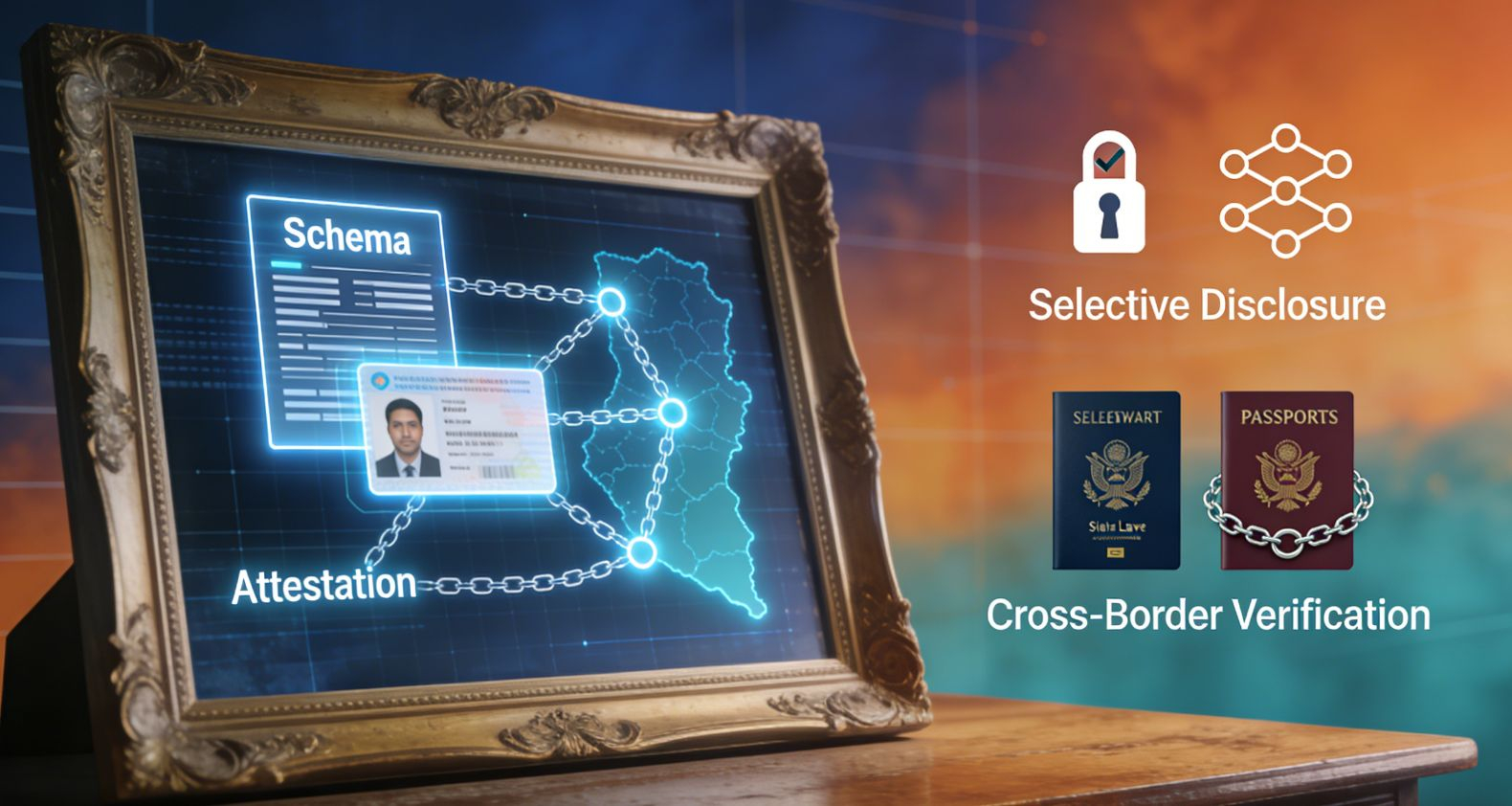
To be honest, when I first saw the news about Sierra Leone's Ministry of Technology signing a contract with @SignOfficial , my reaction was the same as most people's — just another country doing a 'blockchain pilot,' nothing to pay too much attention to. It wasn't until I carefully reviewed the contract content that I realized this time it was different.
Sierra Leone is not trying to create some flashy CBDC gimmick; their primary phase goals are just two things: a digital identity system and local stablecoin payments. This is probably the first time a sovereign nation has entrusted the citizen identity verification process to a Web3 protocol as the underlying infrastructure.
A scene suddenly flashed in my mind: If I were a citizen of Sierra Leone, in the future, when opening a bank account or applying for a loan, I might only need to present an on-chain credential, and the other party could scan it to verify who I am and what my credit history is. No more lugging around a stack of paper documents to run between seven or eight windows, and no fear of some department's database crashing.
This reminds me of when I first entered the space and missed an opportunity due to one project. The Booster event page was entirely in English, and the qualification requirements were overwhelming; I thought it was 'too troublesome' and closed it. Later, watching others share their profits, I felt a certain way. In retrospect, I realized that what held me back was not my English proficiency, but rather the friction costs of having to go through the verification process every time.
What SIGN is doing is essentially systematically reducing this friction cost.
Its core mechanism is called Schema — a structured data template defined on the blockchain. For example, it's like the form you fill out when applying for a passport; all consulates worldwide recognize this format, so you won't be asked to prove your identity again when you arrive in a new country. SIGN has transferred the same logic to the blockchain: identity qualifications, compliance status, and authorization records can be read and verified across systems, institutions, and even jurisdictions as long as they are generated according to the same schema.
There is a detail in the white paper that I find particularly interesting; it supports 'selective disclosure.' In other words, you can only show 'I meet this qualification' without needing to expose all underlying data. This feature is a lifesaver for compliance scenarios — often, the issue is not insufficient data, but rather that having too much data triggers another privacy protection threshold.
Moreover, with the attestation binding the issuer's information, generation timestamp, and revocation status, it means that a credential on SIGN is not just 'I have this qualification,' but also 'I was certified based on this set of rules at this point in time.' This level of detail is what can truly be implemented for compliance mutual recognition across jurisdictions.
SIGN's TokenTable has already done quite a bit of work. According to public data, this token distribution engine has processed distributions to over 40 million wallet addresses, covering amounts exceeding $4 billion, and has served over 200 projects including Starknet and ZetaChain. The annual revenue for 2024 reached $15 million, with a net profit margin of about 40%. This is not some 'promising' PPT project, but a business that already has cash flow.
So what role does the $SIGN token play in this?
My understanding is that it is the 'fuel' of the entire verification service network. Developers need to pay SIGN when calling the full-chain verification interface, and users also consume SIGN when distributing digital credentials. This consumption-based demand deeply binds the token to the actual usage rate of the protocol — the more people use it, the stronger its essential demand becomes. Additionally, 40% of the tokenomics is reserved for airdrops and community incentives, clearly indicating that the design aims to disperse the tokens into the hands of those who truly contribute, rather than allowing the large holders to hoard them in anticipation of price surges.
Of course, I must mention that the current circulation of SIGN is less than 17% of the total supply, and there is indeed ongoing unlocking pressure. This structural risk objectively exists, and I won't pretend not to see it.
But I'm increasingly convinced that the high compliance costs are not just a minor issue for a specific industry, but rather a wall that everyone will inevitably encounter during the global expansion of the digital economy. Sierra Leone's choice to partner with SIGN is not based on its token price, but rather on its ability to use a standardized schema to significantly reduce the costs of identity verification. Just think, if in the future two or three dozen countries integrate this standard, the educational credentials you obtain in country A, the social security records you pay in country B, and the professional qualifications you receive in country C can all be verified at the push of a button in country D — the value of this network may indeed exceed our current imagination.
The experience of missing an opportunity because it was 'too troublesome' taught me one thing: In Web3, the ones who win in the end are not necessarily the most qualified, but those who can endure the friction costs. What SIGN is doing is helping us to move this hurdle out of the way.
As for whether $SIGN is worth participating in, that is a judgment you need to make for yourself.#Sign地缘政治基建