
I read the Midnight piece. The one that talks about fatigue, about the “uncomfortable middle,” about a project that finally doesn’t make you close the tab. I felt that fatigue reading it. Not because the writing wasn’t competent, but because it perfectly encapsulates the current rot in this market: the desperate romanticizing of mediocrity.
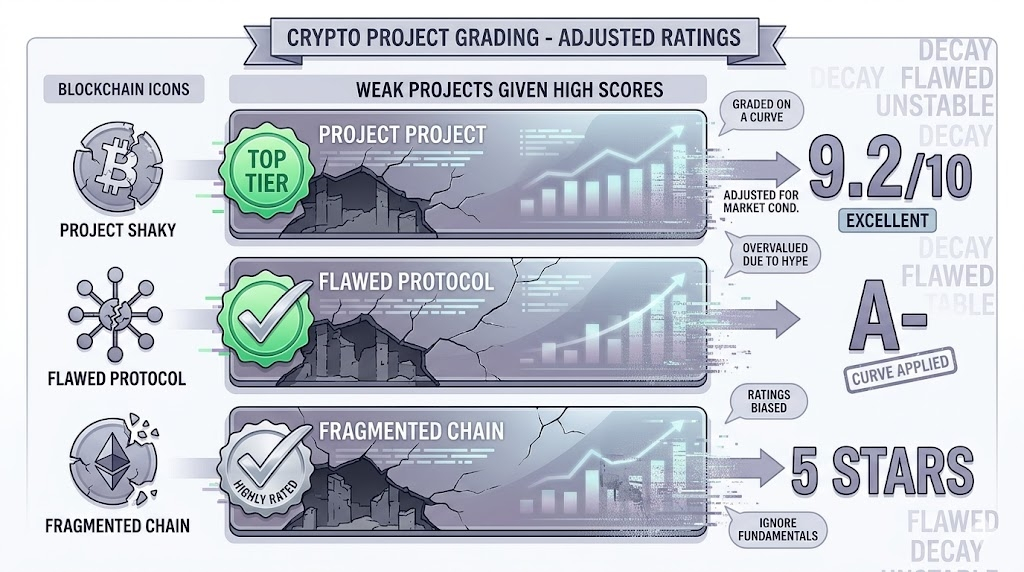
We’ve gotten so used to scams and vaporware that we’ve started applauding projects just for seeming like they’re trying. We’re grading on a curve so steep that a project with a half-decent whitepaper and a reluctance to scream into the void gets hailed as a beacon of maturity. But maturity isn’t the same as utility. And a quiet pitch doesn’t equal a viable protocol.
I’ve been watching Midnight, too. And where the author sees a "live question," I see a project that has already decided on the answer before the market has even asked the question.
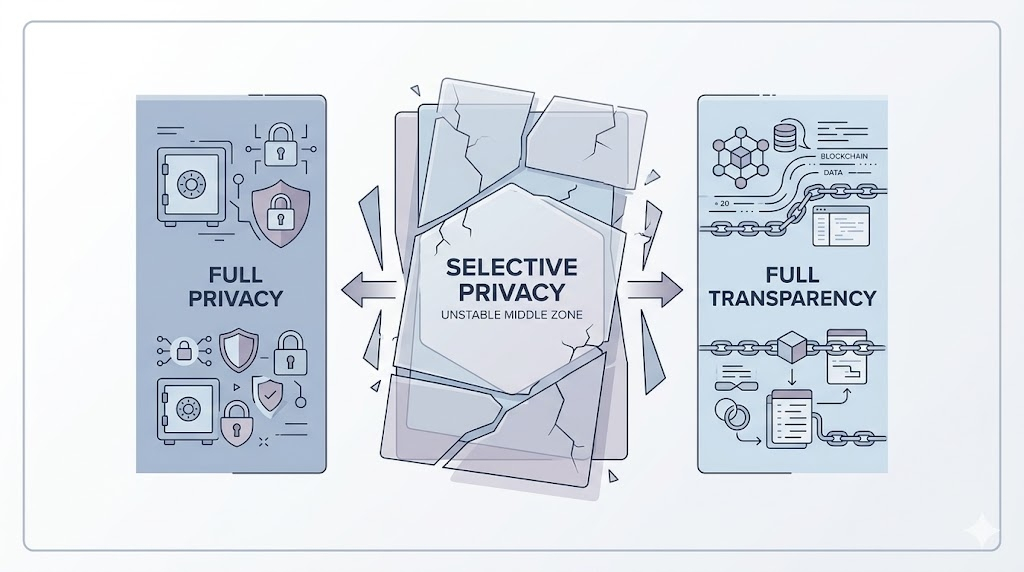
They’re selling “selective privacy” as if it’s a radical middle ground, when in reality, it feels like the most politically convenient, venture-capital-friendly version of a problem that requires a radical solution.
The original author says that cryptos focus on openness is the problem. They are right that it causes issues. Wrong, about how to fix it. The issue is not that we have much openness; it's that we have too much unnecessary information. The industry’s problem isn’t that every transaction is visible; it’s that we’ve spent five years building infrastructure for nothing but speculation. Midnight is trying to sell a privacy layer to an industry that still hasn’t figured out what it wants to do when it grows up.
Let’s call this what it is: the Enterprise Pivot.
We’ve seen this movie before. A chain launches. It promises scalability. Then it promises interoperability. Now, the new hottest trend is promising "compliance-ready privacy.
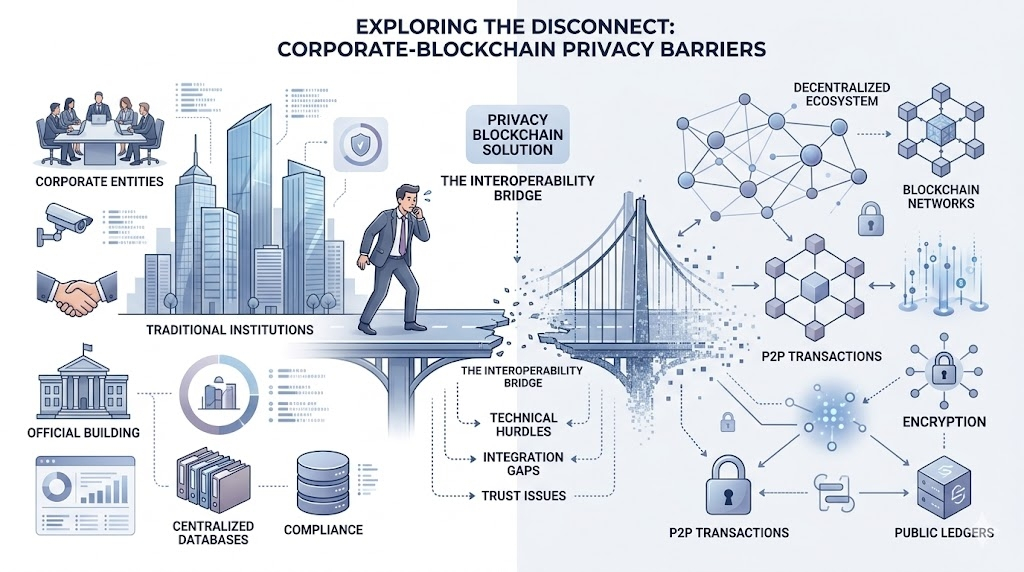
" Midnight is walking into a room full of regulators and institutions and saying, "Don't worry, we're the safe ones. We'll let you see what you need to see." It sounds pragmatic. But to me, it sounds like a project that has already accepted the premise that blockchain is a surveillance tool with a cryptographic afterthought.
The original author says Midnight is "staring at a real point of friction." I disagree. Midnight is staring at the current market narrative and dressing it up as a technical revelation. The friction in crypto isn’t transparency. The friction is that the user experience is still a nightmare, the liquidity is fragmented, and no one can explain to a normie why they need a “data availability layer” before they need a cup of coffee.
Building a chain that lets you "prove without exposing" is a complex technical feat. I’ll grant them that. But complexity isn’t value. The market is littered with the corpses of technically brilliant chains that solved a problem nobody was willing to pay for. Midnight’s thesis hinges on the idea that institutions will flock to a chain where they can have their privacy and eat it too—keeping the immutability while hiding the balance sheet.
That’s a fantasy.
Institutions don’t want "selective privacy." They want a database with a firewall. They want control. The moment you tell a bank or a corporation that their data is stored on a decentralized network run by anonymous validators—even if it’s “private”—they aren’t going to clap. They're going to ask for the phone number of the guy who can turn it off when something goes wrong.
Midnight is building a bridge to a place that does not want to be visited.
That's where I really start to feel tired.It’s not exhaustion from "too many projects." It’s exhaustion from watching smart people pretend that the next L1, with a slightly different consensus mechanism and a rebranded version of ZK-proofs, is going to unlock the next wave of adoption.
We’re past the era where "early" is a virtue. Being "early" used to mean you were pioneering something unseen. Now, being "early" just means you haven’t launched a mainnet that no one uses yet. The author says Midnight feels "early in the way that gets my attention." To me, it feels late.This project seems like something that took a look at the market and saw that the rules were getting tougher in the US and Europe. So it decided to make something that would follow these rules of trying to change everything.
The middle ground is not a place to be it is like being, in a place where nobody wants to be. It’s where you get shot from both sides. You’re too complicated for the degen crowd who just wants to ape into memecoins, and you’re too decentralized for the institutions who want a custodian. You end up with a ghost chain: technically elegant, philosophically neutered, and commercially irrelevant.
I do not think Midnight is a scam. The team that works on Midnight is very talented.. I think the idea behind Midnight is not good. Midnight has some problems with its idea. The way Midnight is supposed to work does not seem right to me. Midnight is a project that I have doubts, about because of its premise. The reason the market feels like it’s recycling stories isn’t because the innovators are tired; it’s because the innovation stopped being about the user and started being about the narrative.
The original author asks if Midnight will hold up when it leaves the comfort of theory. That's a question but people are looking at it from the wrong side. The real question isn’t whether the tech holds up. It’s whether anyone actually needs a middle ground. In a world where you can use Monero for true privacy or Ethereum for true transparency, the market for "kind of private, but not really" is a niche within a niche.
So, no. I don’t look at Midnight and see a project grinding toward relevance. I look at it and see the next step in the slow grind toward irrelevance. It’s a project built for the narrative of 2024—the "regulation is coming" panic—rather than the reality of 2025 and beyond, where users are going to demand tools that are either sovereign or simple, not a complicated compromise that satisfies no one.
Maybe I’m wrong. Maybe the market does want a chain where you have to prove your credit score without revealing your wallet balance. Maybe the "uncomfortable middle" becomes the new standard. But until then, I’ll pass. I’ve read this chapter before. The logo is just cleaner this time.
