

I’ve always wondered why most digital systems depend so much on trust, rather than verifiable proof. We all use these systems daily - payments, IDs, even government services - but we rarely stop to question how much we can actually trust them. The real question is: what happens when that trust is broken?
That’s when I stumbled upon $SING Protocols. This isn’t just another cryptography project; it’s a shift in the very foundation of how we build and use digital systems. $SIGN Protocols are designed to take systems from “trust-based” to “proof-based.” It’s about creating an ecosystem where everything, from payments to identity verification, is backed by verifiable proof.
I think what really makes $SIGN stand out is how it takes complex, often abstract ideas, and makes them real and actionable. The idea that each transaction or verification action has proof attached to it is a game-changer. Whether it's proving eligibility for benefits or verifying a secure transaction, $SIGN provides the evidence layer that ensures everything is legitimate and can be traced. It’s no longer about trusting the system; it’s about having the proof to back up the system’s actions.
What really clicked for me was $SIGN’s focus on attestations. These are essentially cryptographically signed records that show exactly what happened and when. If a record is updated or a distribution occurs, there’s proof that it was authorized and conducted according to the right rules. It’s like a digital notary service for every action.
For me, this takes the idea of trust to a new level - trust backed by proof. And in the world of digital identity and finance, that’s exactly what we need. Imagine the impact on sectors like government programs, financial systems, and even corporate transactions when everything can be verified. No more relying on assumptions. Everything is traceable and auditable.
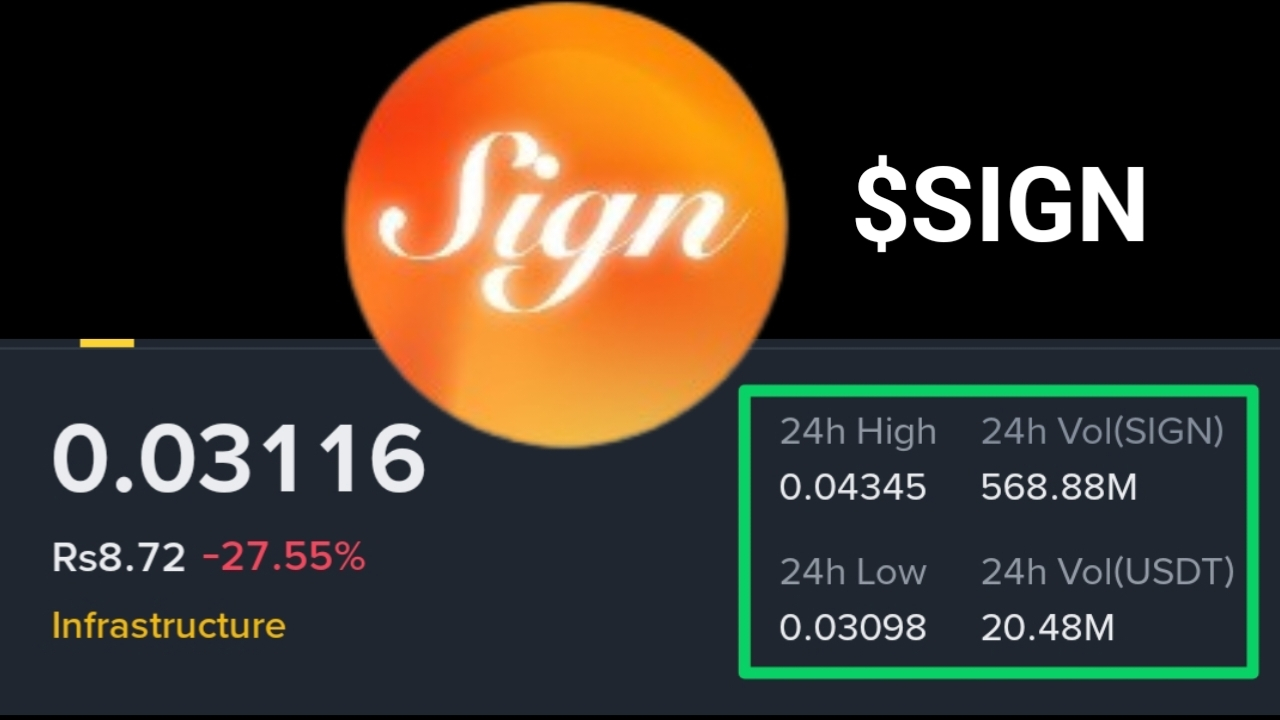
The market for $SIGN is already seeing action, as we can see from the recent data: $SIGN’s price dropped by 27.55% in the past 24 hours, currently sitting at $0.03116 with a 24h volume of 568.88M SIGN. Despite this dip, it highlights the volatile nature of emerging infrastructure tokens. However, it’s also clear that the token's high liquidity shows strong interest, and the potential for future recovery could align with the rise of digital infrastructure solutions like $SIGN.
In my view, $SIGN isn’t just solving a problem for today - it’s laying the foundation for the future. With privacy, transparency, and verifiable actions at its core, it’s building the trust that’s needed to scale digital economies.
As I reflect on how fast the digital landscape is changing, I believe $SIGN Protocols could very well become the backbone of digital infrastructure worldwide. It’s not just about adding another layer of technology; it’s about rethinking how we trust in the systems that govern our daily lives.
The future is coming, and it’s about verifiable systems that we can rely on. $SIGN. is showing us how it’s done.
#SignDigitalSovereignInfra @SignOfficial
