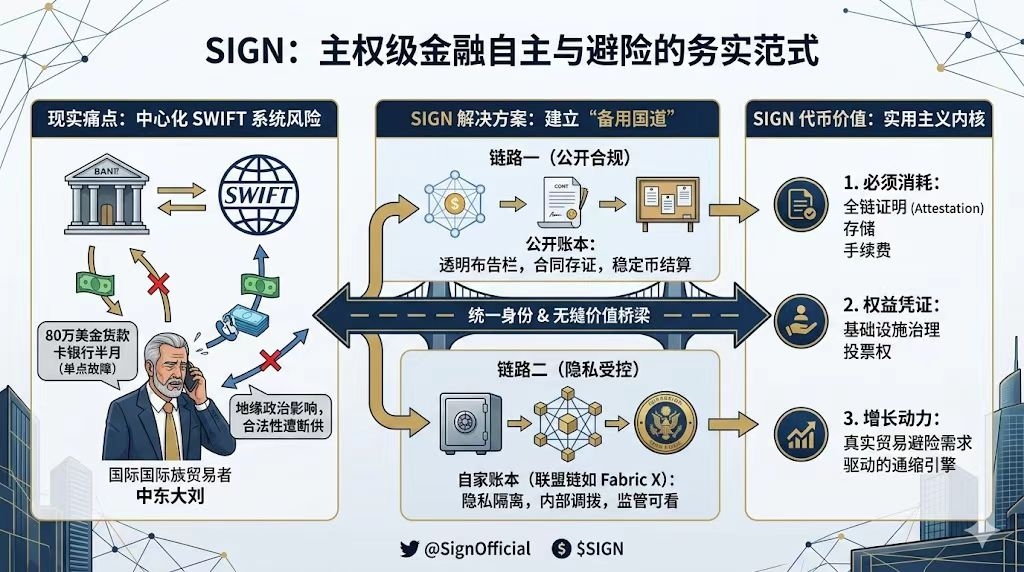
Last night at three in the morning, my brother Liu, who is dealing in building materials in the UAE, pulled me out of my dream with a phone call. It wasn't just catching up; it was a cry for help. 'It's over, brother, a batch of over 800,000 USD in payments has been stuck in the bank for half a month, and I can't do anything about it.' His voice was hoarse like it had been rubbed with sandpaper, and the bank on the other end said the SWIFT channel was delayed. I know it's because the situation over there has tightened, and some remittance routes are being closely monitored.
I listened to him cursing on the other end of the phone, and my heart sank as well. This wasn't the first time he had encountered such a problem. In the past, it was at most slow, and he would spend a bit more to find an agent bank to detour. But now? The routes can be cut off at any moment, and the money seems to have fallen into a digital black hole, with no place to reason about it. Liu finally sighed and said, 'You guys with your so-called blockchain, can you stop just trading coins and actually solve some real problems like ours?' After hanging up, I was wide awake. Staring out the window, I had only one thought: Liu was right to curse. We talk every day in our circles about 'decentralization' and 'anti-censorship,' but when a brother like Liu, who is working in a real industry, gets choked, how many protocols can stand up and be that life-saving bridge? I turned around and looked at that position in my portfolio that hasn't moved much lately, $SIGN , and suddenly felt it was more substantial than many of the noisy coins. It might not have as many flashy stories, but it addresses the very pain point that people like Liu feel the most: when the centralized financial postal service cuts off your mail, what do you do?
SWIFT? That's just a 'postman' in 'good times.'
We need to recognize reality. What is SWIFT? It's just a 'transnational WeChat group' among global banks, responsible for delivering messages: 'Bank A says to transfer 1 million to Bank B.' It only relays messages, doesn't touch money, and the group owner and admin are determined by whoever is stronger and louder.
Once geopolitical winds and rains blow, if the group owner says 'certain banks can no longer speak in this group,' or 'messages on certain paths are delayed,' then you, like Big Liu, will be left staring blankly. Your trade contracts, your letters of credit, your inspection documents instantly become 'kites with broken strings' in the digital world—beautiful, but useless. The lifeblood of your business is in someone else's hands. This problem cannot be solved by the traditional banking system itself. This is not a technical issue; it's a matter of trust and power structure. What you need is a new way to transmit messages and deliver money that doesn't rely on that 'big road.'
Two paths, one of them must lead somewhere: the two legs of SIGN.
So what to do? I carefully pondered the design in the @SignOfficial white paper and found that it provided a two-legged approach, quite down-to-earth, not like floating in the air.
The first leg: a public ledger, for everyone to see. You can understand it as a super transparent 'public bulletin board.' The key information of contracts with your partners, payment commitments (of course, using technology to hide sensitive prices and other information), can be turned into verifiable code 'evidence.' Any connected node in the world can see this bulletin board and prove that 'this matter was confirmed by both parties on a certain date.' Where's the money? It can be settled using stablecoins associated with this bulletin board. This path is open and aboveboard, suitable for most businesses that can see the light.
The second leg: a private ledger, counting behind closed doors. Some businesses, like international oil settlements, large internal transfers within banks, can't be made public. This requires another system, like an 'internal ledger' such as Hyperledger Fabric X. Only a few authorized banks or institutions can participate in the accounting, the transaction speed is extremely fast, and outsiders can't see the transaction details; only regulatory roles like central banks have keys to get a general overview. This is prepared for the most core and sensitive financial transactions.
The beauty is that these two legs don't operate independently. The white paper states that they built a 'bridge' between them. This means you can safely exchange digital currency from the 'internal ledger' for stablecoins on the 'public bulletin board' to buy things globally. The reverse is also possible. This adds flexibility, allowing you to choose between the 'bright avenue' or the 'internal passage' based on business needs, and you can switch paths anytime. Isn't this just a 'backup national road' built for people like Big Liu? Once I understood this point, looking at #Sign地缘政治基建 felt different. It's not just the gas fee for paying transaction fees in this system. You need it to store contract evidence on that public bulletin board. You also need it to exchange internal currency for stablecoins across that bridge. More importantly, as more players like Middle Eastern countries begin to seriously build their own 'internal ledgers' and connect with external 'bridges,' they will need a large amount of $SIGN to drive the entire system. What does this mean? It means its demand is tightly bound to the 'trade risk hedging demand' and 'financial autonomy demand' in the real world. The more the Middle East wants to escape the risk of being choked, the stronger the demand for such infrastructure. This is not about speculation; this is about laying the foundation.
So, why am I willing to invest some money in $SIGN and hold onto it? I'm not betting that it will double next month. I see it as a special 'stockpile.' What I'm stockpiling isn't consumer goods, but the 'reinforced concrete' for building roads and bridges in the future digital world. When the old roads of the real world occasionally collapse and get cut off, will these materials for new infrastructure become more valuable? Big Liu is still pleading for help with his stuck 800,000. Meanwhile, I've quietly exchanged a small portion of my assets for materials that are constructing the 'new roads' and bridges. I don't know when the new roads will completely replace the old ones, but I believe that having an additional route that works is always a solid principle. Next time Big Liu calls to complain, I might be able to discuss with him whether there are other possibilities besides waiting for SWIFT. After all, in this era, tying the lifeblood of a business to a postal route dictated by others really makes it hard to sleep at night.