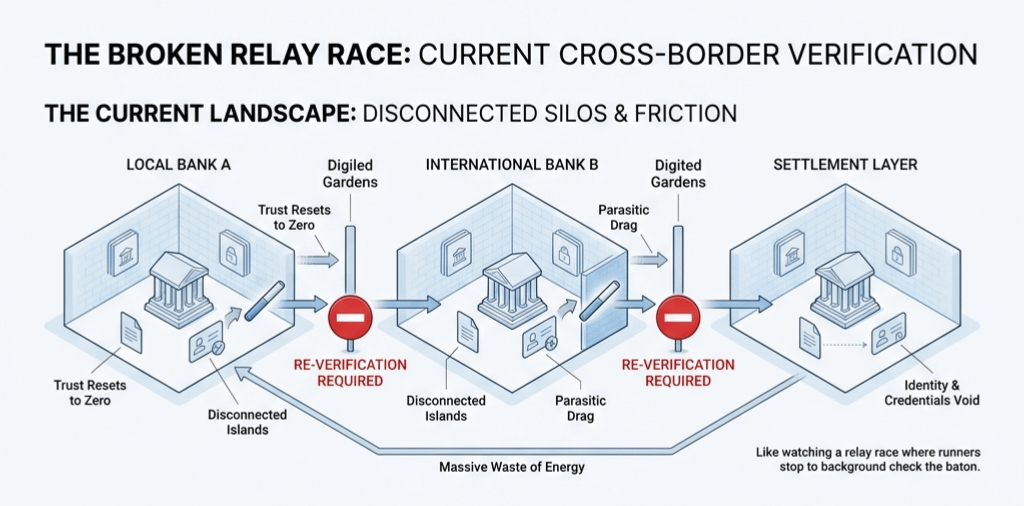
I used to think that the friction in Middle East deal flow was just a cultural quirk or a byproduct of high-stakes caution until I spent an afternoon watching a mid-sized cross-border settlement grind to a halt for no apparent reason. The capital was sitting right there and the handshake was firm but the entire process hit a wall because one system refused to acknowledge a verification that had already happened ten minutes prior in another environment. It was like watching a relay race where the runners stop to perform a background check on the baton before they start running their leg. This is the quiet tax on growth that nobody talks about in the glitzy brochures for regional expansion and it is exactly why I started paying attention to Sign after ignoring the noise for months.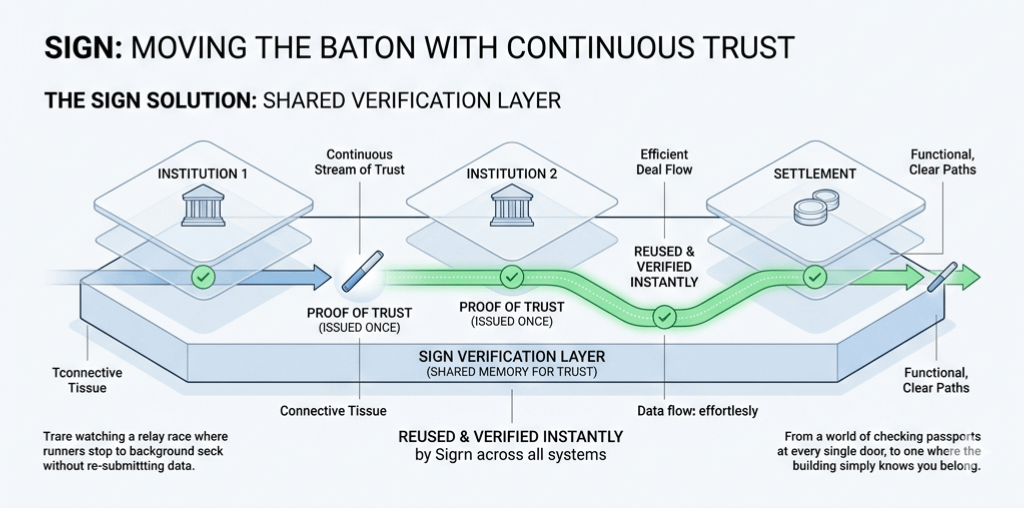
The current landscape is a patchwork of walled gardens where trust has the shelf life of an open gallon of milk. We are stuck in this archaic loop where identity and credentials reset to zero the moment they cross a digital border and it makes the old guard systems look like a series of disconnected islands rather than a unified global economy. You see these massive giants boasting about their digital transformation but the reality is just a bunch of fancy silos that do not talk to each other. Every time a deal moves from a local bank to an international settlement layer it has to scream its credentials into the void all over again. It is a massive waste of cognitive and computational energy that treats every verified participant like a complete stranger until they prove their worth for the tenth time that day.
What Sign is doing with their verification layer actually feels like it addresses the bone-deep reality of this inefficiency by creating a shared memory for trust. Instead of the typical crypto play of trying to replace everything with a brand new shiny toy Sign is building the connective tissue that allows proof to be reused without being compromised. It is not about making things look faster with a slick interface but about stripping away the redundant re-verifications that act as a parasitic drag on the entire system. Of course the skeptics will point to the latency of decentralized coordination and the massive hurdle of getting legacy institutions to stop hugging their proprietary data like a security blanket and they are right to be cynical. Adoption is a brutal uphill battle and the graveyard of tech is full of great ideas that were too early or too complex for the average bureaucrat to grasp.
Yet the direction here feels different because it acknowledges that trust should be a continuous stream rather than a series of broken fragments. In a region that is scaling at breakneck speed you cannot afford to have your infrastructure tripping over its own feet every time a transaction crosses a system boundary. If Sign can actually hold the line and prove itself under the pressure of real world volume it moves us away from the era of digital gatekeeping and toward something far more functional. We are effectively moving from a world of checking passports at every single door in a building to a world where the building simply knows you belong there. It is the difference between a city of high walls and a modern shipping terminal where the containers move because the manifests are already trusted and the path is already clear.