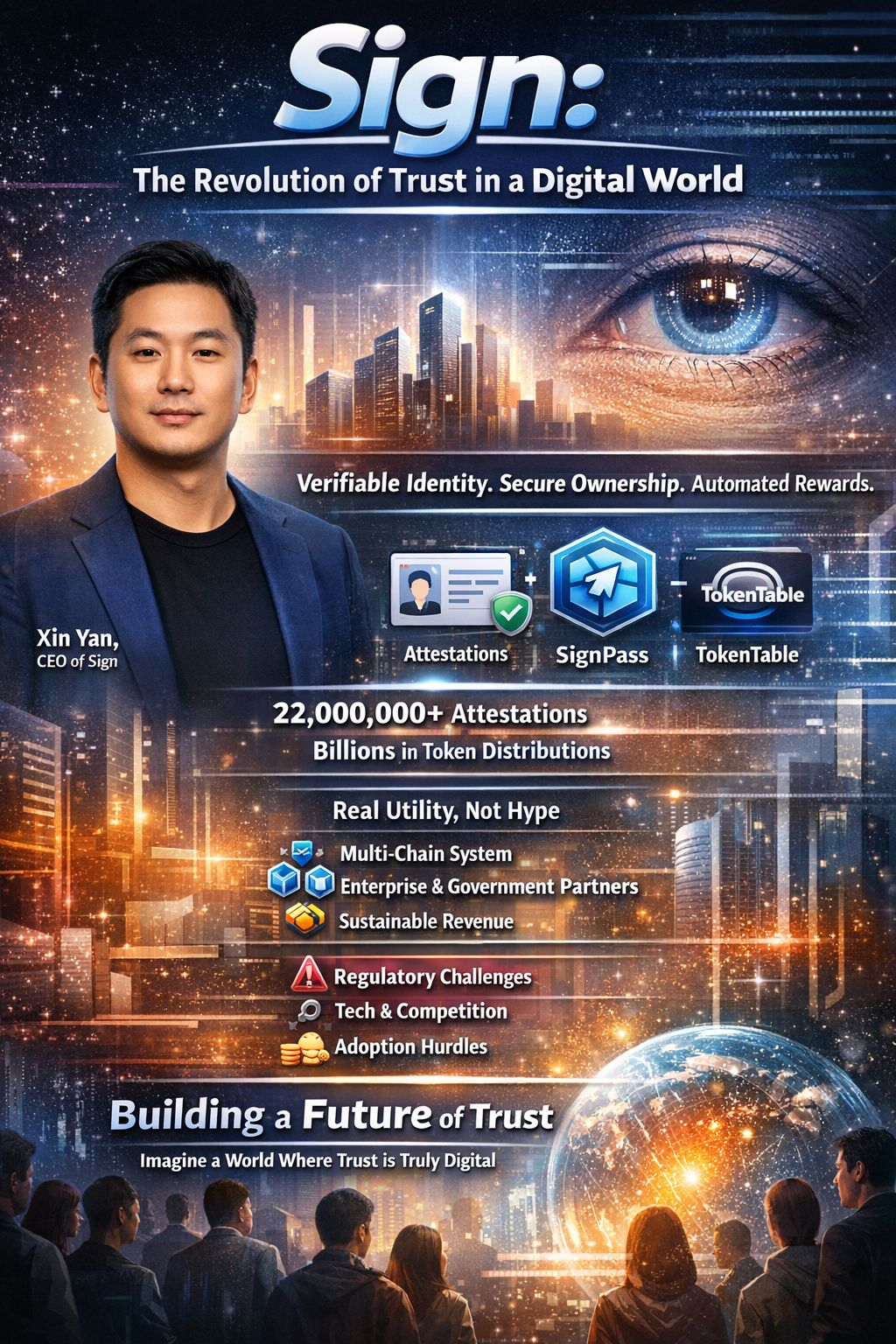
In a world where everything can be copied, faked, or manipulated, trust has become the rarest commodity. I’m realizing that our digital identities, ownership, and agreements are no longer guaranteed by institutions. We’re seeing a reality where every interaction online depends on fragile systems that can fail. Sign, led by Xin Yan, is not just another crypto project. It is a movement to rebuild trust from the ground up, creating a future where digital verification is as natural and reliable as a handshake in the real world.
$SIGN was born from a simple yet powerful idea. What if we could prove who we are, what we own, and what we agree to, without relying on intermediaries? If It becomes widely adopted, this vision can reshape the internet itself. Instead of central authorities holding all the power, Sign empowers users with verifiable digital proofs called attestations. These attestations confirm identity, ownership, or agreements securely, privately, and transparently. They’re the building blocks of a world where trust is programmable, portable, and universal.
Sign operates on multiple layers, each carefully designed to create a seamless experience. The attestation layer allows trusted entities to issue signed statements about a person or asset. A company can verify you passed KYC, or a protocol can confirm you are eligible for rewards. These attestations live on blockchain networks, making them instantly verifiable by anyone with permission. The identity layer, often called SignPass, bridges real-world credentials and blockchain addresses. I’m seeing this as the critical link between our physical and digital selves, enabling governments, enterprises, and individuals to interact securely and confidently. The distribution layer, powered by TokenTable, automates the delivery of tokens and rewards. It ensures that millions of users can receive distributions without delays or errors. The system has already handled billions in token distributions and reached tens of millions of wallets, proving its efficiency and scalability. Finally, the multi-chain structure ensures that no data is trapped on a single blockchain. This flexibility enhances security and allows the system to grow without limits.
Most crypto projects chase trends or hype, but They’re fragile and often fade. Sign chose a different path. By building infrastructure instead of chasing speculation, the system serves real-world needs like identity verification, credential distribution, and enterprise solutions. We’re seeing a shift from hype-driven markets to utility-driven ecosystems. This long-term vision creates lasting value. Infrastructure is not temporary. Once adopted, it becomes essential. That’s the genius behind Sign’s design.
The $SIGN token is not just a currency; it is the lifeblood of the network. It powers transaction fees, governance voting, staking incentives, and community rewards. A large portion of tokens goes directly to the community, encouraging participation and decentralization. If It becomes widely adopted, the token’s value will reflect real utility, not hype. We’re seeing a system where usage drives worth, aligning incentives between developers, users, and long-term supporters.
True health of Sign is not reflected in charts alone. The first measure is adoption. Millions of attestations and billions in token distributions show active real-world usage. The second is network reach. Multi-chain compatibility ensures scalability and resilience. Third is enterprise and government integration, signaling strong demand and trust. The fourth is revenue sustainability. Unlike many crypto projects, Sign is generating real income, proving that the project is not a short-term experiment.
No system is perfect. Sign faces regulatory risks, adoption friction, competition, and technological complexity. They’re proactively addressing these challenges by collaborating with governments and enterprises, expanding product lines to diversify revenue, and creating user-friendly applications. These strategies reflect foresight, resilience, and a commitment to long-term growth.
Sign aims to become a global standard for digital identity and asset verification. Plans include deeper government collaboration, expansion across new networks, and further infrastructure development. If It becomes successful at scale, we’re not just witnessing a crypto project; we’re seeing the foundation of trust for digital economies. Imagine a world where your identity, credentials, and assets are instantly verifiable without intermediaries. Sign is building that world.
I’m watching this journey and realizing that technology alone does not change the world. Belief, persistence, and solving real problems are what create impact. They’re not just building code; they’re building trust in a world that desperately needs it. We’re seeing the dawn of a new era where digital interactions are safe, reliable, and human-centered. If you remain curious, patient, and engaged, you won’t just witness this future. You’ll be part of it.