

Hello BS family, Saïd here. Grab a coffee and pull up a chair, because today we need to have a serious conversation about the one thing holding the entire digital world back: Trust.
Look around us right now.
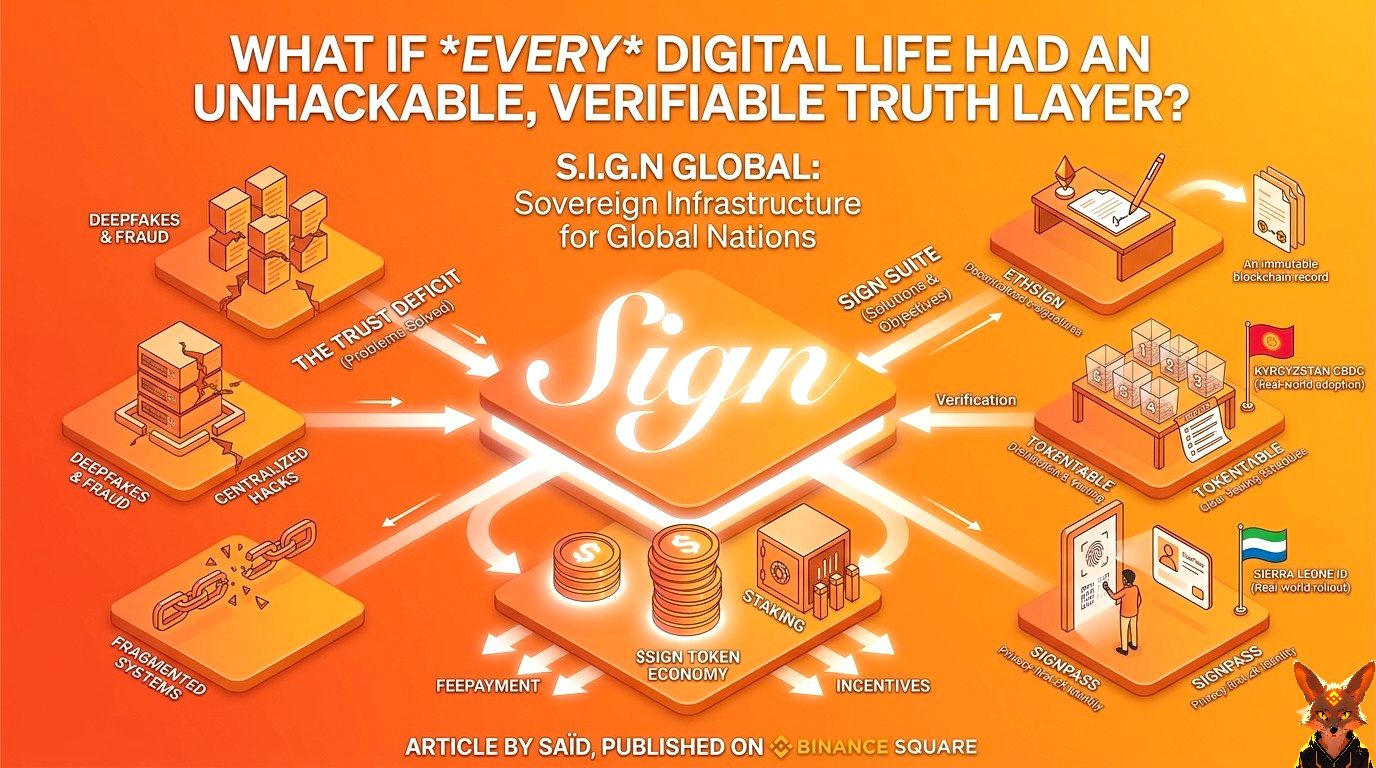
Deepfakes are everywhere.
Credential fraud is rampant.
Token launches can be completely opaque, and centralized databases are getting hacked every other Tuesday.
For years, we've been promised that Web3 would fix this.
But until now, most crypto projects have just been trying to onboard individual wallets with the same old promises.
But what if I told you there’s a project out there that isn't just trying to onboard users, but is actively onboarding entire countries?
That’s exactly what Sign Global is doing.
And honestly, it’s one of the most fascinating infrastructural shifts I’ve seen in this space. Let’s break down what S.I.G.N is, the massive real-world problems it solves, and why the $SIGN token is quietly becoming the backbone of a new digital economy.
The Broken Promise of "Trust Me, Bro"
In traditional finance and digital identity, we are forced to rely on middlemen.
You trust a bank to hold your money.
You trust a government server to verify your passport.
But these systems are fragmented, incredibly slow, and vulnerable to single points of failure.
Even in the crypto space, we suffer from "trust crises"—fake airdrops, hidden tokenomics, and anonymous actors vanishing into the night.
Sign Global looked at this landscape and realized something fundamental: The world doesn't need another memecoin or a slightly faster blockchain.
It needs a universal, cross-chain truth layer.
What is Sign Global (S.I.G.N) Actually Solving?
Sign Global is building S.I.G.N—Sovereign Infrastructure for Global Nations.
Let that sink in for a second.
They are creating the foundational technology for programmable CBDCs (Central Bank Digital Currencies), verifiable digital identities, and tokenized real-world assets.
At the core of this is the Sign Protocol, which is an omni-chain attestation layer.
Think of an "attestation" as cryptographic proof of a real-world fact. "This person owns this house," "This developer graduated from this university," or "This token unlock schedule is legitimate." Sign Protocol lets anyone sign everything on-chain and verify it anywhere, across any network, without needing a centralized bridge.
It powers a suite of heavy-hitting tools:
EthSign: The decentralized e-signature platform that started it all, allowing legally binding agreements to live on-chain.
TokenTable: A smart-contract token distribution platform that brings absolute transparency to airdrops and vesting (goodbye, opaque founder allocations!).
SignPass: Privacy-first digital identity verification utilizing Zero-Knowledge proofs.
The $SIGN Token: Fueling the Truth Machine
Now, let's talk about the $SIGN token.
In a system where data verification is this critical, security and economic alignment are everything.
SIGN is the native utility token powering this massive ecosystem.
It’s not just a governance token sitting idle; it's the heartbeat of their economic and social layers.
It’s used for staking to secure the protocol, paying transaction fees, and incentivizing the ecosystem.
When major enterprises rely on TokenTable to distribute billions in assets, or when governments use SignPass for national ID systems, SIGN is the infrastructure making it all tick.
And this isn't just a whitepaper theory.
This is happening right now.
We are talking about active, real-world deployments—like Kyrgyzstan building its CBDC on Sign, or digital ID rollouts happening in Sierra Leone.
They are building a "digital lifeboat" for national economies to ensure fail-safe resilience.
As a content creator, I see a lot of hype come and go. But what Sign Global is building isn't hype; it's plumbing. It's the essential pipes and wiring needed to make Web3 safe, compliant, and useful for governments, enterprises, and everyday people.
They are effectively replacing the phrase "Trust me" with "Here is the cryptographic proof."
For the next billion users to enter Web3, they shouldn't even need to know they are using a blockchain.
They should just know their data is safe, their money is secure, and their identity belongs to them alone.
What are your thoughts on this? Do you think nations will fully embrace decentralized attestation layers, or will legacy systems fight back? Let’s discuss it in the comments below!
Until next time, keep learning and stay curious.