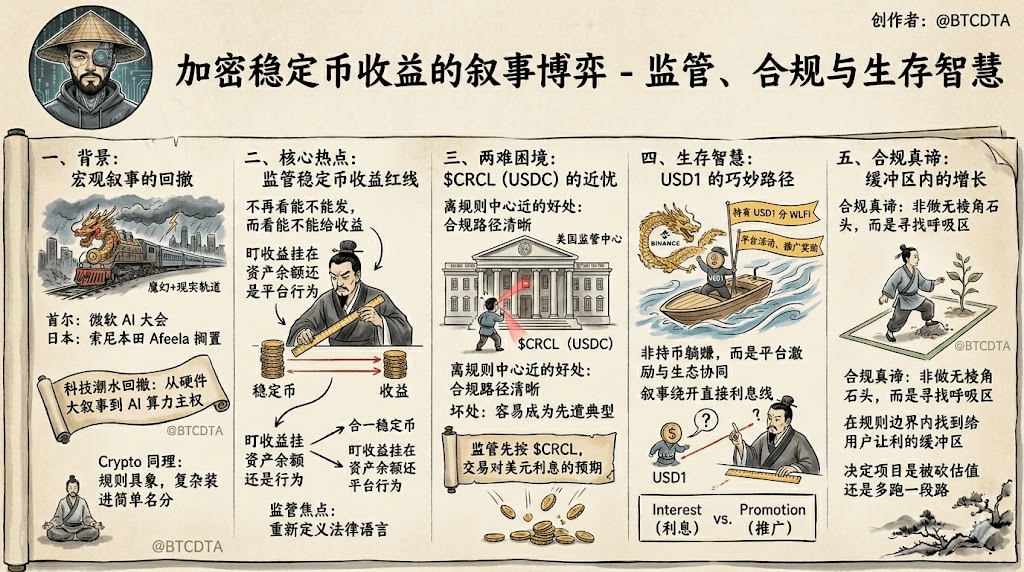
In the morning, as I opened my eyes, the world was still racing along that magical yet realistic track. In Seoul, Microsoft's AI conference was in full swing, showcasing how Copilot has evolved from a supportive chat tool into a digital employee capable of independent thought. Meanwhile, Japan's automotive giants Sony and Honda suddenly announced the suspension of the Afeela electric vehicle plan. This contrast is quite interesting: the tide of technology is withdrawing from a broad narrative of hardware to a focused and deep exploration of AI computing power and sovereign models.
In this context, looking at Crypto, you will find the same logic: the rules are becoming more and more specific, while the wisdom of survival lies in how to encapsulate complex things into simple definitions.
The recent focus that major players should pay attention to is not which altcoin is rebounding, nor which market maker is facing liquidation, but rather that U.S. stablecoin regulations are starting to shift from whether they can be issued to how they can provide returns, how they can give returns, and who will provide those returns. Regulation is no longer just focusing on stablecoins themselves, but rather on the red line between stablecoins and returns, and how to delineate it.
Many people understand this matter as a bearish signal for $CRCL, but I think they are only seeing the surface. The real issue is not whether stablecoins can still benefit users in the future, but who will issue these benefits, whether these benefits are tied to asset balances or platform actions, and ultimately what they are called in legal terms.
The issue with the structure of Circle and Coinbase is not that the product is poor, nor that the assets lack transparency, but that it is too close to the U.S. regulatory center. Being close to the center of the rules has a benefit: the compliance path is clear; but it also has a downside: once regulators want to find typical cases, they can most easily find you first. Especially when discussions begin to focus on whether holding stablecoins can directly generate interest, it is not the fringe projects that resemble deposits and are most easily monitored by the traditional banking system, but rather the most central, standard, and most akin to legitimate financial extensions.
So it's not surprising that $CRCL was initially pressed by the market. The market is not trading a piece of legislative text; it is trading an expectation: Will the U.S. prioritize cutting the stablecoin earnings issue from the parts that look most like interest? As long as this expectation holds, the closer the model is to U.S. regulatory narratives, the faster the discount will be.
Looking at USD1, the path it is currently taking is even more interesting. It does not present the story as simply holding the currency to passively receive dollar interest; instead, it places more incentives on platform activities, ecological collaboration, and promotional rewards. Recently, holding USD1 on Binance has essentially given users a sense of actual returns, but the narrative has not directly clashed with dollar interest.
This is a layer that many people overlook. Regulation never just looks at whether you are issuing money; it looks more at why you are issuing money and under what name. If it's a fixed return based on balance, then legally it resembles interest more; if it's incentives related to platform operations, user behavior, and ecosystem promotion, then at least at this stage, it resembles promotion more. The user experience may be similar, but from a regulatory perspective, they are not in the same drawer.
So my current judgment is very simple: $CRCL did not suddenly collapse in product logic, but it got too close to the center of the rules and became a subject of stress testing. USD1 has not received a permanent immunity card; it is just temporarily stuck in a smarter position, leveraging platform incentives and nominal design to bypass the most direct legal conflicts.
This is also why I have always felt that the real strength of compliance is not in becoming a smooth stone, but in finding a breathing, growing buffer zone within the boundaries already defined by the rules, where users can still benefit. This buffer zone often determines whether a project is first cut in valuation by the market or can still run for a while longer.