
A chicken plate解——颜驰@颜驰Bit
Hello everyone, the theme of today's content is (Yan Chi Trading Performance Deep Penetration Report).
This is not simply looking at a few profit screenshots, nor is it about seeing one or two miraculous trades. Rather, it is based on a set of core real trading data to dissect Yan Chi's profit logic, asset allocation, leverage usage, and risk control model. The core question I want to answer is: is Yan Chi simply lucky, or does he possess repeatable trading ability? From the results presented in this report, the answer leans more towards the latter. Because this set of data not only made money but also demonstrated a relatively complete system in terms of win rate, profit-loss ratio, drawdown control, and asset switching.
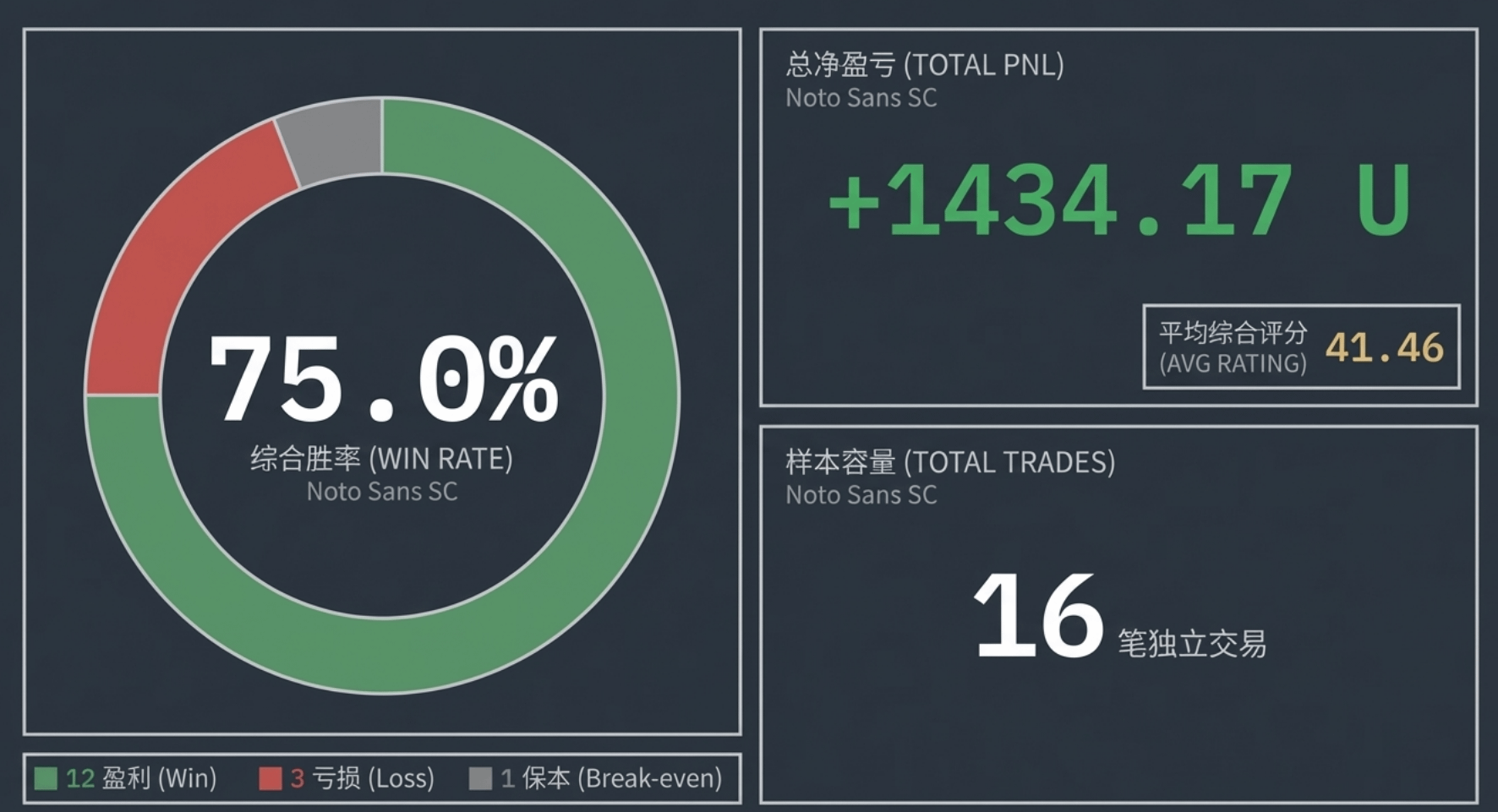
First, let's look at the core data.
Yan Chi currently has a total of 16 independent trades, of which 12 are profitable, 3 are losses, and 1 breaks even, resulting in an overall win rate of 75.0%; the total net profit and loss is +1434.17U, with an average comprehensive score of 41.46. This page actually highlights a very key issue: he is not relying on high-frequency trading to pile up profits, but has produced very high quality within a relatively limited sample. So if I were to summarize this page in one sentence, I would say: Yan Chi's current sample size is not large, but the sample quality is very high, already possessing the value for key tracking and in-depth research.
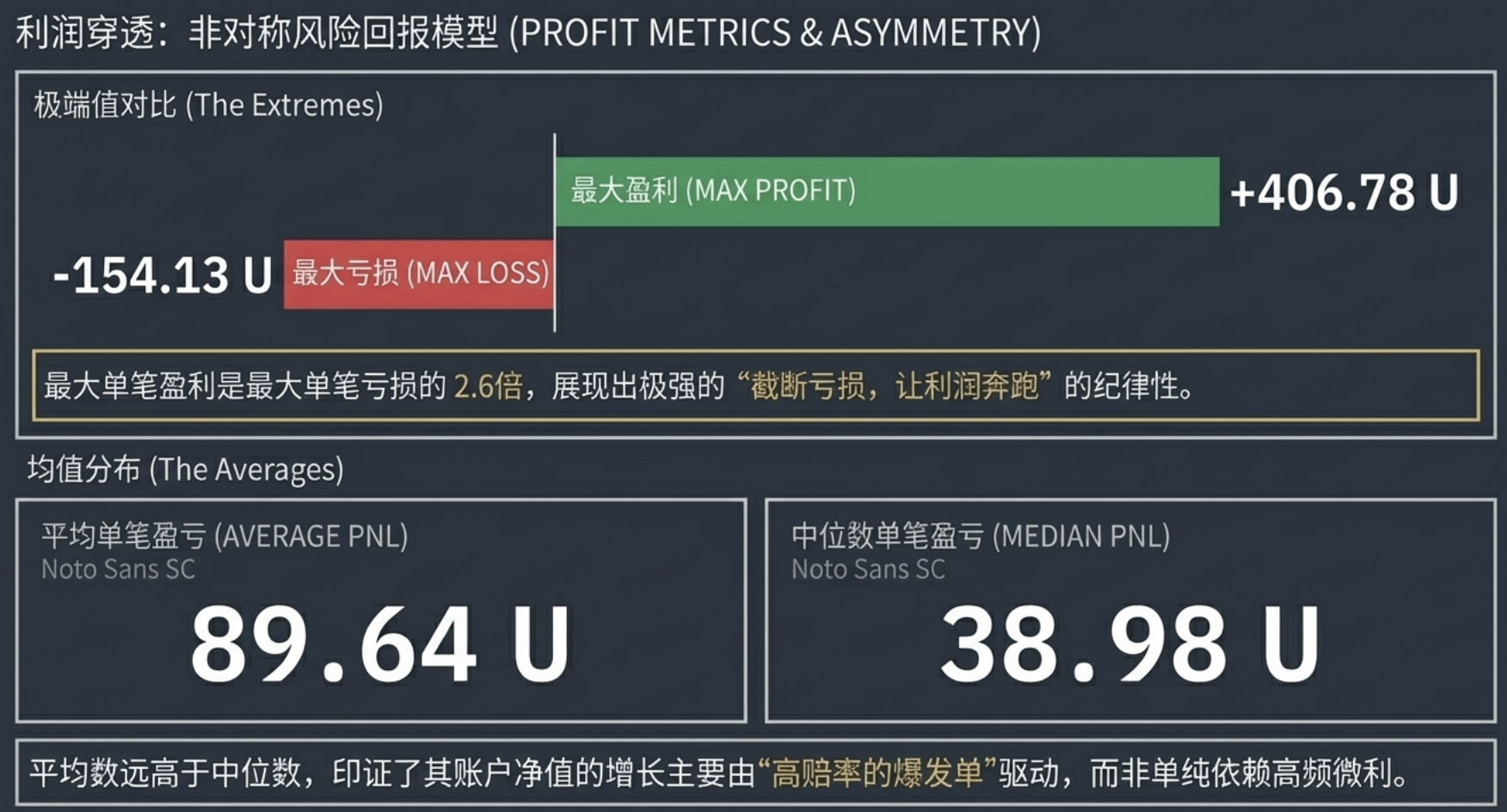
This page looks at the profit structure, not just how much was earned in the end.
The most critical piece of information in the report is that Yan Chi's maximum single profit reached +406.78U, while the maximum single loss is only -154.13U, meaning the maximum profit is 2.6 times the maximum loss.
At the same time, his average single profit and loss is 89.64U, higher than the median single profit and loss of 38.98U. What does this represent? It means his profits are not derived from slowly grinding out small gains on each trade, but he has a clear asymmetrical profit and loss structure: losses can be controlled, while truly good opportunities can amplify profits. In simple terms, it means: he knows when to cut losses and when to hold onto profits. This reflects a strong trading discipline.
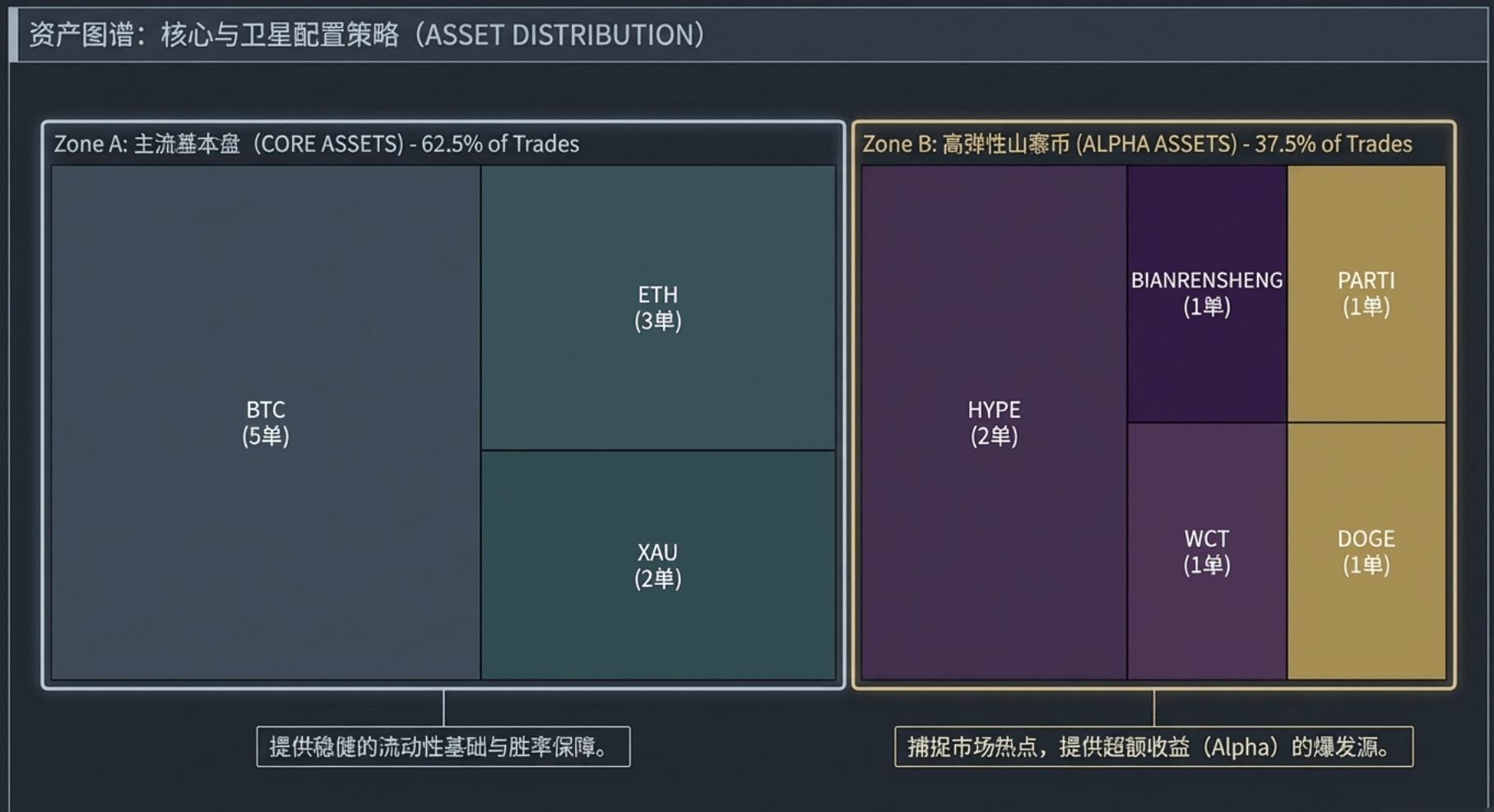
This page talks about Yan Chi's asset allocation logic.
From the distribution perspective, he does not only trade a single mainstream cryptocurrency, but rather divides it into two tiers.
The first tier consists of mainstream basic assets like BTC, ETH, and XAU, accounting for 62.5%; the second tier consists of high-elasticity assets like HYPE, BIANRENSHENG, PARTI, WCT, and DOGE, accounting for 37.5%.
This structure is very important. Because it shows that Yan Chi is not blindly chasing hot spots, but rather doing a kind of 'core asset safety net and satellite asset yield enhancement' allocation. Mainstream assets are responsible for providing a more stable win rate foundation and liquidity safety net, while high-elasticity assets are responsible for releasing alpha at the right moment, that is, excess returns. So what this page really wants to convey is: Yan Chi knows how to allocate; he does not act chaotically.
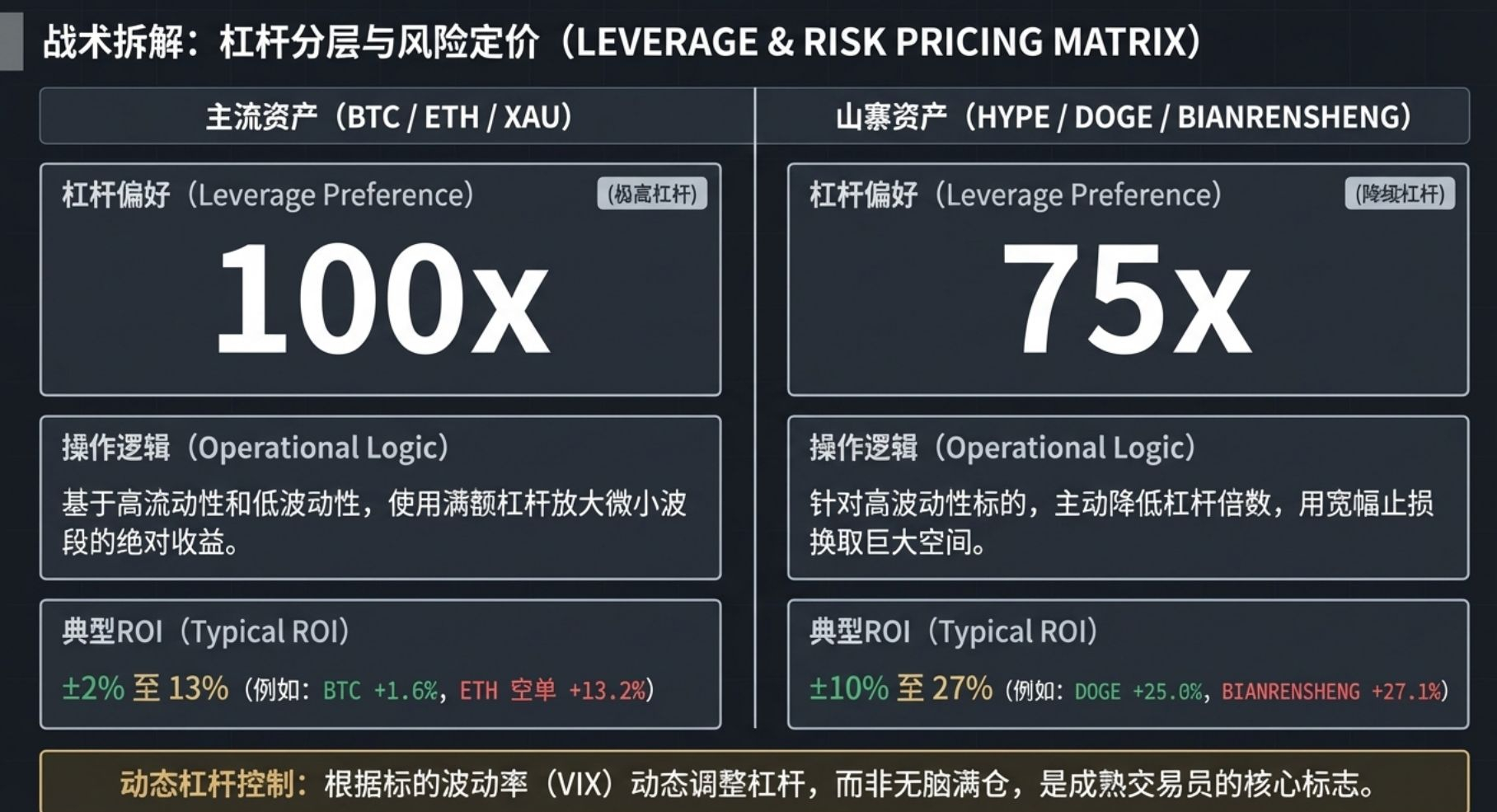
Many people see high leverage and their first reaction is to think it's aggressive.
But this page tells us that Yan Chi's understanding of leverage is not 'the higher the better,' but rather pricing risk according to the asset's volatility.
On mainstream assets like BTC, ETH, and XAU, he prefers 100x leverage, as these assets have better liquidity and relatively controllable volatility, making them suitable for using high leverage to amplify small wave profits. However, for high-volatility altcoins like HYPE, DOGE, and BIANRENSHENG, he actively reduces leverage to 75x, using wider stop losses and greater volatility space to gain higher elasticity. This is very crucial because it shows he is not emotional about leveraging, but is making dynamic risk pricing.
A truly mature trader does not always use full leverage, but knows how to leverage which assets.
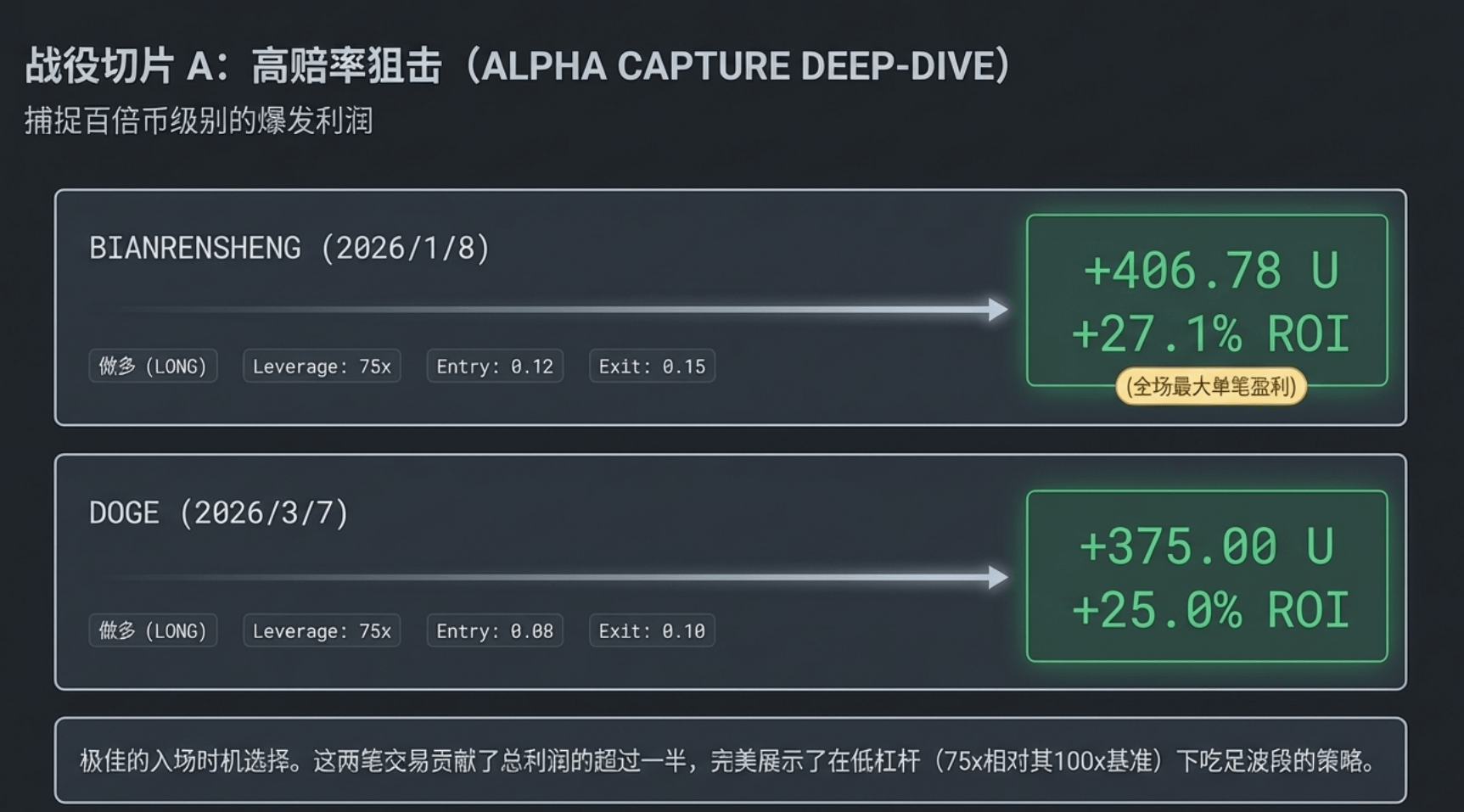
This page features Yan Chi's most representative 'explosive trade'.
The first trade is a BIANRENSHENG long position on January 8, 2026, with 75 times leverage, from 0.12 to 0.15, yielding +406.78U and +27.1% ROI;
The second trade is a DOGE long position on March 7, 2026, with 75 times leverage, from 0.08 to 0.10, yielding +375.00U and +25.0% ROI.
These two trades together contributed a significant portion of the total profit. So this page is actually explaining: Yan Chi can not only execute stable trades, but more importantly, he has the ability to seize real big market opportunities. It's also worth noting that these two trades were not made under higher leverage; rather, they were completed after reducing to 75 times leverage. This shows he understands one thing: high volatility assets are not tackled with more aggression, but rather with more reasonable leverage to capture the entire wave.
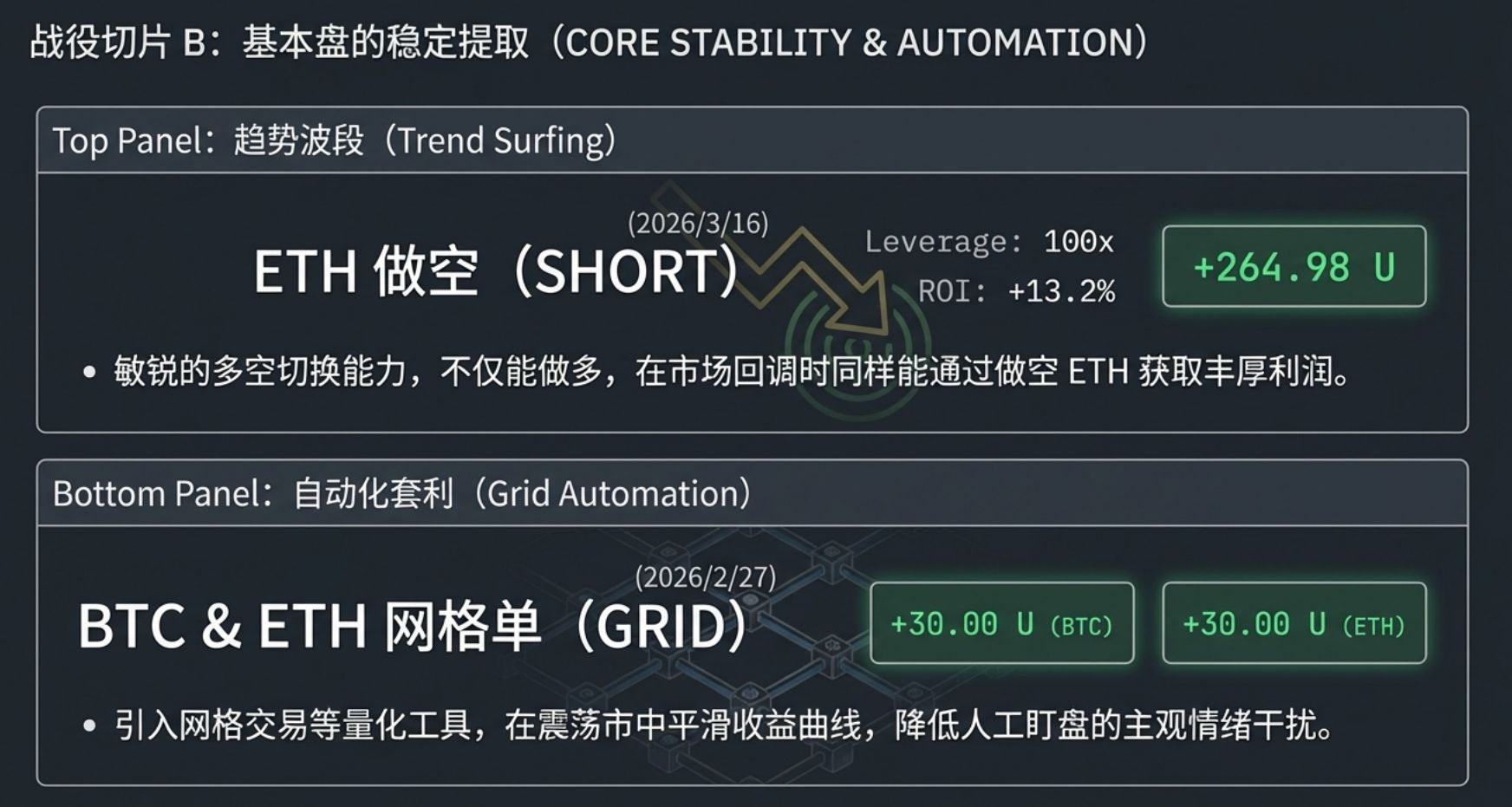
If the previous page talks about explosiveness, then this page talks about stability.
In trend extraction, Yan Chi not only knows how to go long, but he can also short ETH during market pullbacks to gain profits.
The case given in the report is a short position on ETH on March 16, 2026, with 100 times leverage, yielding +264.98U, and an ROI of +13.2%. Additionally, he introduced grid trades on BTC and ETH, each yielding +30.00U.
This indicates that Yan Chi's trading is not a single model. He can both do trend swings and use automated tools to smooth out the profit curve during oscillation phases, reducing the emotional interference caused by purely manual monitoring. So the key point on this page is: Yan Chi does not only have explosive performance, but also a solid foundation; he has offensive capabilities and stable extraction ability.
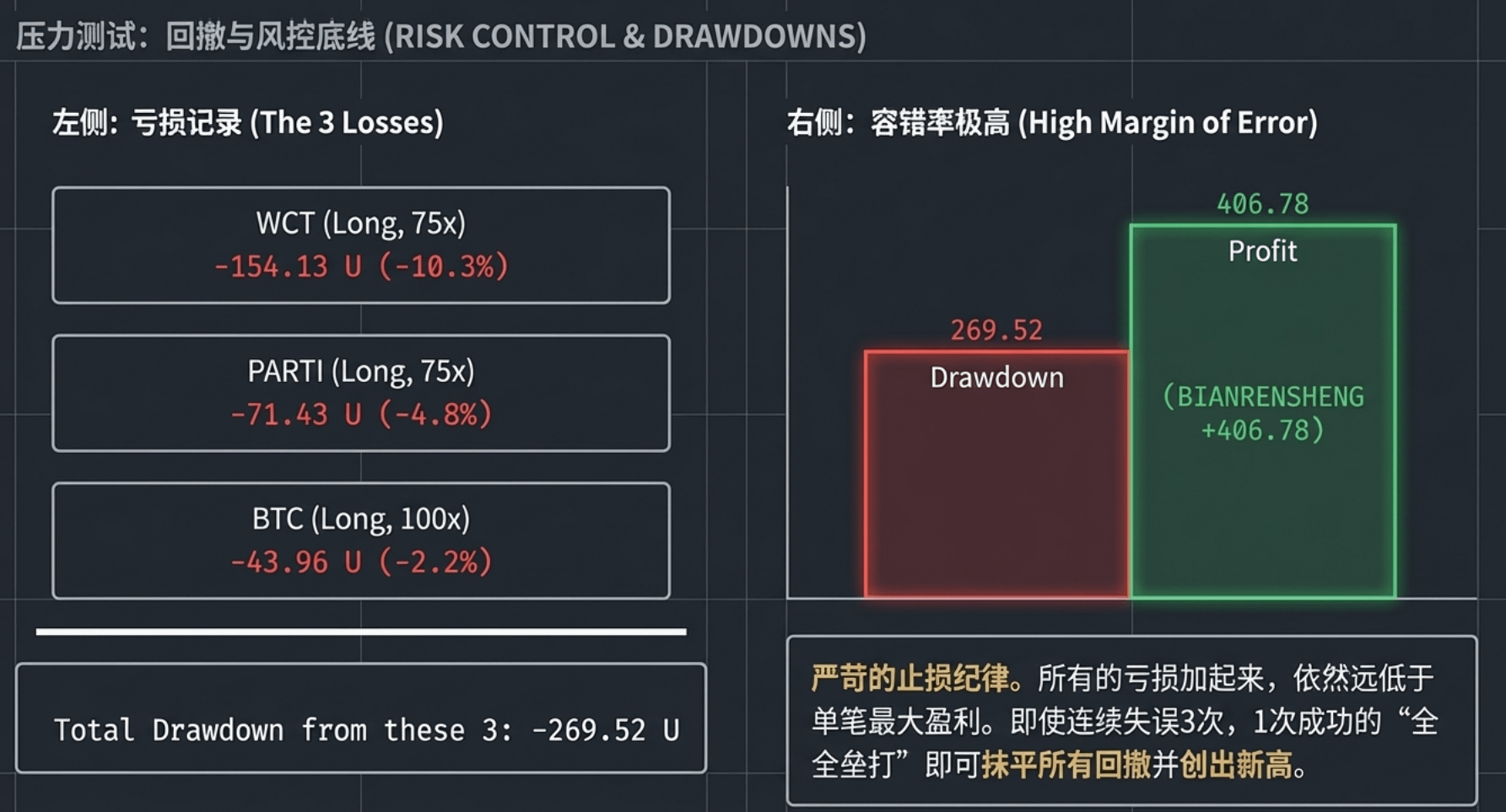
This page is the one that I think best shows a trader's level.
Because what truly distinguishes is not how aggressively you make money, but whether you have a bottom line when losing money. The report lists Yan Chi's three losses: WCT long -154.13U, PARTI long -71.43U, BTC long -43.96U, with a total drawdown of -269.52U.
But the most crucial point is that even if you add up these three losses, they are still less than his single maximum profit of +406.78U. What does this mean?
This means that even if he makes three mistakes in a row, as long as he seizes one high-quality opportunity, he still has the ability to erase the drawdown and even push the net value higher. So this page truly reflects that: Yan Chi's risk control is not just verbal, but has already been embodied in the real risk control reflected in the profit and loss structure.
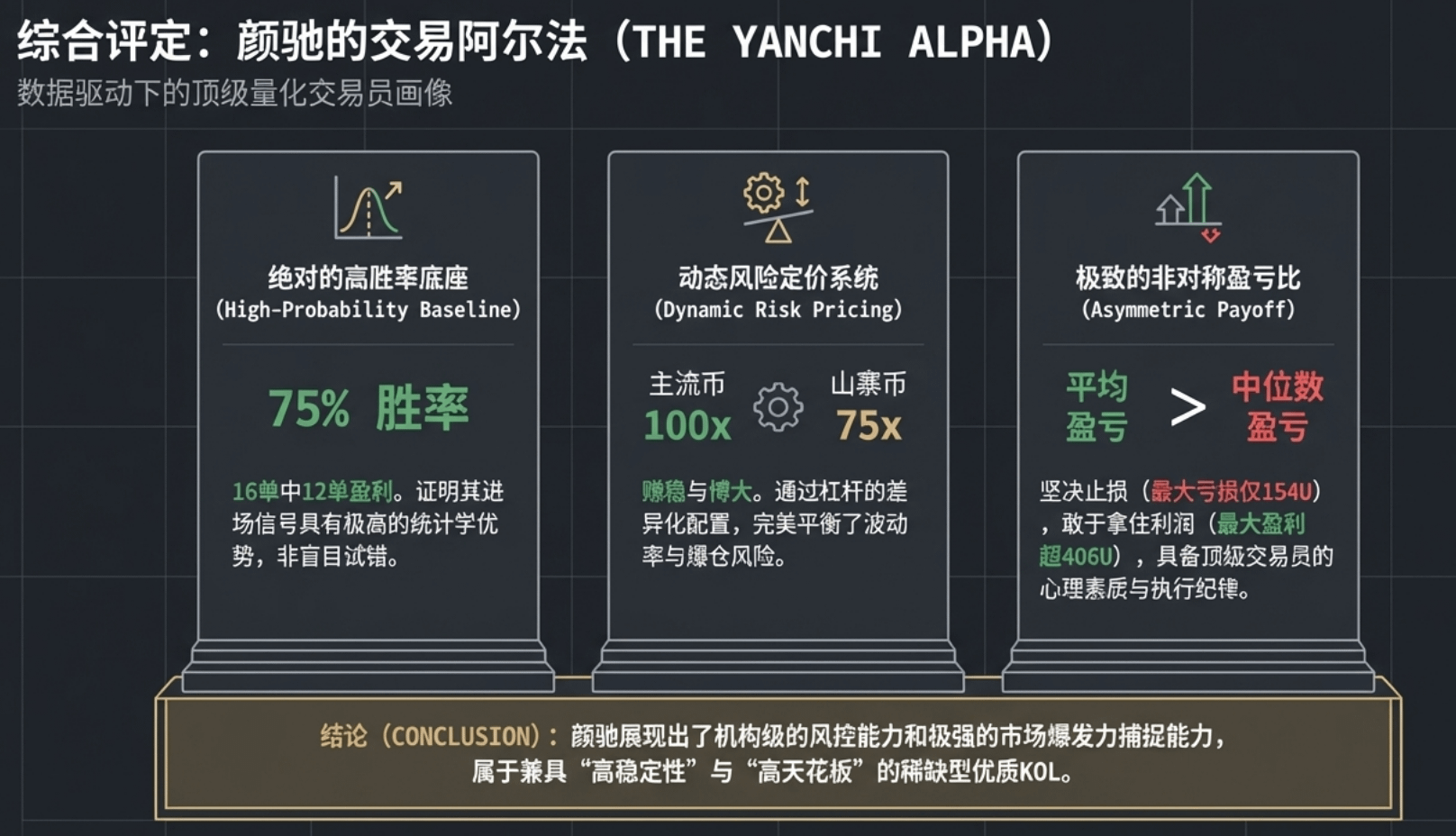
Finally, let's make a summary. This report summarizes Yan Chi's trading ability into three keywords.
First, high probability base. Out of 16 trades, 12 are profitable, with a 75% win rate, indicating that his entry is not just based on luck, but possesses a statistical advantage.
Second, dynamic risk pricing. Mainstream assets use 100 times leverage, while altcoins drop to 75 times, indicating he adjusts leverage according to volatility rather than using a one-size-fits-all approach.
Third, an extreme asymmetrical risk-reward ratio. The average profit is above the median, and the maximum profit is far greater than the maximum loss, indicating he can 'control losses and let profits run'. So my final conclusion is: Yan Chi belongs to a very rare type of KOL in the current database—one that has both stability and a ceiling; capable of doing the fundamentals while also capturing alpha.
This is also why the report ultimately defines him as a high-quality entity with both 'high stability' and 'high ceiling'.
Who to watch next? Let me know in the comments!