
There’s a quiet problem sitting underneath almost everything we do online. Whether it’s claiming an airdrop, signing a document, proving eligibility for a program, or verifying identity, most systems still rely on trust that isn’t easily transferable. You prove something once, and then you have to prove it again somewhere else, often from scratch. SIGN steps into that gap with a simple but ambitious idea: what if trust itself could be turned into reusable infrastructure?
SIGN didn’t start out trying to solve something this big. It began as EthSign, a decentralized document signing tool built to challenge the limitations of traditional e-signature platforms. Back then, the focus was straightforward—give users more control over their signed agreements and reduce reliance on centralized services that could lose or restrict access to important data. But over time, it became clear that signing was just one piece of a much larger puzzle. The real issue wasn’t just about signatures—it was about proving anything, in a way that others could independently verify and reuse.
That realization led to the creation of Sign Protocol, the core engine behind SIGN today. Instead of treating data as isolated pieces locked inside platforms, Sign Protocol treats information as verifiable claims. These claims—called attestations—can represent almost anything: a completed KYC check, a DAO membership, a qualification, or even participation in an event. What makes them powerful is that they’re structured, cryptographically signed, and designed to be understood by machines, not just humans. This means once something is verified, it doesn’t have to be re-verified endlessly. It becomes portable.
Think about how fragmented verification is right now. You upload documents to one platform, redo KYC on another, and still can’t carry that proof across systems. SIGN tries to change that by turning verification into a shared language. A credential issued in one context can be referenced in another without repeating the entire process. It’s a small shift in concept, but a massive shift in efficiency.
Then there’s TokenTable, which tackles a completely different kind of headache—distribution. If verification is about proving who qualifies, distribution is about making sure the right people actually receive something, whether it’s tokens, incentives, or funding. Historically, this has been messy. Projects rely on spreadsheets, manual processes, or scripts that are difficult to audit and easy to break. TokenTable brings structure to that chaos. It allows distributions to be rule-based, verifiable, and automated at scale.
A good example of this in action is KYC-gated airdrops. Instead of sending tokens blindly and hoping for fairness, systems can now ensure that recipients meet specific conditions before claiming. Identity gets verified, eligibility is confirmed, and only then does distribution happen. It’s not just about efficiency—it’s about accountability. Every step becomes traceable, and the logic behind distribution is no longer hidden behind opaque processes.
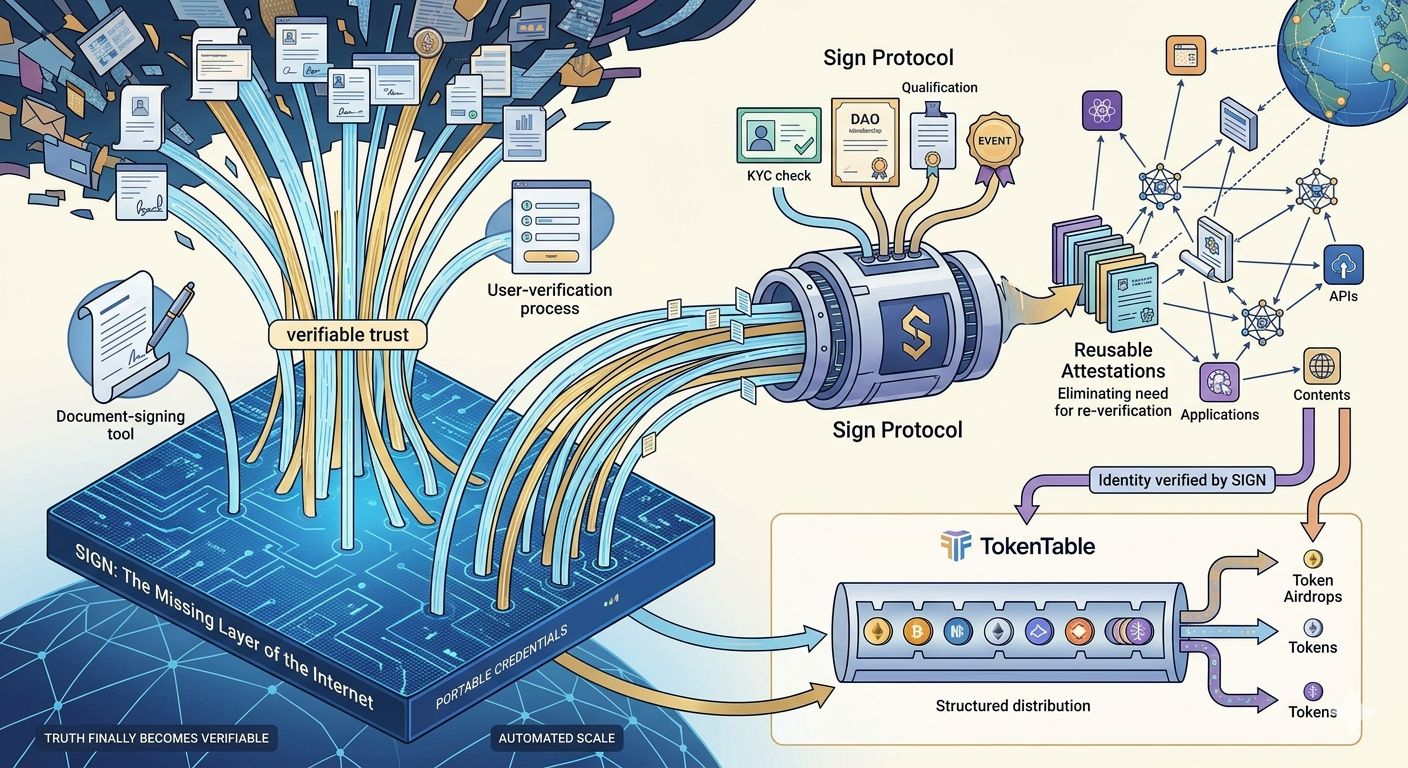
What makes SIGN stand out is that it isn’t trying to be just another blockchain project chasing trends. Its focus is more foundational. It sits at the intersection of identity, verification, and value movement. In many ways, it feels less like a product and more like infrastructure—something other systems can build on top of rather than compete with.
And the scale it has already reached hints at how real the demand for this kind of infrastructure is. Millions of attestations processed and billions of dollars distributed across tens of millions of wallets suggest that the problem SIGN is addressing isn’t theoretical. It’s already happening, quietly, behind the scenes of large ecosystems.
But the bigger story isn’t about current numbers. It’s about where this could lead. If verification becomes standardized and reusable, entire industries could shift. Governments could distribute subsidies more transparently. Online communities could manage membership and rewards without constant friction. Financial systems could integrate compliance without turning user experience into a nightmare. Even something as simple as proving your credentials online could become instant instead of repetitive.
Of course, none of this is guaranteed. Infrastructure projects face a different kind of challenge compared to consumer apps. They don’t succeed because they look good—they succeed because others depend on them. Adoption, interoperability, and trust in the system itself will determine whether SIGN becomes a core layer of the digital world or just another ambitious idea.
Still, there’s something compelling about its direction. In a space often driven by speculation, SIGN focuses on something more grounded: making truth verifiable and usable across systems. It doesn’t try to eliminate trust entirely, but it reshapes it into something that can be checked, shared, and built upon.
If the internet’s early evolution was about connecting people, and the next phase was about moving value, then what SIGN is aiming for might define the next step—connecting trust itself.
#SignDigitalSovereignInfra @SignOfficial $SIGN
