
Circle Internet Group (CRCL) fell by 20% on March 24 after a ban on passive income from stablecoins appeared in the Clarity Act bill. This wiped out about $4.6 billion in market capitalization.
The sell-off began against the backdrop of several factors that hit Circle simultaneously. The ban on yield scared investors, competitor Tether (USDT) announced an audit check by the Big Four, and 16 USDC business wallets were also frozen.
What the Clarity Act really does
The Digital Asset Market Clarity Act has been stuck in the Senate Banking Committee since January due to one key question. Can holders of stablecoins receive passive income?
On March 20, Senators Thom Tillis (Republican, North Carolina) and Angela Alsobrooks (Democrat, Maryland) announced that they had reached an agreement with the White House. By Monday, the draft document was sent to industry participants.
The essence of the changes is simple. Platforms, exchanges, and brokers are prohibited from offering yields on stablecoins. Only rewards tied to activity, such as transactions or participation in governance, are allowed.
The SEC, CFTC, and Treasury have 12 months to draft rules against circumventing these restrictions.
Banks actively promoted such an outcome. The American Bankers Association stated that yield programs on stablecoins could lead to a withdrawal of trillions of dollars from deposits.
Analyst Mizuho Dan Dolev warned that the ban could reduce Circle's short-term value. Coinbase (COIN) shares also fell by about 10%, as around 20% of its revenue is tied to stablecoins.
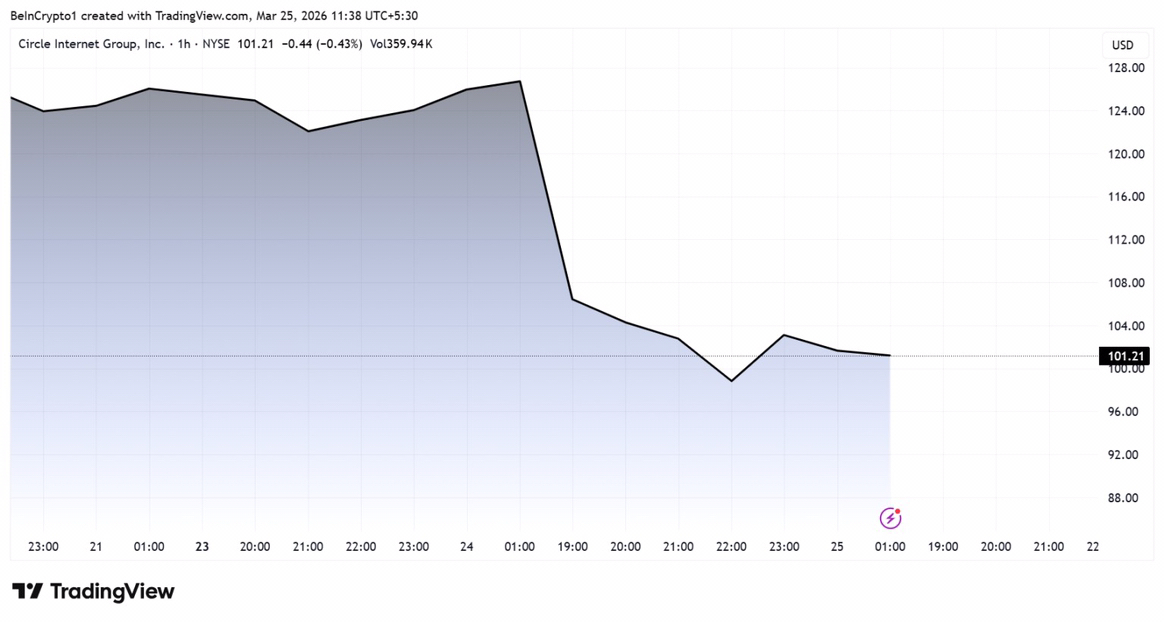
Dynamics of Circle (CRCL) shares. Source: TradingView
Counterargument
At the same time, Circle has an important feature. As of the third quarter of 2025, about 96% of its revenue came from interest on USD Coin (USDC) reserves. Since 2022, this figure has remained in the range of 95-99%, according to data from the S-1 report. The majority of reserves are held in U.S. Treasury bonds.
And here is the key point. The Clarity Act does not affect this source of income. The law prohibits platforms from sharing yields with users, but Circle itself continues to receive all the interest from reserves.
Before this bill appeared, pressure was mounting on the company. It was increasingly expected that it would start sharing income with USDC holders, especially against the backdrop of DeFi protocols that offer passive income. Now this issue is effectively off the table.
Analyst Simon Dedik disagrees with the bearish sentiment in the market.
"This is the most bullish scenario for Circle. Their entire business model is based on retaining income from USDC reserves. The Clarity Act essentially creates a regulatory barrier for them," he wrote.
Former Fox journalist Eleanor Terrett also noted that the ban on passive income had been discussed for several months. Therefore, such a sharp market reaction came as a surprise to many.
Tether, ARK and wallet freezing
Against this backdrop, Tether announced that it had engaged a Big Four auditing firm for its first full independent audit. The name of the firm has not yet been disclosed. The market capitalization of USDT currently exceeds $184 billion.
Previously, Circle positioned itself as a more transparent alternative. While Tether was limited to quarterly reports from BDO Italia. A full audit from a Big Four firm could significantly close this trust gap.
Tether's Chief Financial Officer Simon McWilliams stated that the auditor was selected through a competitive process. The audit will cover the company's assets, liabilities, and internal processes.
ARK Invest sold CRCL shares for $5.9 million on March 20, four days before information about the bill became public. This raised questions in the market.
However, on March 24, after the drop, the fund bought shares for $16.3 million. Such a turnaround rather indicates a portfolio rebalancing than a clear bet on the market direction.
Separately, on-chain analyst ZachXBT reported that Circle froze funds in USDC on 16 hot wallets associated with exchanges, casinos, and forex companies.
The freeze occurred due to a civil case in the U.S., the details of which are not disclosed. ZachXBT criticized Circle for not checking the wallets before blocking them. This case intensified the negativity surrounding the project and raised the question of USDC centralization again.
At the same time, the Clarity Act has not yet been passed. Consideration in the Senate Banking Committee is expected at the end of April, and some provisions related to DeFi are still not agreed upon.
DeFi protocols have already started changing their reward models to meet the new requirements. Now they are betting on user activity rather than passive income.
The main question remains open. Will USDC be able to maintain demand without yields? It depends on whether the drop on March 24 was just an emotional reaction or the beginning of a longer re-evaluation.
#Circle #USDC #CLARITYAct #Write2Earn #BinanceSquare
