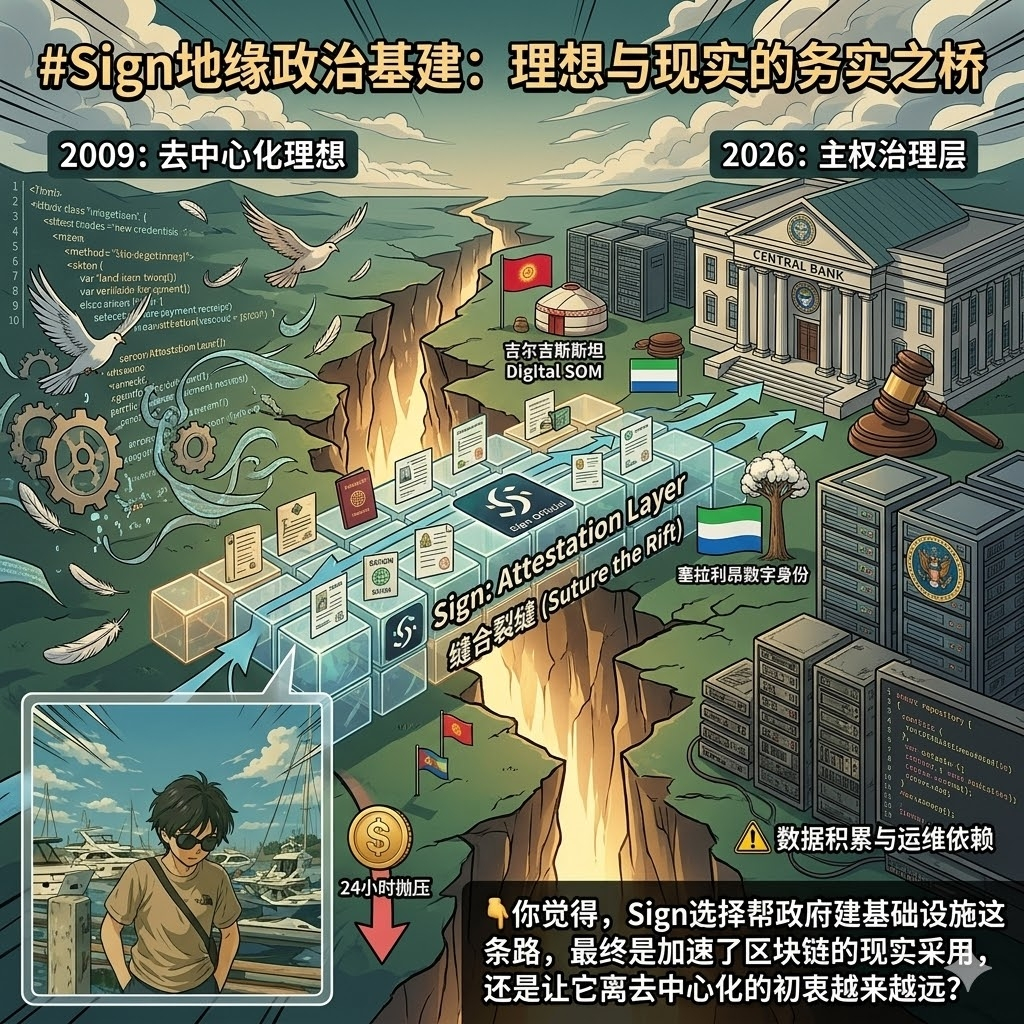
Sometimes Fengzi wonders whether the original narrative of the blockchain industry is a peculiar form of optimism: no need for banks, no need for governments, no need for any intermediaries: code is law, math is trust.
This narrative made sense in 2009. In 2026, it began to show a crack. It is not a technical crack but a reality-level crack: when you really want three hundred million people to use a certain system, when you really want welfare payments to arrive on time, when you really want cross-border capital flows to no longer go through seven intermediaries, you will find that something is missing in that narrative: identity is issued by the state, property rights are protected by law, and the ultimate source of trust, in most people's lives, is still a form of authoritative institution.
Sign @SignOfficial is stitching this gap, which is also the place where Sign is most easily misunderstood.
The design philosophy of S.I.G.N. is: policy and regulatory power remain at the sovereign governance level, while the underlying technology maintains verifiability. This statement seems simple, but it contains great tension.
On one hand, Sign is helping the government build digital currency systems, on-chain identity systems, and programmable welfare distribution, which are inherently linked to "control". CBDC allows the government to see the flow of every transaction, digital identity means your credentials have a main node in a certain system, and the programmability of welfare distribution means that someone has defined what you can do with this money at the code level.
On the other hand, Sign Protocol, as an attestation layer, emphasizes that credentials are controlled by the holder, verification does not require calling a centralized "query my identity" API, and data can be verified without passing through any intermediary server. Both of these things can be true at the same time, but their goals may pull against each other in edge cases.
Fengzi does not think Sign has done anything wrong. The reality is: if you only serve users who idealize decentralization, your limit is a sophisticated protocol that very few people use, which cannot change anything; if you want the identities and capital flows of one billion people to go through a more trustworthy and transparent system, you must sit at the same table with authoritative institutions. Sign chose the latter, a more difficult path.
Fengzi also wants to clarify a specific risk that is not at the technical level but at the power level. When Sign has built the Digital SOM for Kyrgyzstan and deployed a digital identity system for Sierra Leone, the data and processes accumulated in these systems will gradually make the option of "replacing Sign" increasingly costly. The design of S.I.G.N. gives sovereign institutions control over nodes and rules, which is true at the time of contract signing. However, after the system has been running for two or three years, the real control is not who owns the hardware, but who understands this system, who can maintain it, and who can fix it when problems arise.
This is not a problem unique to Sign; it is a reality that all suppliers deeply embedded in government systems will face. It does not make Sign a bad project, but it requires a more careful reading of the term "sovereign infrastructure."
Returning to the original question itself. The tension between the ideal of decentralization and the reality of adoption will not disappear due to the clever design of any one project. Sign's answer is: to build a bridge in this crack, allowing governments to use the verifiability of blockchain without having to give up their sovereign control.
This is a pragmatic choice. Fengzi is not sure if it is ultimately the right one, but at least it is honest, not pretending that this crack does not exist, but stepping directly into it, trying to find a way out from within.
$SIGN may have led to selling pressure in the past 24 hours due to a potential unlock in a few days, causing prices to drop. Selling pressure expectations are released first, and Fengzi will continue to monitor the follow-up actions of the project party.

Do you think that Sign's choice to help the government build infrastructure has ultimately accelerated the real adoption of blockchain, or has it moved further away from the original intent of decentralization? 👇