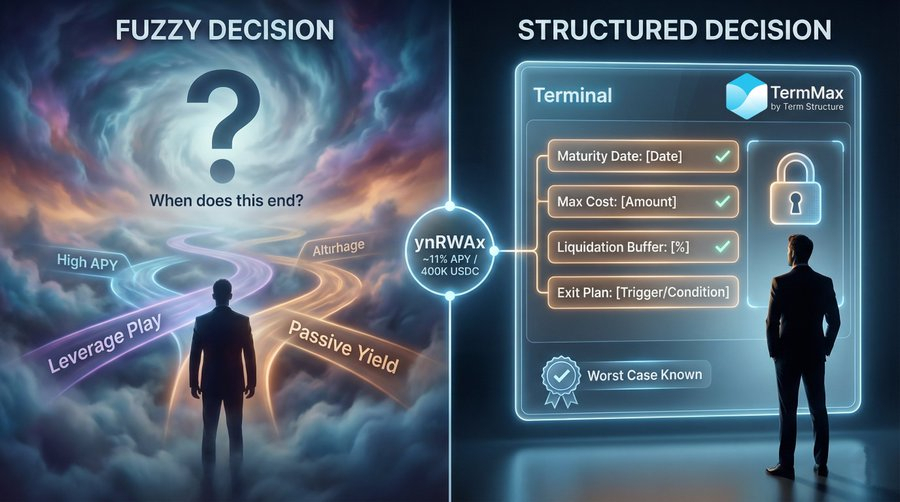
TermMax is not selling returns; it is waiting for you to answer: when will this position end?
Today I saw the user profile vote from @TermMaxFi. Most people were choosing A, B, and D. But I thought of a more fundamental question—many people are not choosing the wrong type; they have never thought about when this position will end.
1. TermMax This question is actually not asking who you are, but whether you have written down the expiration answer before placing an order.
A chase APY
B play with leverage
C passive gain
D structural strategy
My first reaction was not to choose D. I thought about how I opened positions before and never wrote down when this money would end.
2. TermMax essentially turns future considerations into present actions.
You must think clearly. Whether it's FT / XT / GT or fixed rate, the essence is not more complicated; it's about bringing three things forward: what is the maturity date, how much needs to be repaid at most, and if it doesn't go well, how to exit. It doesn't help you make money; it prevents you from making ambiguous decisions.
3. Fixed rate is not necessarily safer; it just lets you know what the worst-case scenario is.
Many people misunderstand fixed rates: thinking = stable = safe = better, but that is not the case. Liquidation is still subject to collateral fluctuations; RWA is not risk-free. The difference is that at the moment you open the position, you know the worst outcome.
4. So for the ynRWAx question, the key is not 11%.
The current official structure is: using ynRWAx to earn about 11% APY while borrowing up to 400K USDC. Most people see the returns, but those who truly strategize see:
- Assets are generating interest.
- Liabilities are locking in costs.
- During this intermediate period.
How I arrange this is the key.
5. TermMax is truly screening for not the capital, but for those who have the ability to be responsible for their positions.
You may not understand Range Order or FT/XT, but you must answer: how long will this position last before the worst loss occurs, and if it doesn't go as planned, how to exit? This is not a technical threshold; it is a cognitive threshold.
6. I am now giving myself a very simple rule.
You can choose not to open a position. But as long as you open a position, you must write 4 lines: maturity date, maximum cost, liquidation buffer, exit plan. If you can't write it out, then don't do it.
7. So in the end, I still choose D.
It's not because it’s advanced; it's because I start to understand when I have ended a position. Which one do you choose? Don't choose the right one; choose your current reality.
@TermMaxFi#TermMax #defi #FixedRate #RWA