If you ask me why I value Sign @SignOfficial among the myriad of current Web3 projects, the answer lies in its practical applicability.
While many projects are still caught up in abstract concepts, Sign chooses to address the root of all transactions, which is trust.
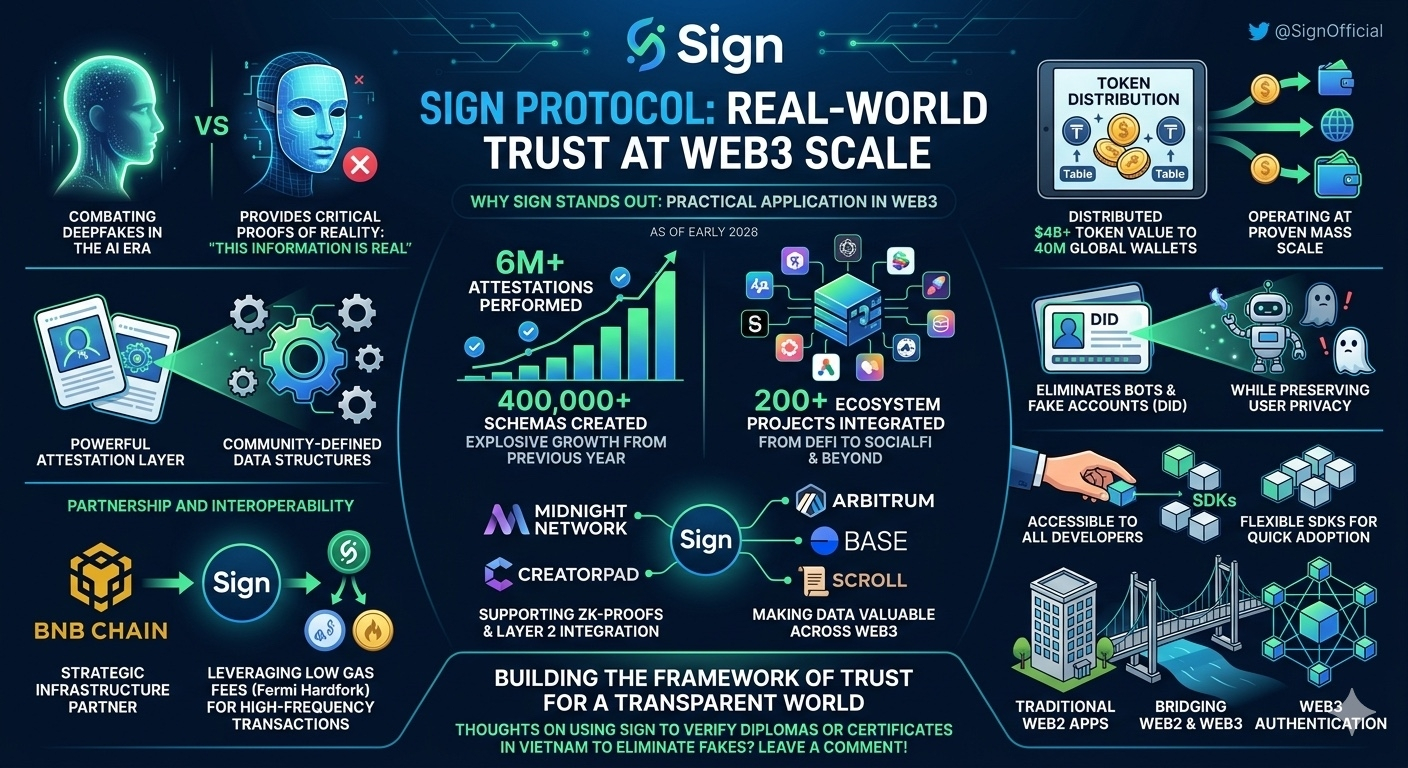
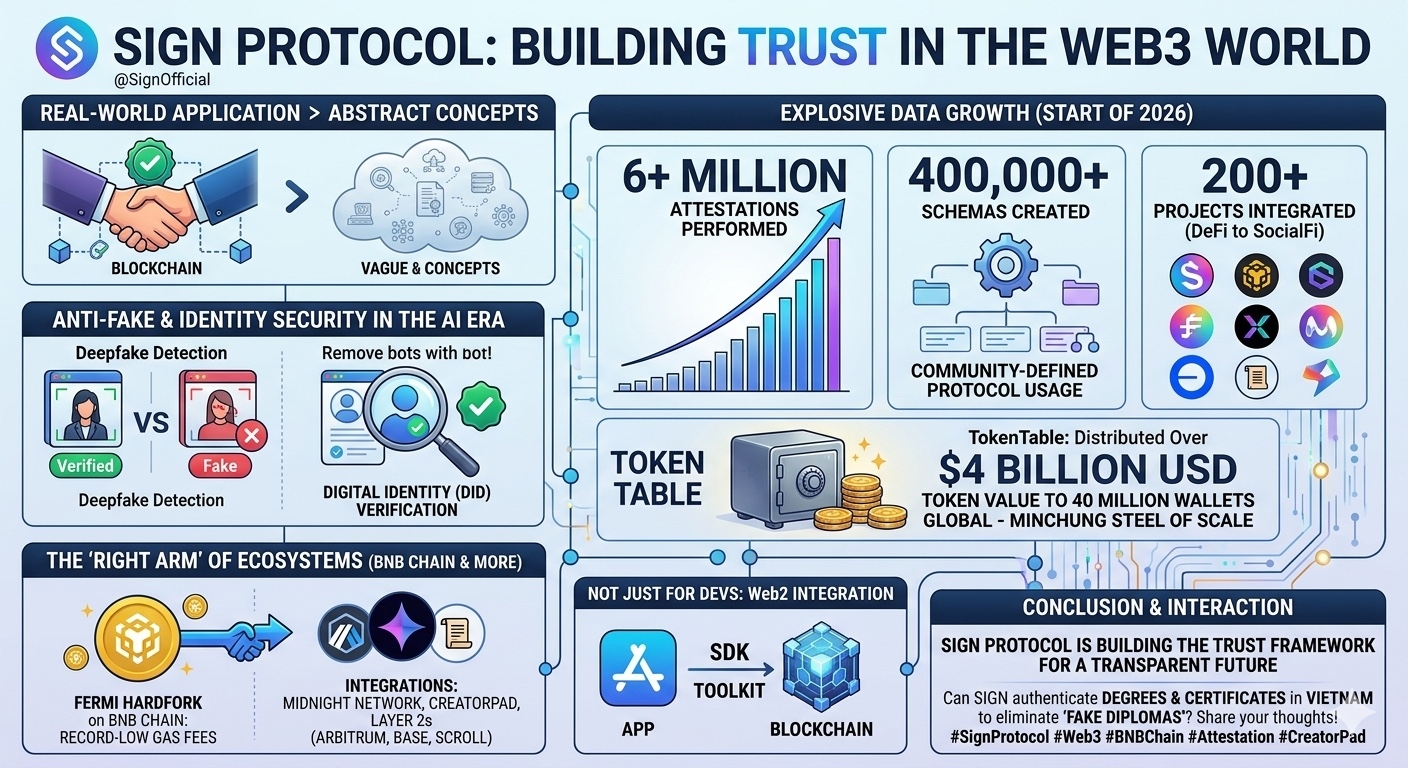
The practicality of Sign is not on paper but is reflected through the explosion of data. As of early 2026:
* More than 6 million attestations have been made, skyrocketing from just a few hundred thousand last year.
* 400,000+ Schemas (data structures) have been created, showing the community is self-defining countless ways to apply this protocol.
* An ecosystem of 200+ integrated projects, from DeFi platforms to SocialFi. Notably, their TokenTable tool has supported the distribution of over 4 billion USD in token value to 40 million global wallets — a strong testament to operational capability at scale.
Sign plays a significant role in "fighting fake" and securing identity in the AI era
Now, the line between true and false is blurred, especially with the explosion of Deepfake. Sign acts as a filtering layer. It provides evidence to assert: "This is me doing this, this information is real."
By providing an Attestation Layer, Sign helps digital identity (DID) projects completely eliminate bots and fake accounts without infringing on user privacy.
Sign is the "right hand" of major players like BNB Chain and more
The timing of Sign Protocol is extremely favorable as major ecosystems are thirsty for validation infrastructure:
On BNB Chain: With the infrastructure upgrade (Fermi Hardfork) leading to record-low gas fees, Sign has become the top choice for validating high-frequency transactions.
Sign does not stand alone; it is actively supporting projects like Midnight Network or Sign Protocol's CreatorPad to build security proofs (ZK-proofs). Cross-integrating with Layer 2s like Arbitrum, Base, or Scroll ensures your data is valuable anywhere in the Web3 world.
Sign is not only for developers but also for all traditional applications:
What I like is that Sign does not "challenge" users. With flexible SDK toolsets, even traditional Web2 applications can integrate this validation feature into their systems in no time.
Therefore, Sign Protocol does not attempt to create a new world; it is quietly building a "trust framework" for the current world to operate more transparently. As trust becomes a luxury, real projects, real data like Sign are the future.
What do you think about using Sign to validate degrees or professional certificates in Vietnam? Could this be a step to eliminate the problem of "fake degrees"? Leave your comments below!
$SIGN #SignDigitalSovereignInfra