I've been following this project for a long time, but @SignOfficial always raises some questions, so I'd like to share my thoughts.
1. My original aspiration: to find an indestructible financial foundation.
I have always firmly believed that by 2026, traditional hedging logic is failing. When artillery fire destroys bank buildings, SWIFT is cut off, and cloud services are sanctioned, gold, though hard, is difficult to carry, and cash, though fast, is easily devalued. What I am looking for is a "code-level right to survival"—an infrastructure that does not depend on a specific physical location, is not controlled by a single centralized institution, and can quickly rebuild order from ruins.
This is why I'm so fixated on Protocol (SIGN). It's not one of those meme coins that promises overnight riches, nor is it simply a DeFi protocol. In my eyes, it's currently the only project on the market attempting to incorporate "national sovereignty" into its blockchain code. Its slogan, "Blockchain for nations. Crypto for all," sounds grand, but I see the ambition behind it: to ensure that every citizen retains a verifiable identity and liquid assets even if the government collapses.
2. My favorite core architecture: the "survival wisdom" of dual paths.
Among numerous blockchain projects, the design of Sign Protocol that impressed me most was its dual-path blockchain architecture. This is not merely a technical optimization, but a survival strategy for extreme environments:
Public Path (Transparency and Auditing): Leveraging the security of public blockchains like Ethereum to process data requiring global consensus. Even if all nodes in your home country are destroyed, global nodes can still recover your identity records. This is the guarantee of "resistance to destruction".
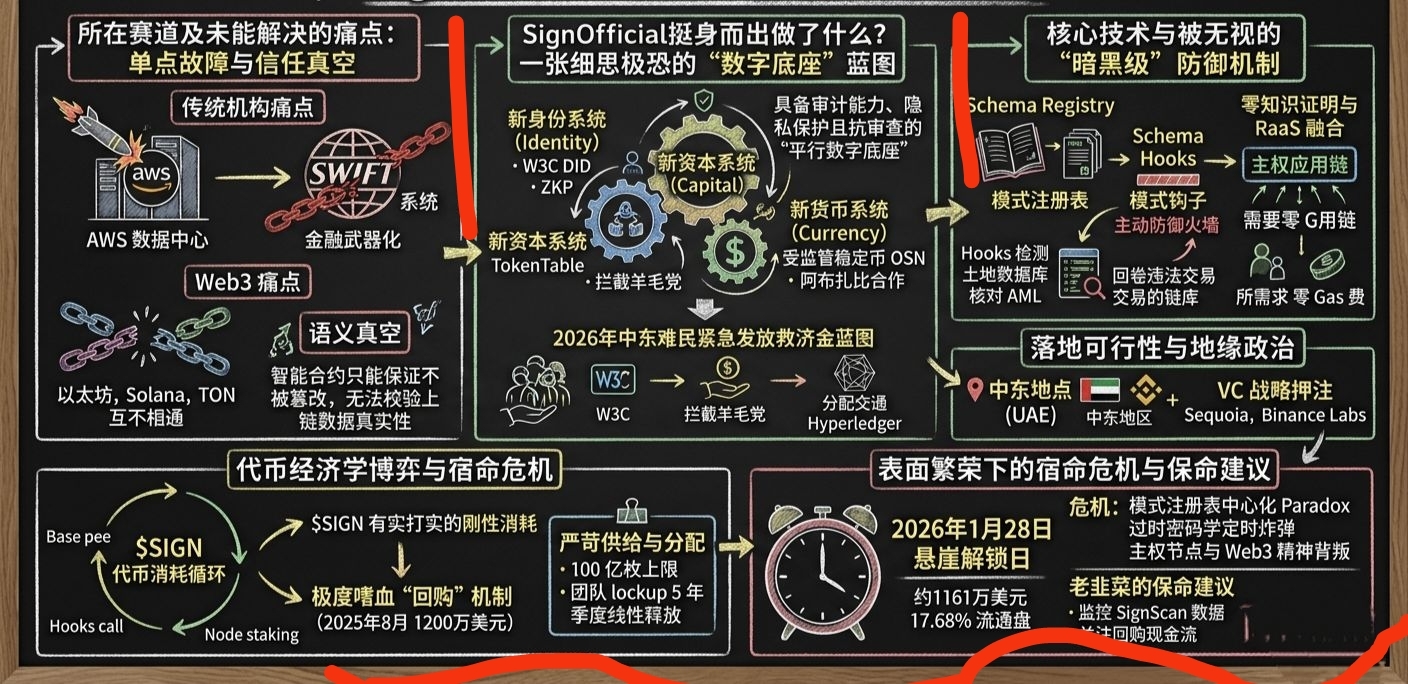
Private Path (Sovereignty and Privacy): Based on permissioned blockchains (such as Hyperledger Fabric X), this allows national central banks to have complete control over order nodes to handle high-frequency transactions of retail CBDCs. This ensures "controllability" and addresses governments' concerns about not fully decentralizing the system.
My assessment: This design is extremely clever. It satisfies governments' desire for control over data sovereignty and privacy during peacetime (which is why Kyrgyzstan and Sierra Leone were willing to sign the agreement), while also preserving the possibility of switching to a public blockchain for "disaster recovery" in wartime. This is a true "digital lifeboat"—an efficient management tool in peacetime and a final backup system in wartime.
3. From concept to reality: What I've witnessed in practice
Many projects remain only white papers, but #Sign地缘政治基建 showed me "bloody bargaining chips" (referring to real national-level contracts):
Kyrgyzstan's digital som pilot: This is not a testnet, but a real collaboration between national banks. This means that at some point, a country's currency issuance power may actually be running on the Sign code.
Sierra Leone's National ID System: Facing the predicament of 60% of the population being unidentified, the SSI (Self-Sovereign Identity) scheme offered by #sign is not only a technological upgrade, but also the cornerstone of social reconstruction.
When I saw that they had served 50 million users and distributed over $2 billion in assets, I realized: this is no longer an experiment; this is history in progress. If a full-blown conflict were to erupt in a country in the Middle East or Eastern Europe tomorrow, this already operational system could very well become the only tool for that country to rebuild its financial order.
4. My Calm and Vigilance: How Far Away is the "Ultimate Safe Haven"?
While I am passionate about Sign's vision, as a rational observer, I must pour cold water on it. As of 2026, SIGN is still a long way from becoming the perfect "last refuge":
Physical layer vulnerabilities: Code may be immortal, but the servers and fiber optic cables running that code can be destroyed. While there are multiple blockchain backups, how can ordinary people access on-chain assets in extreme war zones with complete internet and power outages? Have current offline payment solutions truly been battle-tested? This is my biggest concern.
Liquidity Test: Currently, $SIGN has a market capitalization of only around $70 million, classifying it as a mid-cap project. In the event of a large-scale panic exchange, can its liquidity withstand "national-level" selling or buying pressure? If on-chain assets cannot be quickly converted into physical food or energy, its "value preservation" attribute will be significantly diminished.
The Gap Between Marketing and Reality: I must admit that many promotional posts in the Chinese community clearly show signs of being paid for. FOMO (Fear of Missing Out) may mask the slow pace of technology adoption. True "sovereign adoption" is measured in years, while cryptocurrency hype is measured in days. This mismatch can lead to drastic price fluctuations before the fundamentals materialize. $SIGN