
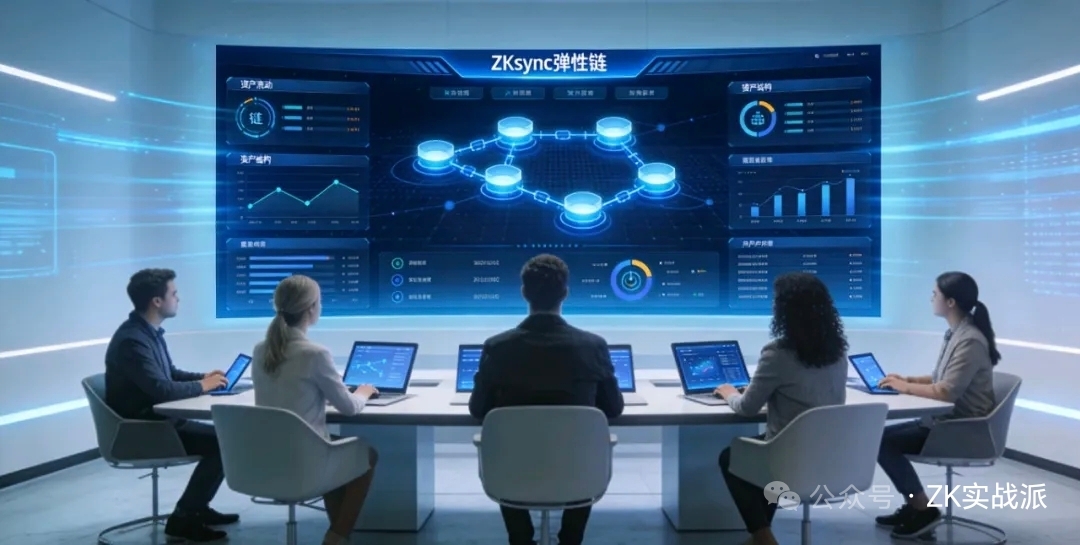
As the Chief Content Officer of the ZKsync Super Guardian DAO community, we focus on the innovation of Web3 underlying technologies, dissecting the core architecture of ZKsync 3.0 from a professional perspective, helping you understand the underlying logic of Elastic Chains and Elastic Networks, and how they reshape the development landscape of Web3.
1. First, clarify: Elastic Chain vs Elastic Network (Relationship + Differences)
1. Core Definition (Official Statement) - ZKsync 3.0 Elastic Chain: An infinitely scalable ZK chain network composed of ZK solutions such as Rollup/Validium/Volitions, ensuring security through recursive ZK proofs, achieving native interoperability and a unified user experience.
- ZKsync Elastic Network: The underlying operational carrier and ecological collective term for elastic chains, supporting the collaboration of multiple Hyperchains through distributed infrastructure, including shared routing, native asset vaults, ZK proof layers, and other core modules.
2. Relationships: The overall and the local, architecture and ecology - Elastic chains are the 'concrete form' of elastic networks: elastic networks are the underlying architecture, and elastic chains are their interactive and scalable chain network forms.
- Elastic networks are the 'operational base' of elastic chains: Without the interconnection, shared security, and liquidity of elastic networks, elastic chains cannot achieve the seamless experience of 'multiple chains as one chain'.
- Simple analogy: Elastic network = traffic + energy + security systems of city clusters; Elastic chain = the entire city cluster; Hyperchain = independent cities within the cluster.
3. Key differences (understand at a glance) - Different positioning
- Elastic chains: Product forms aimed at users and developers, emphasizing 'unlimited scalability, native interoperability, and uncompromised security'.
- Elastic networks: a technology architecture aimed at the underlying layer, emphasizing 'protocol-level interconnection, resource sharing, and dynamic scheduling'.
- Different compositions
- Elastic chains: Composed of multiple Hyperchains, each chain can customize rules, economic models, and governance logic.
- Elastic networks: Composed of shared routing, ZK proof layers, asset vaults, cross-chain gateways, and other underlying modules, serving as the 'connecting skeleton' of Hyperchains.
- Different emphasis on capabilities
- Elastic chains: scalability + interoperability + user experience, solving multi-chain fragmentation, liquidity disconnection, and cumbersome cross-chain issues. - Elastic networks: security + collaboration + resource scheduling, ensuring all chains share Ethereum L1 security and enabling trustless, low-latency interactions between chains.
II. ZKsync 3.0 Elastic Chain/Network: The core driving force of Web3 development
1. Ending multi-chain anxiety: From 'fragmented competition' to 'cooperative symbiosis' - Traditional multi-chain: liquidity fragmentation, high cross-chain costs, and significant security risks, requiring users to manually switch networks and rely on external bridges, leading to a fragmented experience.
- Elastic chains/networks: Native interoperability, one-click cross-chain, and atomic asset transfer, with a single address and one signature completing all chain operations, with cross-chain costs ≈ intra-chain transactions, completely bidding farewell to 'multi-chain anxiety'.
- Significance for Web3: A significant increase in capital efficiency, DeFi, GameFi, RWA, and other sectors breaking chain boundaries, with the ecosystem moving from 'islands' to 'continents'.
2. Unlimited scalability: Security and performance are no longer a trade-off - Traditional scaling: single-chain performance bottlenecks, limited TPS improvement, prone to congestion and soaring gas fees; multi-chain sacrifices interoperability and security.
- Elastic chains/networks: Horizontal addition of chains allows for unlimited scalability, with recursive ZK proofs enabling parallel generation and constant time verification, TPS peaks breaking 40,000, settlement in sub-second levels, and costs as low as $0.0001 per transaction.
- Significance for Web3: Supporting the landing of large-scale applications, enterprise-level RWA, high-frequency DApps, and social applications can be easily onboarded, moving Web3 from 'niche experiments' to 'mass usability'.
3. Balancing sovereignty and collaboration: The 'new production relationship' of the Web3 ecosystem - Elastic chains allow project parties to deploy dedicated Hyperchains with one click, customizing consensus, fees, and governance rules, thus holding complete sovereignty.
- All chains share the security and liquidity of the elastic network, developing independently while collaborating for mutual benefit, achieving the ideal state of 'sovereign individuals + organic networks'.
- Significance for Web3: Lowering the threshold for ecological co-construction, moving from 'monopolization by a few public chains' to 'interconnected thousands of chains, with a hundred flowers blooming', giving DAOs, developers, and project parties greater space for innovation.
4. Technical paradigm upgrade: Web3 is moving towards the 'era of elastic computing' - Elastic chains/networks use the ZK Stack as a base to achieve modularity, composability, and customization, similar to Web2's cloud computing, allocating resources on demand.
- Account abstraction, unified experience across multiple chains, DApp gas sponsorship, and other features greatly lower the user threshold, moving Web3 from 'geek-exclusive' to 'universally usable'.
- Significance for Web3: The maturity of the underlying technology lays the foundation for the scaling, compliance, and practicality of Web3, marking a milestone as Web3 transitions from the L2 era to the 'multi-chain collaborative era'.
III. ZKsync 3.0 Elastic Chain: The core value anchor point of Web3's future
1. Irreplaceable security base: All chains share Ethereum L1 security, ZK proof mathematical guarantees, and do not make compromises on 'scalability at the expense of security', making it the most robust scaling solution for Web3.
2. Ecological barriers continue to strengthen: zkEVM is highly compatible with Ethereum, allowing developers to migrate at zero cost; RWA, DeFi, NFT, and other sectors are rapidly taking off, with ecological lock-up and project numbers continuously rising.
3. The future imagination space is limitless: Elastic networks can extend into the physical world, deeply integrating with the Internet of Things and AI to achieve 'on-chain + off-chain' collaboration, supporting Web3's expansion into broader fields.
4. A new paradigm of DAO collaboration: Elastic chains/networks provide DAOs with customized governance, cross-chain collaboration, and unified asset management support, transitioning DAOs from 'online communities' to 'physical, scalable organizations'.
IV. Pitfalls and prospects: How ordinary people can seize the opportunities of elastic chains - Understand the essence: The core of elastic chains is interoperability + security + scalability, not just concept speculation. Before participating, one must understand the technical logic of ZKsync and make rational value judgments.
- Emphasis on security: Choose official channels and compliance tools, protect wallet private keys, be wary of fake Hyperchains and phishing links, and reject misleading 'guaranteed profits'.
- Long-term perspective: Elastic chains/networks are the underlying innovation of Web3, with short-term fluctuations and clear long-term value. Combine this with your own risk tolerance to be a clear-minded participant.
Endnote: ZKsync 3.0 elastic chains and elastic networks are not just simple technological iterations but a paradigm reconstruction of Web3 development - breaking multi-chain barriers, achieving secure scalability, and balancing sovereignty with collaboration, paving the way for the scaling, practicality, and universality of Web3.
As the ZKsync Super Guardian DAO community, we will continue to provide professional science popularization, ecological dynamics, and pitfalls avoidance guides, helping you understand the value of elastic chains, seize future opportunities in Web3, and be a fellow traveler in technological innovation and a guardian of value. Follow us for in-depth analyses of ZKsync elastic chain development, Hyperchain deployment, DAO governance, and other practical content to help you navigate the new journey in Web3 with ease.