In trading, many people lose money, not because they can't understand the market.
But because they want to prove themselves too much.
They place orders not just to make money.
On a deeper level, they want to prove:
I judged correctly.
I am smarter than others.
I definitely didn't misjudge this time.
Once this thought arises, trading starts to go off track.
You were originally making decisions,
but it slowly turned into maintaining self-esteem.
You were originally following the market,
but it slowly turned into a contest with the market.
The harshest part of the market is here:
It never discusses right or wrong with you,
it only gives you results.
You think your analysis is very complete, the logic very smooth, the angle very unique.
But if the price does not acknowledge it, your logic no matter how beautiful is useless.
The market won't reward you just because you are serious.
Nor will it prove you are right just because you persist.
It definitely won't turn back to help you just because you refuse to accept it.
It will only move forward,
taking along those 'who refuse to admit their mistakes.'
Why do people always want to prove they are right?
Because admitting mistakes is too difficult.
Admitting mistakes is not just acknowledging that this trade is wrong.
Many people feel that:
"If this trade is wrong, does it mean my skills are lacking?"
"If I stop-loss, does it mean I'm too weak?"
"If I read it wrong, will others think I'm unprofessional?"
So many people don't not understand stop-losses,
but are unwilling to stop-loss.
It's not that you don't know when to leave,
it's that you are reluctant to admit you judged wrong.
So they start to stubbornly hold on.
When it drops, they tell themselves, 'wait a little longer.'
When it drops again, they tell themselves, 'it’s just a pullback.'
When it continues to drop, they start averaging down.
In the end, it’s not about trading,
it's about burying their obsessions.
This is the most common way to die in trading:
It's not about dying after one mistake,
but about needing to prove they are right after being wrong, that’s when they finally die.
What truly breaks people is not a single judgment error.
But the unwillingness to accept after making a mistake.
The more you refuse to accept, the easier it is to overtrade.
The more you want to turn it around, the easier it is to mess up.
The more you want to make this trade work, the easier it is to ruin yourself.
In the end, you will find that,
what you lost is not just money.
What you lost includes rhythm, state, patience, and the real opportunities you should have earned later.
The biggest difference between a mature trader and an ordinary trader is not that they see better.
But he knows better.
He knows he can be wrong.
He accepts that the market may not follow his script.
He also understands that being wrong is not embarrassing,
stubbornly hanging on is what’s embarrassing.
Experts are not without confidence,
They won’t use their account balance to maintain their pride.
He knew before placing the order:
This is just a probability, not a truth.
If right, take the result.
If wrong, pay the price.
Then immediately move on.
This is how trading should really be.
Many people fail at trading because they take 'right' too seriously.
Taking 'staying alive' too lightly.
You always want to prove you are right,
but essentially still place themselves before the market.
But in trading, the most important lesson to learn is:
You don't need to be smarter than the market,
You just need to not go against the market.
Admitting mistakes doesn't make you weaker.
On the contrary,
That is a true sign of a maturing trader.
Because from that moment on,
you no longer think you can win back in one breath,
but start to rely on discipline to stay alive.
In the philosophy of trading, there’s an important saying:
Judgments can be wrong, but actions cannot be chaotic.
Misreading the market is very normal.
Anyone can be wrong.
But what matters is what you do after being wrong; that determines whether you are a trader or a gambler.
When a gambler is wrong, they will double down.
When a trader is wrong, they will stop-loss.
The gambler thinks about recouping losses.
The trader thinks about the next time.
The gambler wants to prove themselves.
The trader only respects the results.
So, why do you always want to prove you are right?
Not because you are really that confident.
On the contrary, many times, it’s because you are too afraid to admit you are wrong.
And the most counterintuitive part of trading is here:
the more you want to prove yourself, the easier it is to lose.
The more you can admit you are wrong, the closer you are to stability.
The market doesn't need you to prove anything.
Prices won't give you face either.
What you need to prove is not how good your analysis is,
but whether you can stop in time when you're wrong.
Because those who survive long-term,
are never the most stubborn ones.
But the one who lets go of their obsessions first.
The 52nd conclusion of the trading philosophy:
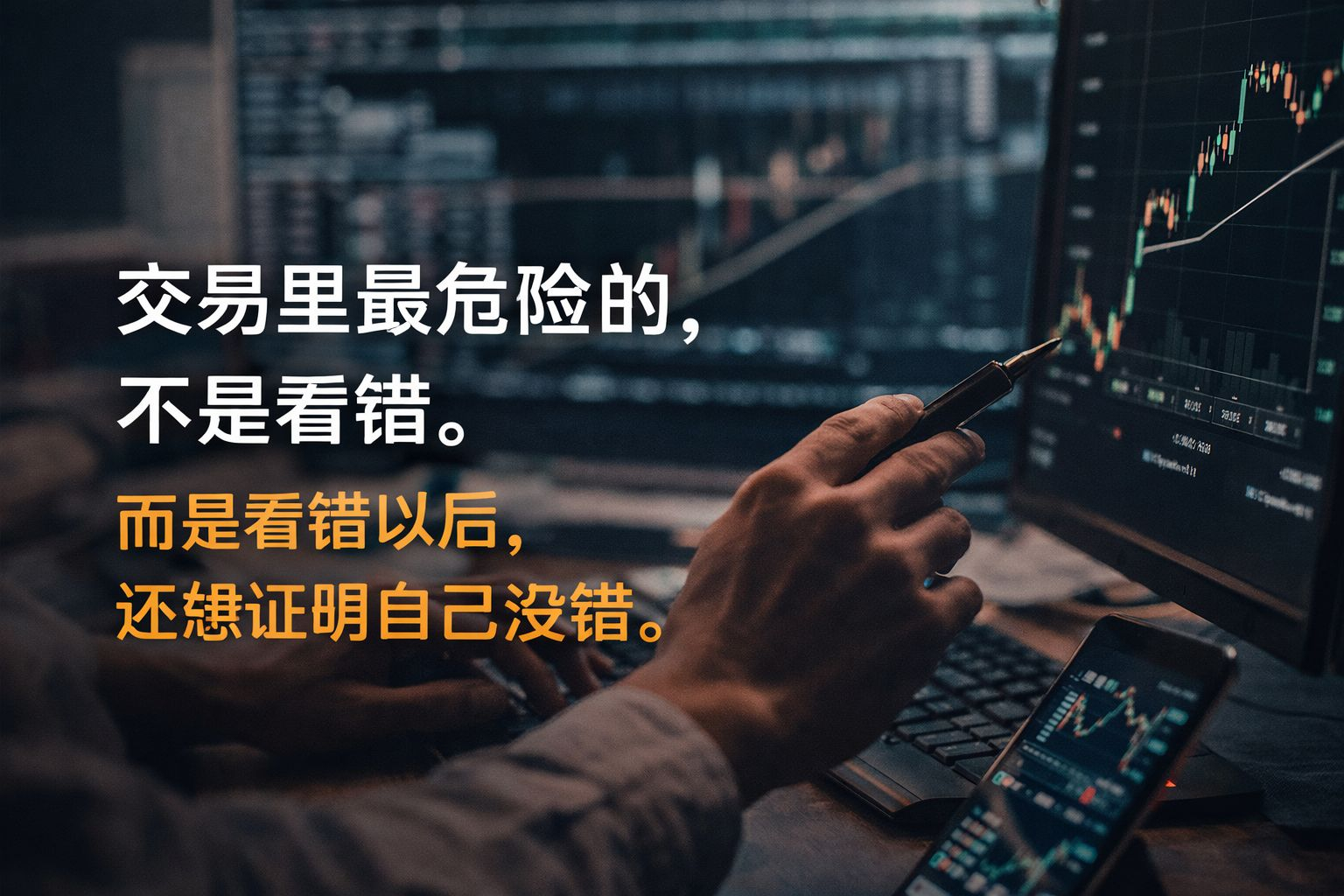
The most dangerous thing in trading is not being wrong.
But thinking you’re right after being wrong.
⚠️ The market doesn't need you to prove anything; if you're wrong, admit it—live to fight another day.
—— MK's trading philosophy