
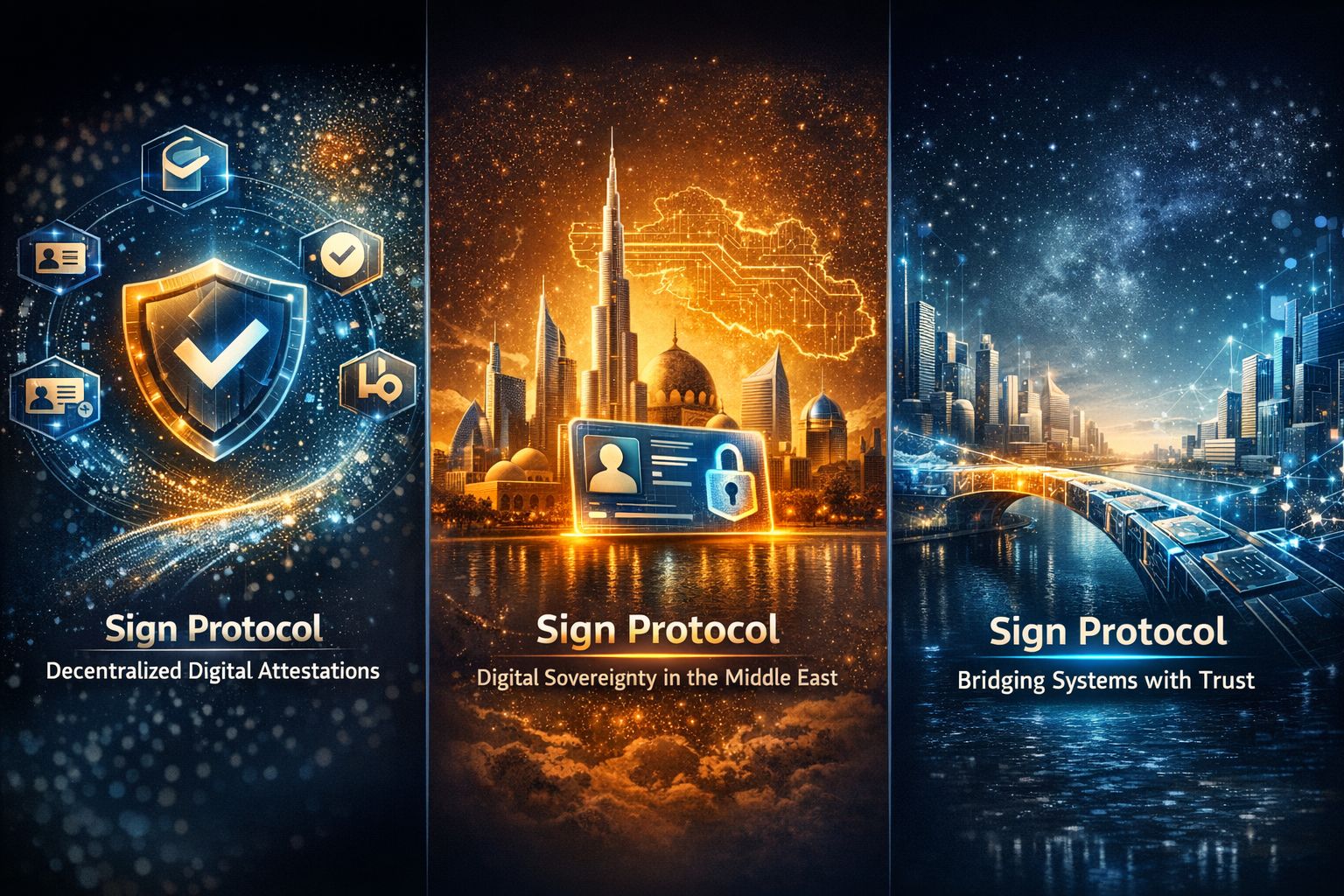
The challenge in the digital world is no longer accessing data, but proving its validity without relinquishing control.
The power equation has changed: it is no longer measured by who possesses the information, but by who can prove it, transfer it, and reuse it across different systems with mathematical confidence.
In this context, Sign Protocol emerges not as a project within the Web3 ecosystem, but as a foundational layer addressing one of the deepest gaps in the internet:
Absence of a standard framework for managing 'digital proofs' independently of intermediaries.
⚙️ From 'Institutional Trust' to 'Verifiable Trust'
Traditional trust models—whether through KYC, identity providers, or major platforms—were built on a central assumption:
Trust is granted, not owned.
These models, despite their operational effectiveness, suffer from structural limitations:
Data monopolization within closed systems
Weak interoperability
Permanent reliance on a third party for verification
As the world moves towards an open digital economy, these constraints have become a structural barrier.
Sign Protocol redefines this equation by transforming trust into:
Cryptographic attestations that can be verified without trusting the issuer.
🔬 Technical architecture: A system of attestations instead of a system of permissions
The true power of Sign Protocol lies not in the interface, but in its design as a proof-based architecture instead of traditional permission systems.
1. Schemas — Defining the truth
Representing the templates that define the shape of the data:
Who is the issuer? What type of proof? What are its validity conditions?
This layer creates a common language of trust among systems.
2. Attestations — The cryptographic truth
Each proof is:
A signed digital statement
Non-modifiable
Linked to the issuer's identity
Verifiable at any time
And here the 'statement' transforms into an independent digital asset.
3. Verification Layer — Independence from the source
This layer enables any party to instantly validate the data.
Without reverting to the system that issued it.
And this means:
Separation of proof from its source… a pivotal moment in the evolution of the internet.
🔐 Features that redefine the game
✔️ Trustless Verification: Verification without the need for trust
✔️ Omni-chain Interoperability: Working across multiple networks
✔️ Selective Disclosure: Partial data disclosure that preserves privacy
✔️ Composable Data: Data that can be reconstructed within different applications
These are not just technical features, but economic properties that reshape how value is created.
🌉 Strategic value: A trust layer for systems, irreplaceable
Unlike many Web3 projects that adopt a narrative of 'replacement',
Sign Protocol adopts a more mature approach: integration instead of exclusion.
It does not seek to abolish centralized systems, but to provide them with a verification layer that makes them:
More transparent
More interoperable
Less reliant on monopolies
In other words:
It is infrastructure, not an application.
🌍 Towards a sovereign digital infrastructure: the opportunity in the Middle East
In the midst of the global digital transformation, the Middle East stands out as one of the most ambitious markets for digital sovereignty—where the goal is no longer just digital transformation, but control over its keys.
Here, the vision of Sign Protocol intersects directly with the needs of the region.
🤝 Driven partnerships as an enabling model
Through driven strategic partnerships, the protocol can become part of the digital infrastructure through:
Developing verifiable national digital identity systems
Empowering governments to manage sensitive data without relying on external parties
Supporting financial institutions in building advanced verification layers
Enhancing the digital economy by reducing trust costs
🏗️ From dependence to independence
Instead of importing ready-made verification models,
Countries can build systems based on:
Local attestations
Open standards
Global interoperability
And here the concept shifts from 'digitizing services' to
Owning the trust infrastructure itself.
📊 Why now specifically?
Because we have entered a phase where:
Data = Economic assets
Identity = Key to market access
Trust = a cost that should be minimized
In this context, systems that cannot provide reliable and scalable verification,
Will turn into bottlenecks in the digital economy.
🤝 Conclusion: From trust as an assumption… to trust as evidence
Sign Protocol does not offer a gradual improvement,
But proposes a profound conceptual shift:
From:
Institution-based trust
To:
Trust based on cryptographic attestations
And this transition does not only redefine technology,
But redefines economic relationships themselves.
🌐 A final look
In the model proposed by Sign Protocol,
The value will not be in owning the data,
But in the ability to prove it without revealing it, and to trade it without losing it.
As the race for digital sovereignty intensifies,
The question may not be: who owns the technology?
But: who owns the trust layer that it is based on?
#SignDigitalSovereignInfra @SignOfficial $SIGN