
The reconciliation export had already gone out.
That was when the proof landed.
A few minutes late for the people staring at the numbers. Still valid for the network.
You could feel the room split right there.
Finance was looking at the cutoff file and saying the state had already moved. Engineering was staring at the acceptance result and saying the proof referenced a root that was still inside the allowed window, so the transaction was fine. Support got stuck in the middle with the worst version of the question:
why did this go through after the system had already moved on?
Midnight has a very uncomfortable answer to that.
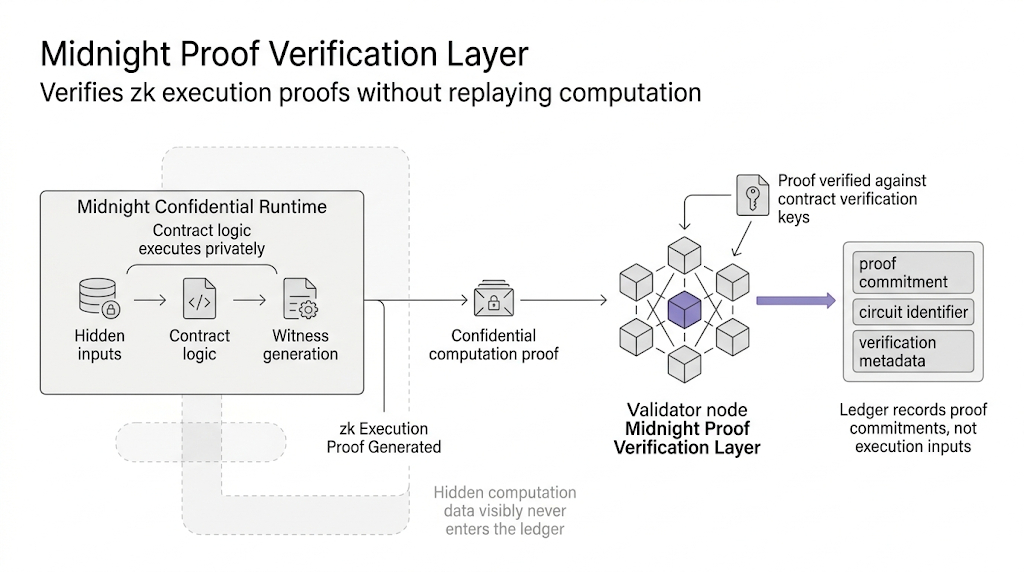
Because on Midnight, the newest state is not the only state that can still matter. Commitment trees keep moving forward. Nullifiers keep marking what has already been consumed. But older Merkle roots do not die the second a new one appears. For a while, they stay usable for proof verification. That is how the system avoids turning proof generation into a race nobody can reliably win.
A user starts from one state.
The network keeps advancing.
The proof finishes later.
If that older root is still within the validity window, Midnight can accept it.
That is exactly what happened here.
The problem was not that the proof was wrong. The problem was that it was built against a version of reality the operations team had already stopped treating as current. The ledger accepted it anyway because Midnight was still treating that earlier root as operationally valid.
So now everyone gets trapped in the same ugly argument.
Did the user act on stale state?
Or did the user act on valid state that just happened to be older than the version everyone else had already moved to in their heads?
Those are not the same accusation. On Midnight they are also not easy to separate.
That is where the design gets strange in a way ordinary blockchain language does not prepare people for. Most systems train everyone to think state has a hard edge. Latest is live. Earlier is history. Done. Midnight keeps a softer boundary because private proof workflows need time. Local execution takes time. Proof construction takes time. If every proof had to target the absolute newest root at the exact moment of submission, half the system would turn into failed retries and pointless friction.
So Midnight keeps a slice of the past alive on purpose.
Useful, yes.
Also a little dangerous to talk about casually.
Because once a historic root can still produce an accepted proof, “past” stops meaning inactive. It becomes another kind of live surface. On Midnight, The commitment-based ledger continues forward. The nullifiers protect against invalid reuse. The proof still checks out. Yet the people around the workflow start arguing about which state was real when the decision happened.
The protocol has one answer.
The business process has another.
That was the bruise in the reconciliation call. Nobody was debating cryptography. The proof passed. Nobody was debating whether Midnight behaved according to its own rules. It did. The fight was over timing language. Current for whom. Settled according to what. Old compared to which cutoff. Safe to accept versus safe to explain.
And that is the part I keep getting stuck on.
Midnight makes proof generation practical by refusing to kill older roots immediately. That flexibility is not some side feature. It is built into the way historic root tracking, commitment trees, and nullifiers work together. But the same flexibility means more than one version of state can remain operationally alive at the same time.
That sounds manageable until somebody has already exported the file, closed the period, answered the user, or promised a partner that the numbers were final.
Then the old root is not just old.
It is inconvenient.
And once a proof built on inconvenient truth is still valid enough to settle, the real question stops being whether Midnight accepted the right thing.
It turns into something more annoying.
How long does a past state stay trustworthy before everyone around the system starts calling it stale just because it showed up at the worst possible moment?