
There’s a phrase that keeps getting repeated.
Digital sovereign infrastructure.
It sounds important. Almost inevitable. Like something the space will naturally move toward over time.
And maybe that’s true.
But I’m not convinced we fully understand what it demands.
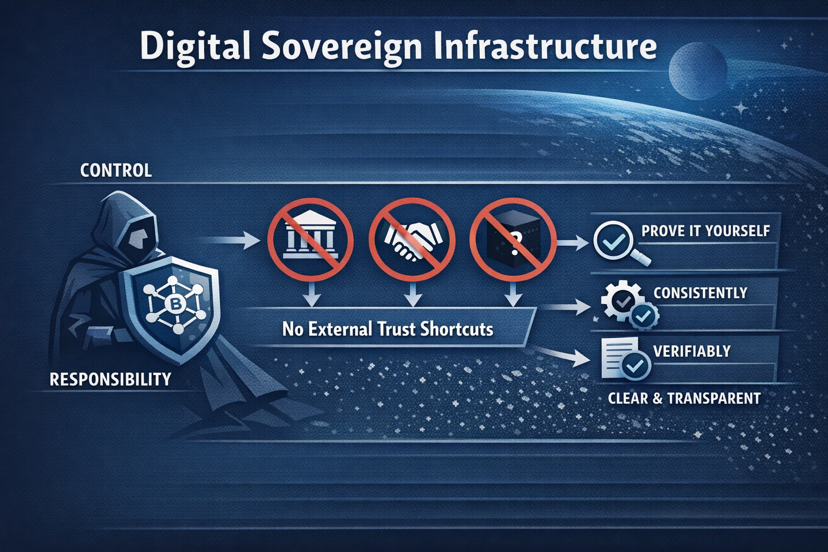
Because sovereignty isn’t just about control.
It’s about responsibility.
If a system claims to be sovereign…
it can’t rely on external trust shortcuts.
It has to prove things on its own terms.
Consistently. Verifiably. Without ambiguity.
That’s where Sign starts to feel relevant.
Not as a product.
But as a pressure point.
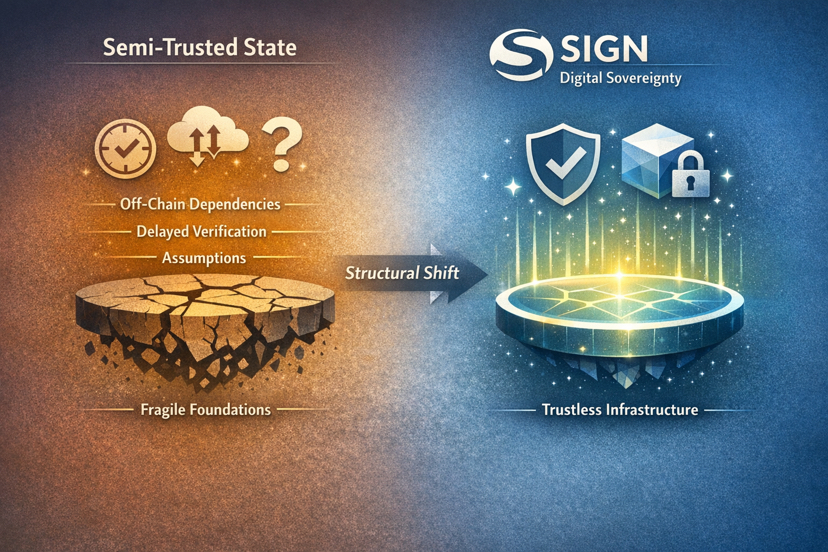
Most of crypto still operates in a semi-trusted state.
We say “trustless,” but we accept gaps.
We accept delayed verification.
We accept off-chain dependencies.
We accept assumptions that haven’t been fully resolved.
It works — until it doesn’t.
Digital sovereign infrastructure doesn’t tolerate that.
It requires systems to stand on their own proofs.
And that’s not a small upgrade.
That’s a structural shift.
But here’s what makes me uneasy.
We’re talking about sovereignty…
without clear evidence that systems are ready to bear that weight.
Because once you remove trust assumptions, you don’t just gain independence.
You inherit complexity.
You inherit responsibility for verification, coordination, and failure handling.
And not every system is built for that.
So where does this fit?
I’m not sure yet.
Sign seems to be positioning itself in that gap —
between what systems claim to be, and what they can actually prove.
But positioning isn’t the same as adoption.
Right now, most interaction still feels… exploratory.
People engaging with the idea.
Testing the edges.
Participating because it’s visible.
Not because it’s required.
And that’s fine.
Early stages always look like this.
But it also makes everything harder to read.
Because interest can look like necessity…
until it fades.
Another thing I can’t shake:
If digital sovereign infrastructure actually takes hold…
it won’t be loud.
It won’t trend.
It will quietly replace assumptions with proofs…
until certain systems simply refuse to operate without it.
We’re not seeing that yet.
No clear dependency.
No moment where something breaks in its absence.
Just potential.
And potential is difficult to price.
It’s also easy to overestimate.
I don’t think this is being rushed.
If anything, it feels measured.
Maybe intentionally so.
But measured progress also risks being ignored in a market that rewards immediacy.
So we’re left in this middle state.
Where the idea makes sense.
The direction feels logical.
But the necessity hasn’t fully arrived.
I’m not looking for confirmation.
Just a shift.
A subtle one.
Where systems stop talking about sovereignty…
and start enforcing it.
If that happens, this becomes foundational.
If it doesn’t…
then digital sovereign infrastructure remains a concept people agree with…
but don’t actually build around.
And I’m not sure yet which way that goes.
#SignDigitalSovereignInfra @SignOfficial $SIGN
