

Foreword
Polymarket's acquisition of MLB (one of the four major American baseball leagues) propelled Kalshina's valuation to $22 billion, marking two instances of "recognition" for the market within two days. One occurred within the core official partnership system of American professional sports, and the other occurred in the capital market's repricing of the sector's ceiling.
Previously, Polymarket had secured official partnerships with MLS and UFC. The NHL has also established partnerships with Polymarket and Kalshi. The Big Four leagues in the United States are being conquered by the Prediction Market. At the same time, media and platform interfaces are being rapidly connected into a network, and the Prediction Market is moving towards more frequent, more popular, and more easily understood everyday events.
Under the spotlight, it's a battle between two super unicorns for the right to define the track and for the right to capture users' minds.
Beyond the spotlight, the community expansion of blockchain natives and the modular penetration of traditional brokers are quietly closing in from the flanks. In the blockchain-native world, expansion relies on airdrops, points, and community operations; the other path is entering traditional brokerage channels, penetrating a larger existing trading population through access, white-labeling, and distribution.
I. Market Pioneers: How Polymarket and Kalshi Define Prediction Markets
Prediction markets are not a new species that appeared out of thin air. Their underlying structure has always been distinctly characterized by binary options and event contracts: to happen or not to happen; yes or no. What truly changes its fate is not the structure itself, but the way it is expressed.
Kalshi pushed this mechanism into the framework of regulated event contracts in the United States, while Polymarket translated it into language more suitable for internet dissemination—rewriting "binary pricing of future outcomes" into a prediction market that everyone can understand and is willing to click on. The former gave it an institutional veneer, while the latter gave it a traffic-driven texture; from that moment on, this thing, which was originally more financial engineering-oriented, began to have the ability to tell a story to the general public.
In this contest over the "pricing power of truth," Polymarket and Kalshi have played the role of game-changers. Through a sophisticated "combination punch," they have directly planted their flags in the cognitive wasteland of the mainstream public.
1. Trending events become the best user education tool
The real brilliance of the prediction market lies not in its invention of "predicting the future," but in its ability to compress complex judgments into the shortest path to participation: one event, one price, one outcome.
For ordinary users, macroeconomics, regulatory maneuvering, and derivatives mechanisms are not easy to grasp; however, questions like "who will win the election," "who will win the Grammys," and "will a certain policy be implemented?" require almost no learning curve. Hot topics naturally become the best teachers for the prediction market. Users may not understand the product structure first, but they will first click, participate, and use price to understand the future through familiar public events. Polymarket's long-standing practice of prominently displaying highly viral topics such as Politics, Sports, Pop Culture, Tech, and AI demonstrates that this is not accidental, but a conscious product design: first make things understandable, then get involved.
The US presidential election gave the prediction market its first truly grand narrative; the Grammys and Oscars brought it into the realm of entertainment consumption; the NBA championship and major social events pushed it from news reading to emotional engagement. Users ostensibly trade the outcome, but in reality, they learn a new way of processing information: no longer just observing events, but directly translating judgments into prices. At this point, the prediction market doesn't need explanation before it's being used.
2. Top-tier events, mainstream media, and official partnerships
The appearance of names like MLB, NHL, CNN, and PrizePicks in the prediction market landscape signifies something even more important: this sector is beginning to be integrated into familiar content and distribution scenarios.
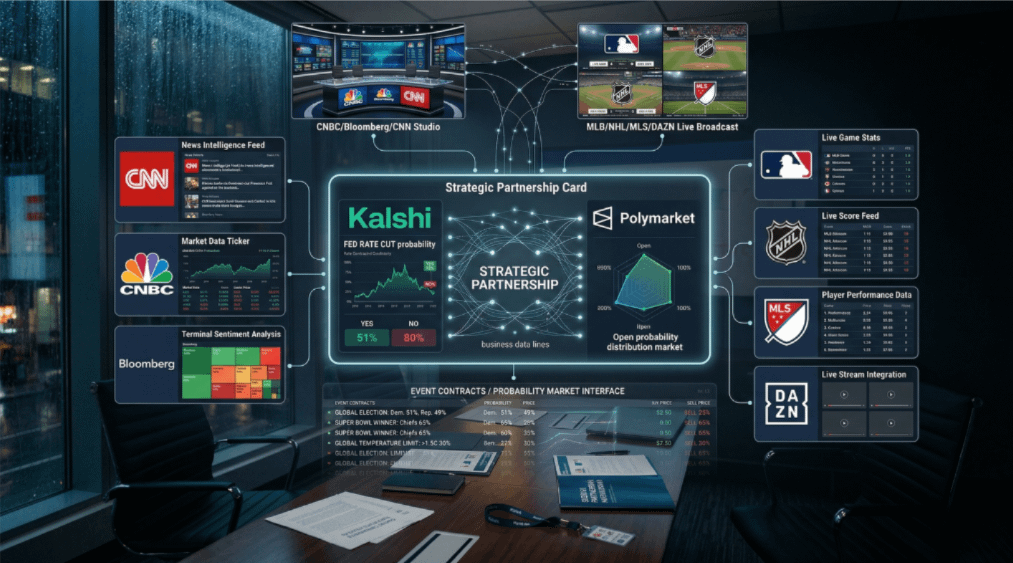
If trending events completed the first round of education, then top-tier sports events, mainstream media, and official collaborations completed the second round of "legitimization." MLB's long-term partnership with Polymarket marked the first time prediction markets were so clearly integrated into the official partnership systems of top-tier American professional sports leagues. The NHL's simultaneous connections with both Kalshi and Polymarket indicate that mainstream sports have begun to accept prediction markets as a new category of collaboration. Kalshi's partnership with CNN and its integration with PrizePicks have propelled prediction markets to the level of media interfaces and distribution on established platforms.
The significance of these collaborations goes far beyond simply "adding a few logos." More importantly, they transform the prediction market from something new that requires active seeking and understanding into something that can be integrated into the daily routines of fans, news users, and entertainment platform users. Sports leagues provide the emotion and frequency, mainstream media provides the right to interpret and credibility, and platform interfaces provide reach and conversion. Only when these three are combined do the prediction market truly gain a shell that is accessible to the general public.
3. The different locations of Polymarket and Kalshi
If you really zoom in, Polymarket and Kalshi are not on the same path.
Polymarket is more like an organizer of global topics and attention. Sports, entertainment, politics, geopolitics, and on-chain spillover traffic can almost all be quickly transformed into tradable topics. Its strength lies not in slowly educating users, but in directly inserting prediction markets into hot topics that users are already discussing, watching, and spreading. Collaborations with MLB, MLS, and UFC amplify this capability: it occupies the entry point for mass event consumption and holds a high ground in global discourse.
Kalshi, on the other hand, is more like a promoter of systems, interfaces, and compliance pathways. It has long focused on the US regulatory framework, operates exclusively in the US market, and emphasizes its status as a regulated event contracter, media partnerships, and access to mainstream platforms. Its goal is not just to "get more people to see it," but to "gain recognition from more mainstream institutions." If Polymarket is responsible for making the prediction market popular, Kalshi is responsible for making it legitimate; one establishes a global context, the other paves the way within the institutional framework.
On another level, what the two are really competing for is not just trading volume, but "who comes to mind first when users hear the words 'prediction market'." In a sense, this is no longer a competition between platforms, but a competition for mindshare in the market.
Compared to other prediction projects, Polymarket and Kalshi's leadership is not just in scale, but also in their dominance in defining the prediction market, expanding compliance, educating users, and capturing mindshare. It was these two paths that jointly shaped the first phase of the market, truly elevating the prediction market from a niche concept to mainstream discourse.
II. The Blockchain Approach of Buying Land by Drawing Circles: Opinion, Predict.fun, and Airdrop-Driven Expansion
The first route, represented by Polymarket and Kalshi, is a battle over "who defines the prediction market." The second route, driven by native on-chain players, is not about defining the market, but about activity, engagement, and the speed of community expansion.
They rarely buy official access points, nor are they in a hurry to enter mainstream media and alliance systems; their more familiar approach is another expansion method that has long been proven in the crypto world: points, airdrops, invitations, tasks, community fission, and expectation management.
While on-chain prediction markets may also be called prediction markets, their underlying growth logic is closer to that of a typical crypto product: first, build up the community, then increase liquidity, and finally, make participation itself part of the narrative.
1. Instead of buying official access points, we will focus on on-chain operations.
The biggest difference between on-chain prediction markets and the first approach lies not in the subject matter, but in the growth method. The former relies on operations, while the latter relies on perception.
In the on-chain world, many users aren't just there to "predict events," but to participate in an early protocol that may offer future benefits. Therefore, transaction behavior, usage frequency, fees, and community interaction are all repackaged into points, ranks, seasons, or potential airdrop eligibility. After acquiring Probable, Predict.fun's primary focus wasn't the acquisition itself, but rather how user migration, point conversion, and historical behavior are transformed into new equity relationships. For this approach, the emphasis is never just on "marketing," but on designing the act of "staying in the ecosystem" itself as an incentivized behavior.
Therefore, the primary growth engine of on-chain prediction markets is often not authoritative scenarios, but rather operational design. Users first become the community, the community then becomes liquidity, and liquidity finally becomes product momentum—this is its most typical expansion path.
2. Typical Projects
Opinion and Predict.fun are two of the most representative examples of this approach. Both are rooted in the BNB Chain and benefit from the spillover traffic from the Binance ecosystem. They attract not primarily mass users, but rather the crypto natives who best understand the language of on-chain incentives, protocol expectations, and community identity.
For these users, participating in prediction markets is not just about judging an event itself, but also about participating in an early protocol with the potential for additional benefits. After Predict.fun acquired Probable, it emphasized user migration and the continuation of benefits, rather than the project's intrinsic capital value. This is very telling: on-chain prediction markets are not just about capturing event buzz, but also about building future community relationships and anticipating future growth.
On-chain prediction markets can hardly escape the cycle that many blockchain projects face today: attracting users based on expectations before launch, maintaining liquidity after launch, and then collapsing once the expectations are met.
Opinion faces similar core challenges: can the protocol generate real revenue? Does the token offer clear benefits? How can it maintain market capitalization and participation after listing? And what will sustain it in the second phase after the first phase of expectations ends? Many projects have strong growth narratives before listing, but once the token is actually implemented, users quickly shift from "participating in the protocol" to "realizing profits," leading to a decline in participation, reduced trading volume, and a cooling of community enthusiasm. The biggest risk of on-chain prediction markets is not a lack of participants, but rather that they come and go too quickly.
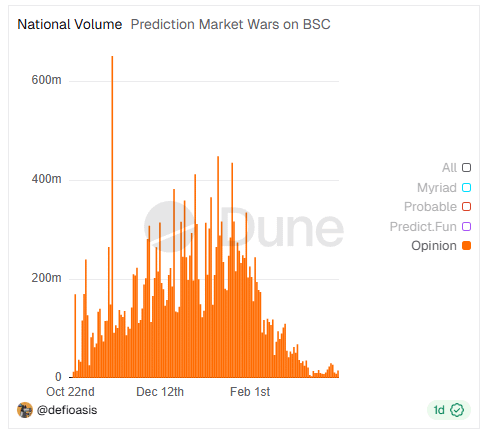
Compared to Polymarket and Kalshi, this approach is advantageous in its lightness, speed, and freedom: fewer subject restrictions, faster product iteration, more aggressive community dissemination, and greater ability to attract crypto users willing to gamble on early gains. Predict.fun's ability to achieve over $1.5 billion in cumulative trading volume in a short period and its rapid expansion through the acquisition of Probable demonstrates the efficiency of this approach in mobilizing a native community.
Its shortcomings are equally apparent: a narrower user base, greater reliance on wallet users and on-chain habits, a more fragile business loop, with hype often preceding revenue and narratives frequently outpacing product development. More importantly, this approach struggles to naturally spill over into mainstream financial scenarios. Front-end platforms are vying for "who can represent the prediction market," while on-chain projects are still largely proving "whether the prediction market can become a successful on-chain project."
III. Under the Spotlight: Traditional Brokers and Infrastructure Providers are Connecting to Prediction Markets
While the market is still debating which trending event offers the best odds and which on-chain project will launch an airdrop, the prediction market has already quietly begun to expand through traditional brokerage channels. This is partly driven by a business "defense" strategy—as the demand for trending, event-driven, and short-cycle trading grows stronger, brokerages are unwilling to relinquish this user attention to independent platforms. It's also driven by a desire to find a second growth curve—integrating a high-frequency, low-decision, and highly topical new category into their already mature account, payment, and trading systems.
This route isn't always in the spotlight, but it may be the one closest to truly becoming a mainstream path.
1. Robinhood proves that mainstream brokerages can capitalize on the prediction market.
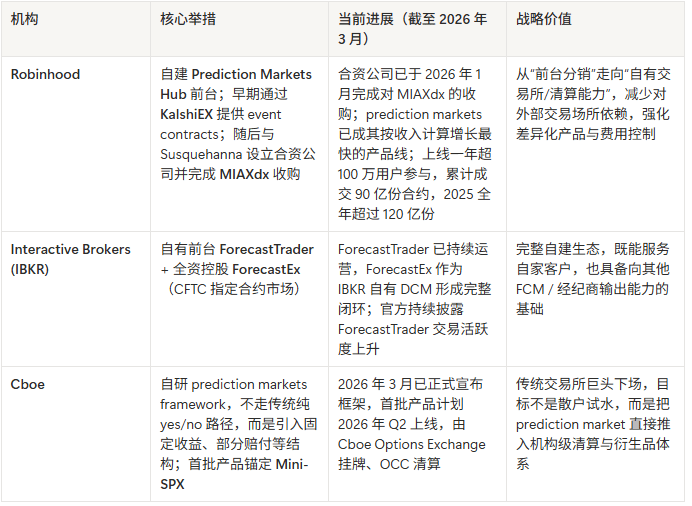
In March 2025, Robinhood launched its prediction markets hub within the app, with initial event contracts provided by Robinhood Derivatives through KalshiEX. Subsequently, it established a joint venture with Susquehanna and acquired MIAXdx, further expanding into exchanges and clearinghouses. With its account system, payment system, existing monthly active users, and distribution channels already in place, the prediction market was integrated into a mature retail brokerage system.
Robinhood has officially disclosed that its prediction markets have become its fastest-growing product line by revenue; within a year of its launch, over 1 million Robinhood users have participated, with a cumulative total of 9 billion contracts transacted. By 2025, this number is projected to further expand to over 12 billion event contracts.
Without radical community slogans or expensive marketing campaigns, it quietly encroached on users' transaction time through existing user conversion and channel penetration.
2. Three access methods
Traditional securities firms, brokers, and infrastructure providers have different paths to access the prediction market, but the direction is clear: some do the front-end conversion themselves, some connect directly to external markets, and some simply sell the entire infrastructure.
A. Self-built front-end + vertically integrated infrastructure
These institutions are not content with merely being traffic entry points; they aspire to control the front-end, exchange, clearing, and brand. Their goal is not simply to "connect first," but to maintain long-term control over product definition, fee structures, and back-end capabilities.
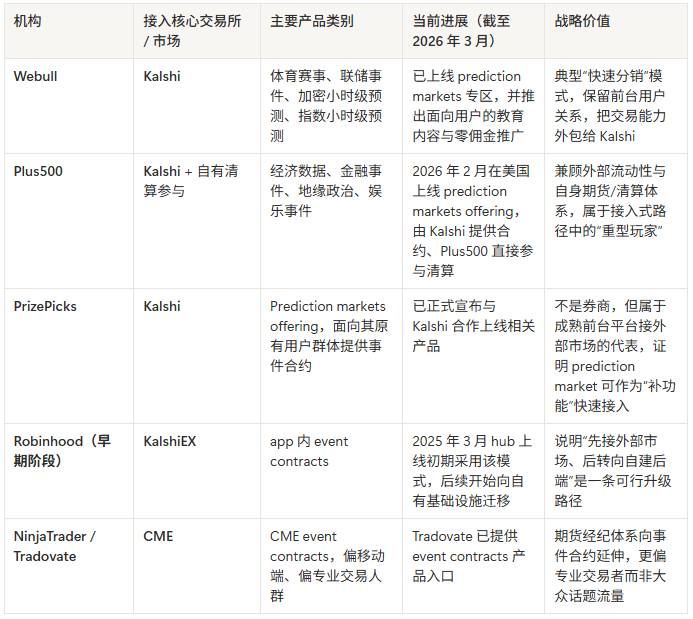
B. External market access + front-end distribution
This is currently the most mainstream and efficient approach: keep the front-end in-house, and outsource the marketing and some back-end capabilities to approved external exchanges. It offers fast launch, low regulatory costs, and ample room for experimentation, making it suitable for platforms that want to quickly integrate prediction markets into their existing product lines.
C. White Label / Broker-Tech Infrastructure Deployment
This layer doesn't directly target end users; instead, it operates by "selling shovels": it prepares the exchange, clearing, compliance modules, and front-end templates, then hands them over to brokers for rebranding and listing. What they're selling isn't a specific market, but the very fact that "a prediction market can be launched within days to weeks."
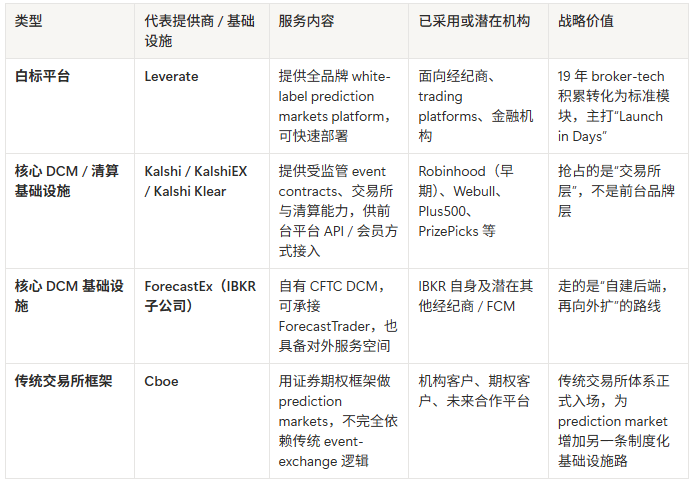
Front-end developers who handle conversions themselves are vying for users; those connecting to external markets are adding features; and those selling infrastructure are selling capabilities. These three paths are different, but they all point to the same result: the prediction market is being modularized, productized, and channelized.
3. Forex Broker in the Spotlight: An Underrated "Ultimate User Pool"
If Polymarket proved the "narrative potential" of prediction markets, then the global forex and CFD (Contracts for Difference) brokerage channel holds the key to its "liquidity explosion."
A sample survey conducted by the Bank for International Settlements (BIS) in April 2025 showed that the average daily turnover in the global foreign exchange market had risen to $9.6 trillion; meanwhile, Finance Magnates' Q4 2025 industry report showed that the number of active CFD accounts globally had reached 6.787 million. This group of people already possesses distinct characteristics: **high-frequency trading habits, greater sensitivity to event-driven factors, and greater familiarity with volatility, requiring almost no initial training.** For prediction markets, this is not a completely new market to be explored, but rather a mature pool of users with existing accounts, funds, trading languages, and operational habits.
Potential transaction size calculation
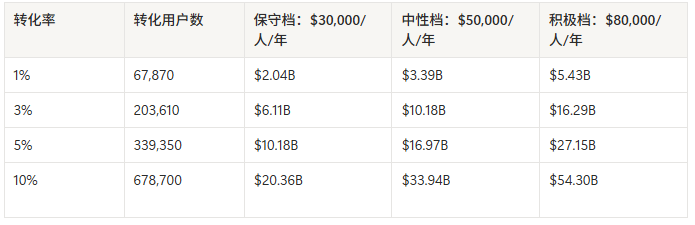
Potential annual nominal transaction volume = Number of active accounts that can be converted × Conversion rate × Average annual nominal transaction volume per converted user
Consider the following factors:
We do not directly use the global average daily trading volume of foreign exchange. The global average daily trading volume of the foreign exchange market in 2025 was US$9.6 trillion, which includes a large number of institutional hedging, swap rollover, and leveraged notional positions, making it unsuitable for direct mapping to the prediction market.
Based on the pool of reachable retail users, the number of active CFD accounts globally in the fourth quarter of 2025 was approximately 6.787 million, a figure that is closer to the actual number of existing users that traditional brokers can handle.
Consider the differences in product structure. Forex/CFD trading relies on leverage and continuous price curves, while prediction markets are low-leverage, discrete-result contracts. The trading frequency and notional amount formation methods are different, so the user intensity of native prediction markets needs to be discounted.
Based on verification data from mainstream platforms, Robinhood traded over 12 billion event contracts in 2025, indicating that mainstream front-ends can handle the prediction market. However, its platform activity is higher than that of ordinary broker channels, making direct migration unsuitable.
Based on this, take:
Number of convertible active accounts: 6.787 million
Conversion rates: 1%, 3%, 5%, 10%
Average annual nominal transaction amount per converted user:
Conservative estimate: $30,000
Neutral: $50,000
Active category: $80,000
Conversion rate
Number of converted users
Conservative option: $30,000/person/year
Neutral option: $50,000/person/year
Active Tier: $80,000/person/year
IV. From Weathering With You to Hedging Blocks: Prediction Markets Are Growing into a New Species
At this point, the outline of the prediction market is actually quite clear:
At the front end, Polymarket and Kalshi are vying for the right to define the market; in the middle, on-chain protocols use airdrops, points, and community operations to amplify participation; and at the back end, brokers, infrastructure providers are breaking it down into capabilities that can be accessed, deployed, and distributed. While these appear to be three separate paths, they all ultimately drive the same thing—the prediction market is evolving from a niche market into a new type of financial container more like the internet age.
Prediction markets are naturally situated at the intersection of finance, content, and online communication.
This is precisely why it doesn't serve only professional traders like traditional financial products, nor does it cater solely to excitement and onlookers like pure content consumption. Instead, it has gradually developed into a unique hybrid form: capable of entering serious trading scenarios as well as embedding itself in mass-market events; able to support both research and judgment as well as emotional engagement. From the very beginning, this sector was destined not to exist in a single context.
1. The nation's "Weather Child" and "Sports Committee Member"
The prediction market is developing its own rhetoric.
It's not an abstract transaction structure, but a product that grows alongside topics, traffic, and emotions. With a short participation path and a light expression, it's naturally suited for high-spread scenarios like sports, entertainment, elections, and macroeconomics, and will naturally give rise to a unique online language specific to this field.
"Weathering With You" and "Sports Committee Member" are not jokes, but signals: the prediction market is making judgments more concrete, participation less demanding, and discussions more like the internet. It's not just about predicting the future, but also rewriting events themselves into a form of public expression that can be traded, disseminated, and observed.
2. The protocol is the "mint": it is not only the platform but also the issuer of the token.
This is also the fundamental difference between it and many traditional on-chain projects.
The growth logic of most blockchain projects still revolves around "platform, token, and distribution": they act as matchmakers, narrative creators, and ultimately, token issuers and market capitalization maintainers. Platforms not only need to retain users, but also need to constantly create expectations, extend the story, and maintain popularity, like a "mint" that can never stop firing.
Prediction markets can certainly be included in this framework, but their true strength lies not in whether they can be wrapped in another layer of tokens, but in the fact that they are more like an independently established financial product. They don't trade abstract emotions or simply protocol traffic, but rather the "judgment" itself. As long as the problem boundaries are clear enough, the settlement rules are explicit enough, and the profit and loss results are sufficiently verifiable, they naturally possess the ability to resemble financial instruments.
3. Binary Aesthetics: "Lego Bricks" for Hedging Risk
The underlying beauty of prediction markets comes from a kind of extremely compressed clarity:
Will it happen? Who will win? What are the probabilities? What will the price be?
The original expressions, which were heavily influenced by financial engineering and technical jargon, have been translated into language that internet users can quickly grasp. With clear settlement of results, predictable profits, and verifiable losses—this well-defined structure makes it naturally suitable for small-scale, short-term, event-driven participation, and also naturally suited for expressing risk.
More importantly, it's not just suitable for single-point betting. Different events, directions, and timeframes can be assembled and combined, like a set of "Lego bricks" to express risk preferences. Sports and macroeconomics can hedge emotions, weather and commodities can hedge scenarios, and politics and market expectations can also reflect each other. It may not be the most mature hedging tool yet, but it has already shown the rudiments of combinable hedging.
4. Growing upwards, compatible with downwards
The most unique aspect of the prediction market is that it almost simultaneously exhibits two growth directions.
Upwards, it serves as a research tool, risk expression, hedging strategy, and a new type of information trading. For professional users, it shortens the "research-judgment-expression" path, directly embedding opinions into prices.
On a smaller scale, it can also be a lightweight experience similar to entertainment consumption, small-amount participation, and lottery-like activities. For ordinary users, it does not require complicated barriers or complete financial knowledge; it can be simply a low-cost participation, a vote on a hot topic, or an action of turning observation into betting.
It can deliver serious judgments as well as resonate with public sentiment; it can align with finance as well as delve into content. This versatility is precisely its strongest driving force for expansion.
5. The Last Narrow Gate: Liquidity, Boundaries, and Regulation
But it hasn't yet passed through that last narrow gate.
The first hurdle is liquidity. Outside of popular markets, many long-tail events still lack sufficient depth, have fragile order books, and are prone to price distortion.
The second hurdle is the settlement boundary. The allure of prediction markets lies in their "clear-cut outcomes," but the real world is far more complex than the title suggests; ambiguities, interpretive spaces, and temporal boundaries do not automatically disappear.
The third hurdle is regulation. The closer it gets to mainstream finance, the harder it is to rely on ambiguous narratives in the long run; the more it wants to reach the masses, the more it must accept a reassessment of systems and compliance.
It is no longer just a small track under the blockchain, as it used to be.