

I’ve been watching $SIGN longer than most of the noise around it, and the one thing that keeps pulling me back isn’t another partnership headline or on-chain attestation count. It’s the supply setup the way this token is structured right now feels like one of those rare moments where the market is pricing in the wrong story entirely.
Right now the float sits at just 16.4 percent of the 10 billion total supply. That’s 1.64 billion tokens in circulation, giving it a market cap hovering around $70 million while the fully diluted value sits closer to $426 million. In plain terms, the market is paying a premium for scarcity that’s about to get tested, but not in the way everyone expects.
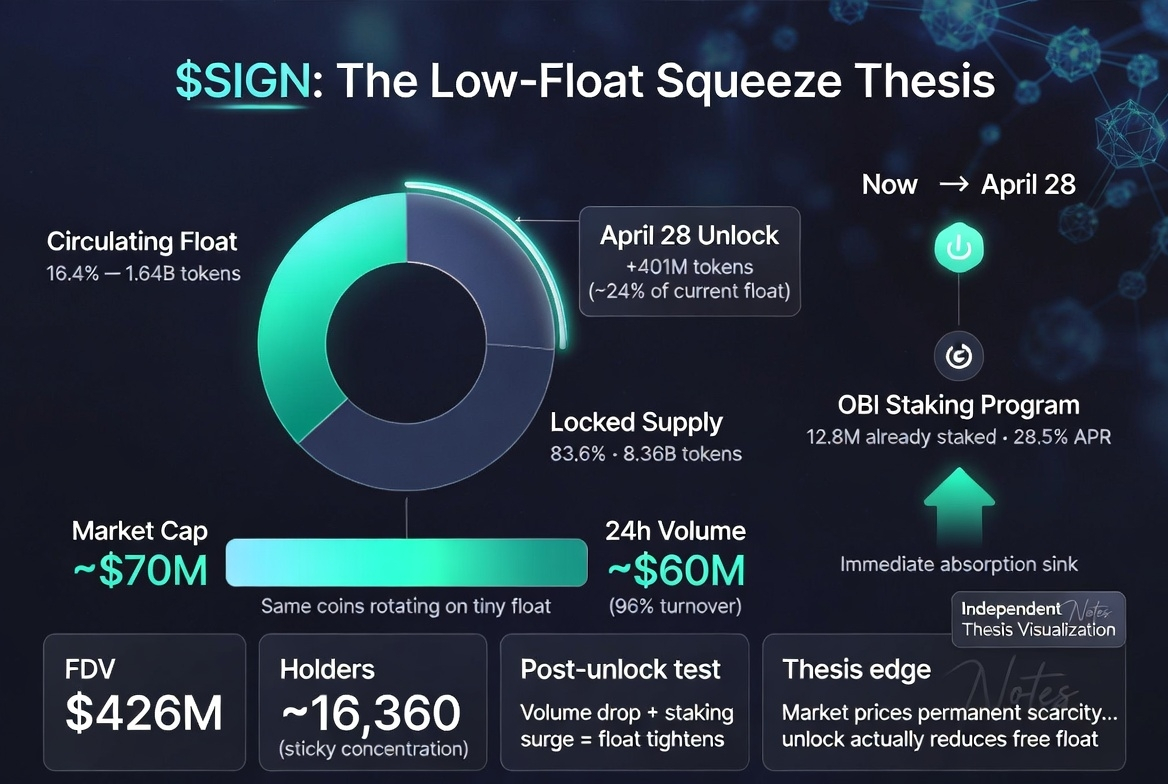
The daily volume tells the same tale in a louder voice. We’re seeing $50–68 million traded in 24 hours on a $70 million market cap sometimes pushing 97 percent turnover. That’s not healthy liquidity flowing in from new buyers. That’s the same coins rotating through the same hands on an artificially tight float, day after day. It feels like the market has convinced itself this scarcity is permanent, and the price action reflects that churn more than any real conviction about utility.
Then April 28 rolls around and roughly 401 million new tokens about 24 percent of everything currently floating hit wallets. On paper it looks like classic dilution. On Tokenomist the release is tagged to backers across five allocations, worth around $18–19 million at today’s levels. Most traders I talk to are already bracing for the usual post-unlock dump. But here’s where the data starts to feel different to me.
The same backers receiving those tokens are the ones tied to the real-world integrations that actually need SIGN to function credential logic, distribution engines, the kind of stuff governments and enterprises pay for in private. More importantly, the Orange Basic Income program that just kicked off is sitting there ready to absorb supply. As of this week, over 12.8 million tokens are already staked in OBI on the official dashboard, earning around 28.5 percent APR with a season that runs through mid June. The reward pool is built to pull more in as milestones hit, and the design explicitly rewards moving coins off exchanges into self-custody wallets. Every new token unlocked has an immediate, high utility home waiting instead of hitting the sell button on Binance.
Holder behavior backs this up too. We’re at roughly 16,360 addresses right now, and the distribution has stayed remarkably sticky through earlier linear releases. These aren’t fresh retail wallets flipping for a quick 2x; the concentration in treasury style wallets suggests alignment with the longer game. The churn we see in volume is happening on top of a base that hasn’t been eager to sell.
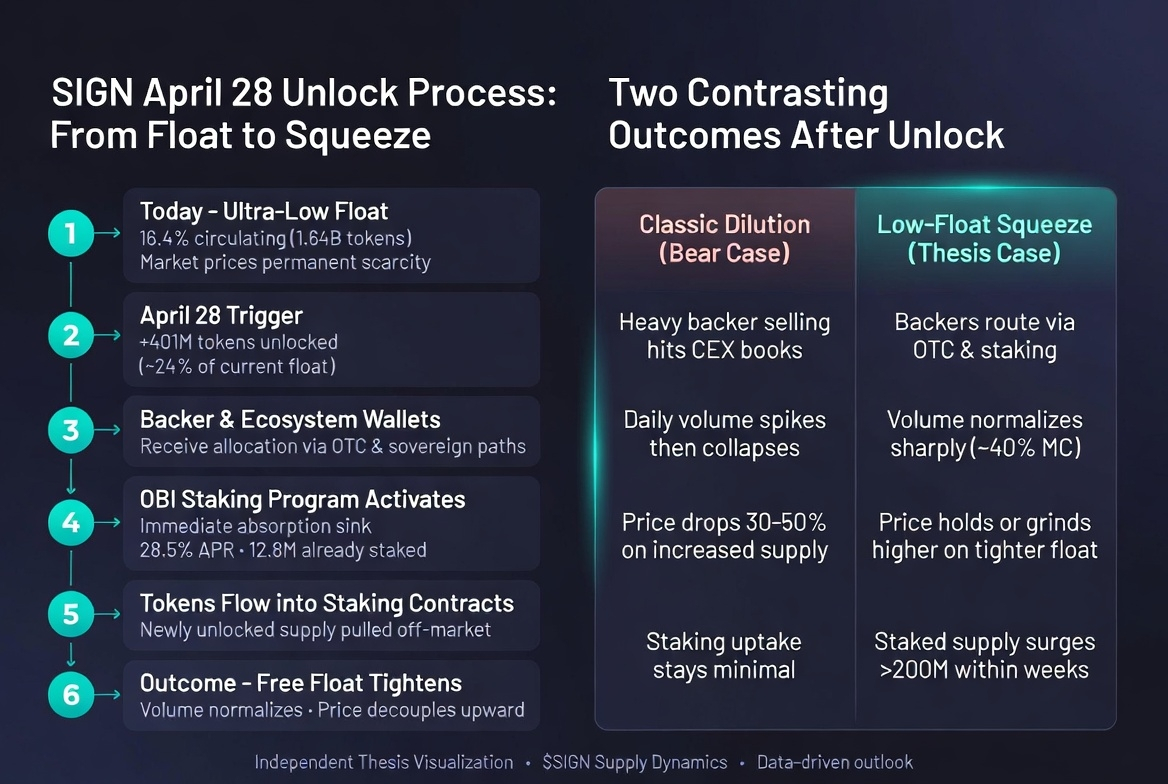
Of course the counter-case is real and I’d be lying if I said it didn’t keep me honest. If those backer wallets simply route everything straight to CEX liquidity and the same speculators who’ve been rotating the float decide to take profits, we could easily see the textbook 30–40 percent drawdown. The data doesn’t pretend that can’t happen. What it does show is that the mechanics staking incentives, OTC paths tied to actual adoption, and the sheer size of the still-locked 83.6 percent tilt the odds away from that outcome more than the chart currently implies.
What will confirm this thesis over the next few weeks is pretty straightforward. After April 28 I’m watching for volume to normalize hard dropping below 30–40 percent of market cap while price holds or grinds higher. A visible jump in staked balances north of 200 million within the first month would seal it. On-chain flows moving into the staking contract instead of exchange deposit addresses would be the cleanest signal of all. If we see any of that, the float doesn’t loosen; it actually tightens further.
The opposite would invalidate it in a hurry: sustained high turnover on unlock day followed by a clean break lower with no measurable staking uptake. That would tell me the absorption story was wishful thinking and the backers treated it like any other liquidity event.
I’m not here pounding the table or calling for a moonshot. I’m just sharing what the numbers have been telling me when I step away from the price chart and look at the structure underneath. $SIGN is priced like the current float is the permanent reality. The unlock itself might be what proves it isn’t and that’s the part almost nobody seems to be talking about.
@SignOfficial #SignDigitalSovereignInfra $SIGN
