

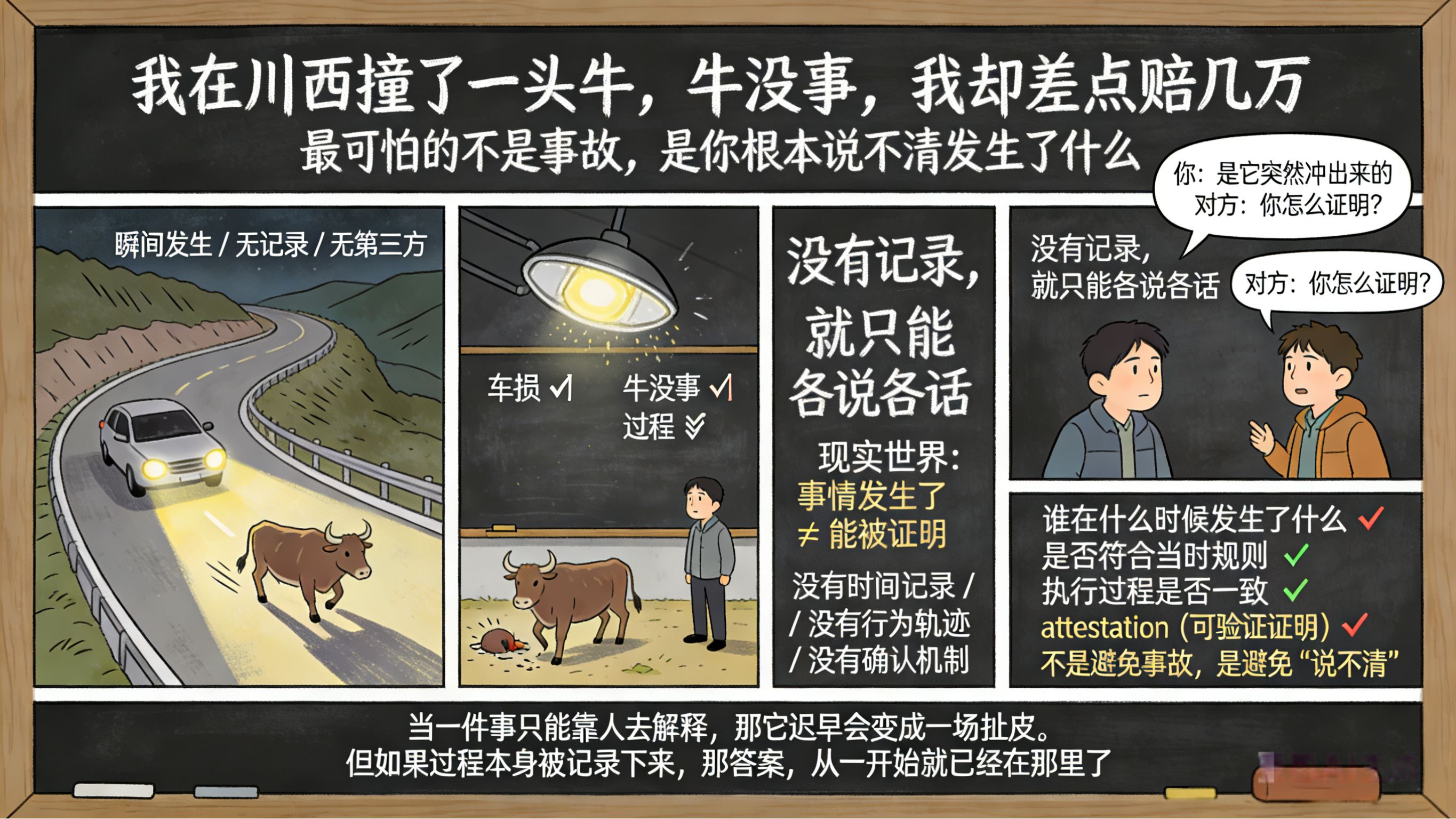
In September 2019, while driving in western Sichuan, a cow suddenly ran out when I was turning.
There was no time to react, and I directly crashed into it.
The right front light of my car fell off on the spot, and the bumper cracked.
But the most ridiculous thing was— the cow got up and walked away, completely fine.
At that moment, there was only one thought in my mind:
Fortunately, the cow was fine; otherwise, it might not just be the cost of repairing the car, but also the cost of compensating for the cow.
But when I calmed down and thought about it, I was actually quite scared.
I let out a sigh of relief at that moment.
There was only one thought in my mind:
Fortunately, the cow was fine; otherwise, today would not be about repairing the car, but about paying compensation, which could start from tens of thousands.
What if that cow hadn't stood up at the time?
What if it gets injured or even dies on the roadside?
How can I prove:
It was because it suddenly rushed out.
It's not that I'm too fast
It's not my operation problem
What specifically happened at that time
At that moment, I realized a problem:
Once something goes wrong, the most terrifying thing is not the loss, but that you cannot clearly explain the process.
There was no video recording at the scene, no third-party records,
It's just me and that cow.
But the cow does not speak.
This feeling is actually quite familiar.
You will find that many disputes in reality ultimately boil down to one thing:
Each has their own story
The contract was signed, but the understanding of the terms is different.
Airdrop participated, but the rules changed.
The task was done, but the standards are unclear
In the end, everything becomes 'who explains it how'.
It is also because of this point that I have been re-examining @SignOfficial .
My previous understanding of it was actually quite shallow.
On-chain signatures, airdrop tools, distribution platforms.
But after seeing its entire structure, I actually changed my perspective.
What it really wants to solve is not whether the 'result is right',
But rather:
Whether the process can be completely recorded and verified by anyone
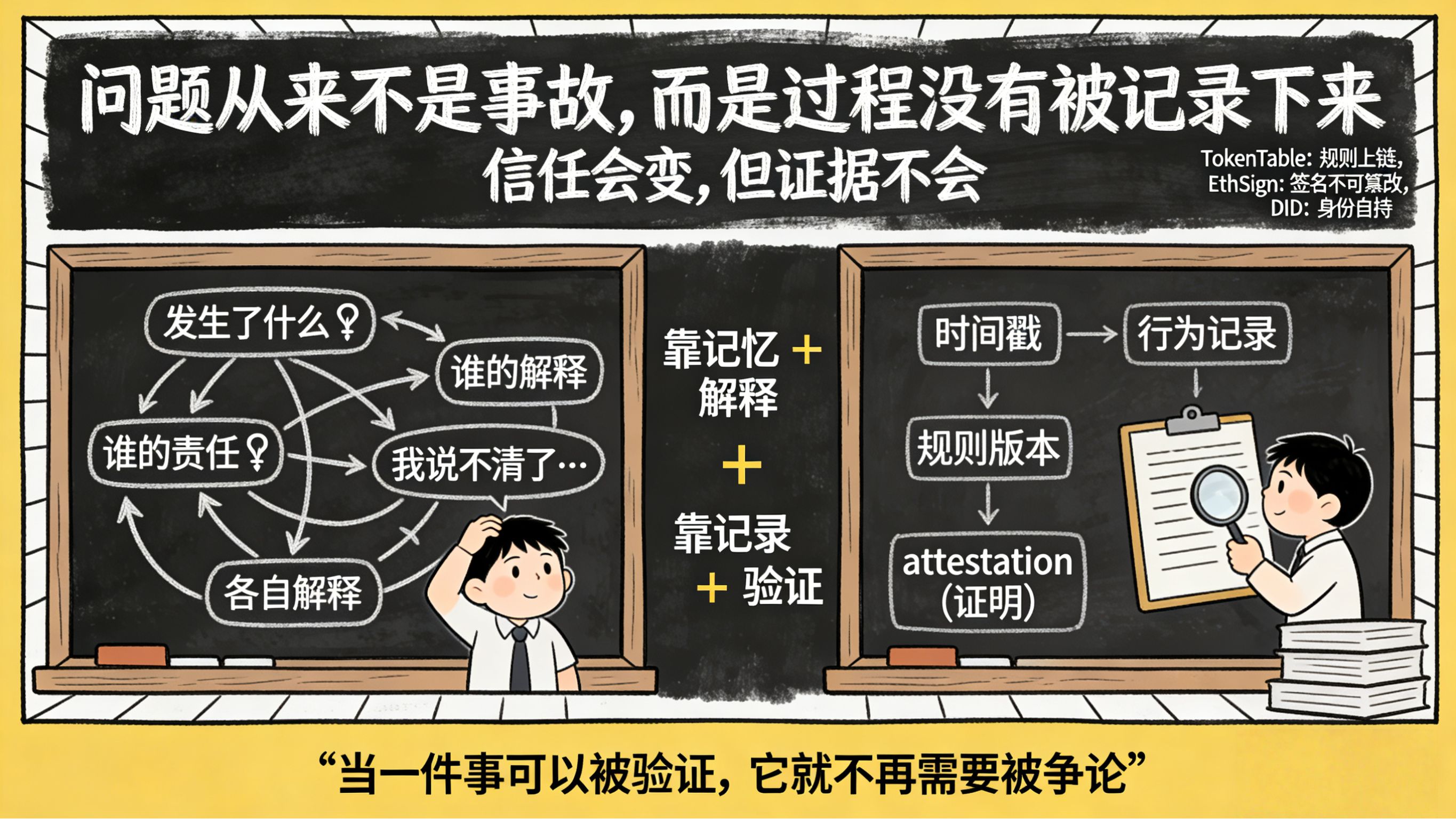
The core of the Sign Protocol is something called attestation.
You can understand it as a kind of 'on-chain proof record'.
When something happens, it will be structured and recorded:
Who initiated it
Who participated
At what time
According to which version of the rules
What conditions were met at that time
This information will be written into the chain together, along with signatures and timestamps.
The focus is not on 'having a record', but rather:
Once this record is generated, it does not rely on any party to maintain its authenticity.
In other words, you don't need to 'trust anyone',
You can verify it yourself.
If you look deeper into the application layer, it will be more intuitive.
For example, its TokenTable.
Many people who participated in airdrops or project incentives should have encountered similar situations.
A lot of rules were written, but in the end, no one can clarify how to filter.
The project party can explain afterwards that 'you do not meet the criteria'
The distribution result came out, but the process is not traceable.
One thing TokenTable does is:
write 'the distribution rules themselves' into the chain in advance
It's not just about recording 'how much was spent'
But rather:
Distribution conditions
Time nodes
Calculation method
Eligibility to participate
Everything is solidified into verifiable parameters before it starts.
During the execution process, anyone can check against the rules:
Whether it was executed according to the rules.
The changes in this matter are actually quite significant—
The interpretation of the rules is no longer entirely in the hands of the project party,
But rather on the chain.
And then there is EthSign.
The biggest problem with traditional contracts is not whether there are clauses,
But rather:
At the moment of signing, it is very difficult to prove which version of the content it is.
What EthSign does is:
Write the complete file hash on the chain
Record the signing time
Bind signature identity
Once signed, any changes will be detected.
That is to say:
What you signed at that moment is what it will always be.
Then to the identity layer, such as SignPass and DID systems.
Now many identities essentially exist within the platform:
Account, permissions, authentication information
Once the platform has issues, these things will disappear with it.
The idea of Sign is the opposite:
Binding identity to the user's own key, rather than the platform's database
Combine with verifiable credentials (VC) and selective disclosure:
You can prove 'I meet the criteria',
But you don't need to hand over all the information.
This is actually reducing another kind of risk:
Information is excessively exposed and abused.
When you put these things together, you will find it is doing something quite unified:
Transform 'what happened' from relying on memory and interpretation into independently existing evidence
Back to that accident I had years ago.
If there had been a similar mechanism at that time:
Vehicle behavior is recorded
The time point is confirmed
The state at the scene has been solidified
then many disputes later actually do not need to be debated.
It's not just what you say goes, nor what the other party says goes,
But rather: it is recorded there
Of course, I do not think $SIGN can solve all problems right now.
For this infrastructure to function, there is a premise:
Before things happen, the rules and systems have already been integrated
But the reality is that most people only realize the need to leave evidence after something goes wrong.
Just like that time I hit a cow,
If something really goes wrong, I can't take anything out.
So now when I look at this project, I actually won't judge it by short-term ups and downs.
It feels more like observing a trend:
The cost of trust is increasing, while the demand for evidence is becoming more rigid.
Platforms will have problems, relationships will change,
But if an event is recorded as it happens,
Then it won't disappear along with these changes.
Finally, let's put it another way.
That day I was actually quite lucky; the cow was fine, I only lost a headlight.
But what truly frightens me is not that impact
but rather:
If things escalate, I can't even prove 'what happened at that time'.
Many problems arise not because there are no rules,
but rather that the rules were not left behind.
If everything can only rely on people to recall and explain,
Then the conclusion is never stable;
But if the process itself can be recorded, verified, and traced back,
Many things already have answers from the very beginning.
Now when I look at $SIGN, it feels more like it's doing this.
It's not about preventing problems from arising,
but because after a problem occurs, it no longer turns into an 'incomprehensible' game.#Sign地缘政治基建 $SIGN
