
i grew up watching my father run a small import business and part time trading on BITCOIN and GOLD and honestly the thing that stuck with me most wasnt the products or the margins, it was the paperwork 😂
every payment had conditions attached. pay on delivery. pay when the inspection certificate arrives. pay thirty days after the goods clear customs. the money was always ready. the question was always whether the condition had been met. and half the disputes in his business were not about whether anyone owed anything
they were about whether the condition had been satisfied yet.
i thought about those payment disputes this week reading through the rCBDC programmable money mechanics in the SIGN stack. because the design is trying to automate exactly that problem. and the place where it gets genuinely complicated is the same place my father's disputes always started.
What the design sets out to do:
the retail CBDC in the SIGN architecture supports programmable payments at the token layer itself. not at an application layer sitting above the currency. inside the token operations.
time-locked transfers release funds at a specified time without any external trigger required
recurring payments execute on a defined schedule automatically. compliance attestations can be embedded as conditions, a transfer only completes if a specific attestation is present and valid. multi-signature requirements can gate a transfer so that more than one authorized party must approve before funds move.
the programmability sits inside the Fabric Token SDK using the UTXO model. each unspent output can carry conditions. the conditions are evaluated when the output is consumed. a token that carries a time-lock condition cannot be spent before the lock expires regardless of what any participant wants
the enforcement is at the protocol level
not dependent on any party honoring an agreement.
that is genuinely powerful for a sovereign payment system. welfare payments that cannot be redirected before a scheduled release date. agricultural subsidies that only reach a farmer after a verified delivery event. compliance checks embedded in the payment itself rather than bolted on top as a separate process.
The part that i think is underappreciated:
compliance automation inside the token is the design decision that most changes what sovereign payments can do
today a government distributes a benefit and hopes downstream compliance checks catch misuse. with programmable conditions the compliance requirement travels with the money. the payment and the rule governing the payment are the same object.
geographic constraints mean a distribution token can be constructed to only be spendable within a defined region. usage restrictions mean a subsidy token for agricultural inputs cannot be redirected to unrelated purchases. vesting schedules mean long-term benefit programs release in stages automatically with no manual intervention required at each release event.
each of these is a policy objective that currently requires administrative overhead to enforce after payment
moving enforcement into the token itself is architecturally the right direction.
Where i keep getting stuck though:
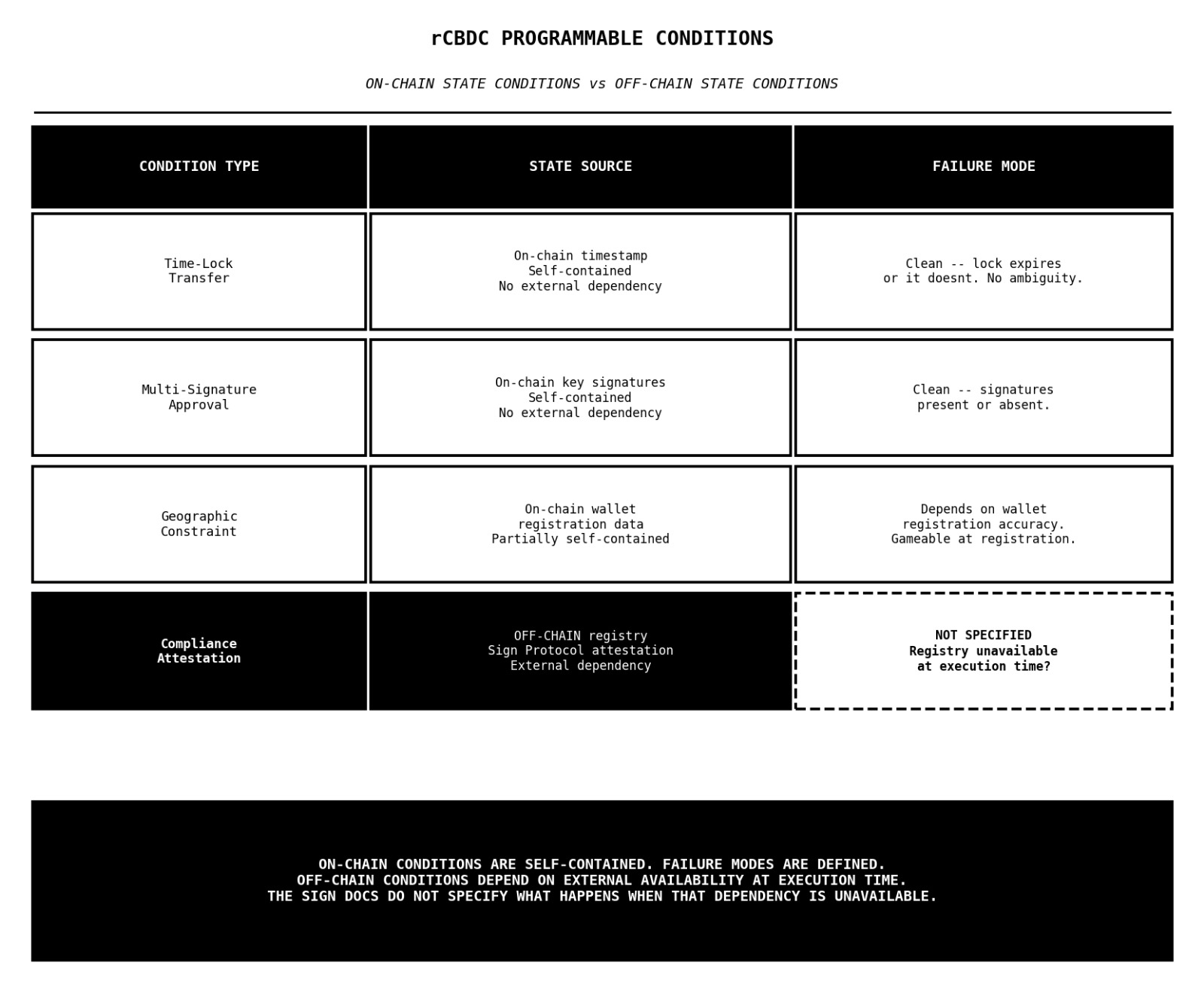
programmable conditions that reference on-chain state are clean. a time-lock is self-contained. a multi-signature requirement is self-contained. the condition and the data needed to evaluate it are both inside the system.
programmable conditions that reference off-chain state are not clean in the same way.
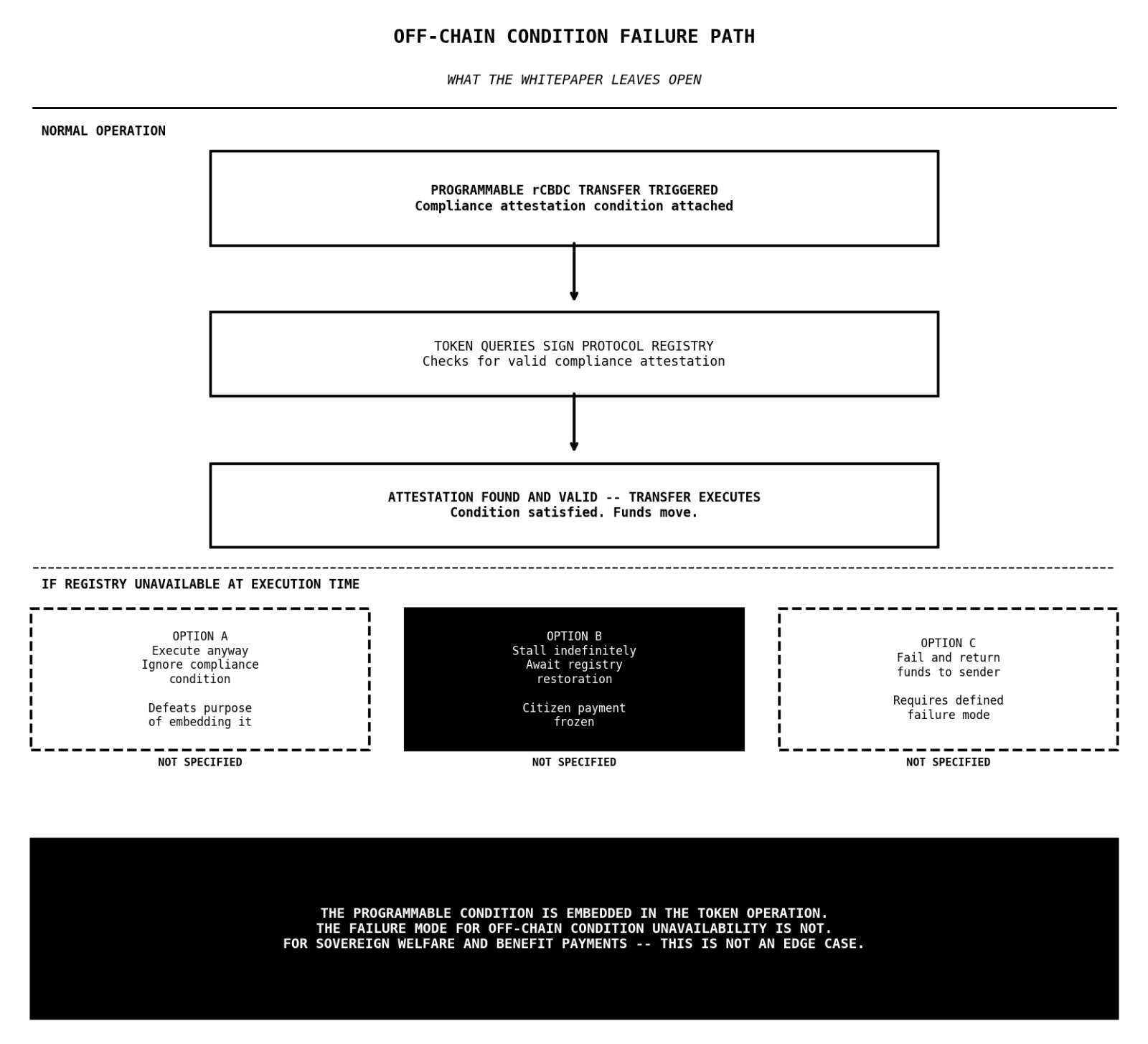
a compliance attestation condition requires the token to verify that a specific attestation exists and is valid at execution time. if that attestation lives in the Sign Protocol registry and the registry is queryable at the moment the transfer executes, the condition resolves correctly.
but if the attestation registry is unavailable at execution time, the token faces a choice the documentation does not resolve. execute anyway and ignore the compliance condition, which defeats the purpose of embedding it. stall indefinitely until the registry becomes available, which means a citizen payment is frozen by an infrastructure dependency the citizen has no visibility into or control over. fail and return the funds, which requires a defined failure mode that the programmable payment specification does not describe.
this matters differently depending on the condition type
a time-lock failure mode is obvious
a compliance attestation failure mode is not.
for sovereign infrastructure distributing welfare payments, agricultural subsidies and healthcare benefits to citizens, a programmable condition that silently stalls or fails because an external registry was briefly unavailable is not an edge case to address later. it is the failure mode that erodes trust in the entire system the first time it happens at scale.
honestly dont know if programmable money mechanics inside the token layer represent the right architecture for sovereign conditional payments or if embedding off-chain condition dependencies into irreversible token operations creates a failure surface that the design hasnt fully mapped yet?? 🤔
#SignDigitalSovereignInfra @SignOfficial $SIGN
