

I want to start with a confession. When I first got interested in $NIGHT I was thinking about it from a very Western, tech savvy, financially included perspective. I was thinking about enterprise use cases. Institutional compliance. Data protection for large organizations.
Then I started thinking about a completely different set of people. And honestly it made me feel things about this project that no technical architecture analysis ever could. 🌍
I want to talk about what Midnight's programmable data protection means for people in the developing world. Because I think this is the most important story about NIGHT that almost nobody is telling.
Let me start with something concrete. In many countries across Africa, South Asia, and parts of the Middle East, the formal financial system has essentially failed large portions of the population. Not failed in the sense of being inconvenient. Failed in the sense of actively excluding people through requirements they cannot meet, surveillance they cannot afford to risk, or systems designed for populations with different needs entirely.
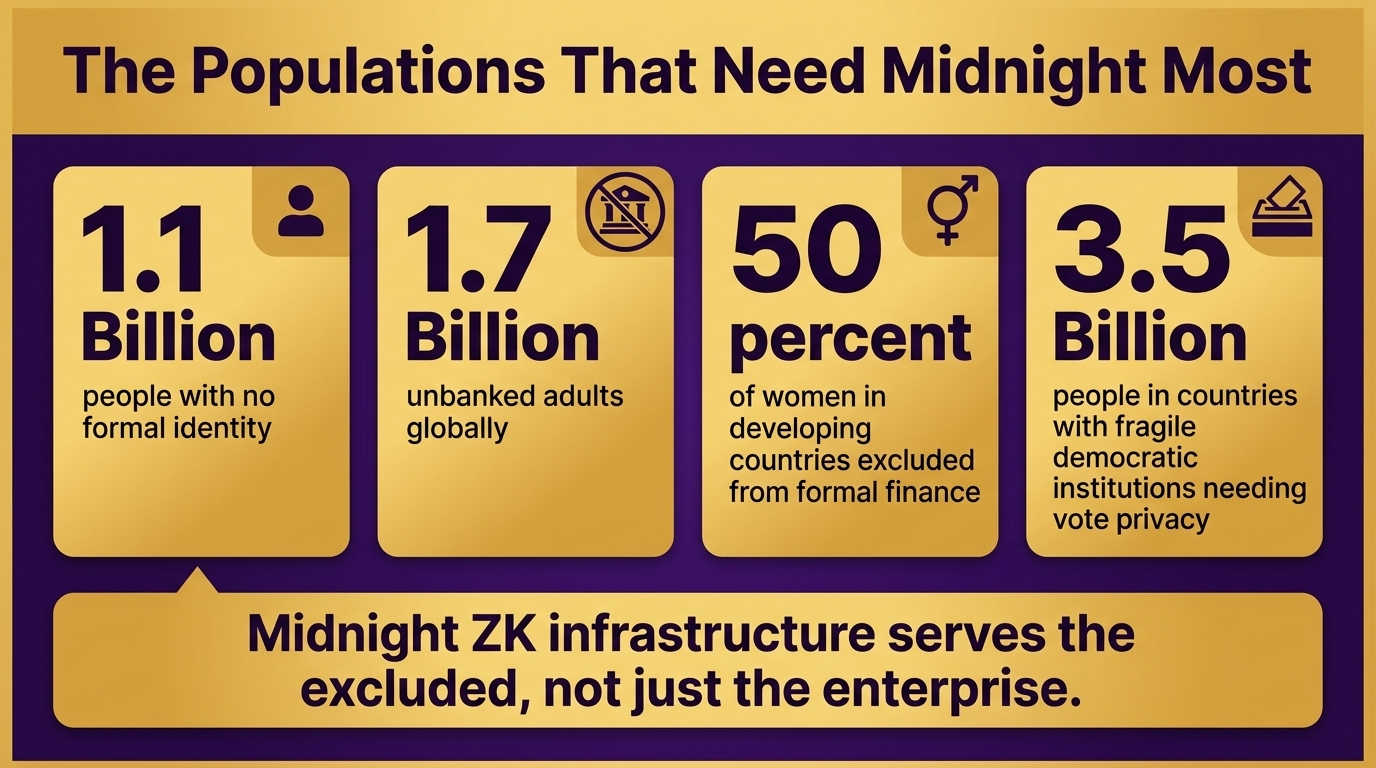
A small business owner in Lagos who runs a successful informal market business might generate the equivalent of $30,000 a year in revenue. By many definitions she is doing well. But she cannot get a business loan from a formal bank because she has no credit history in their system.
She cannot open a business bank account easily because the compliance requirements assume documentation that informal sector businesses do not have. She cannot participate in fintech apps that require government ID verification because her ID documents are from a system that fintech APIs cannot query.
She is financially excluded not because she is untrustworthy or financially unsophisticated. She is excluded because the verification infrastructure that would let financial systems trust her does not exist or does not reach her.
Now think about what Midnight's selective disclosure architecture could mean for her situation. 💛
The core problem is not that she has no financial history. She almost certainly does have financial history. She has suppliers she pays consistently. She has customers who buy from her regularly. She has mobile money transactions. She has informal credit relationships in her community. The data exists. It just cannot be verified by formal systems in a way those systems trust.
Midnight's attestation model does not require you to have a Western style credit bureau entry. It requires you to have a verifiable credential issued by someone the relying party trusts. That trusted issuer could be a community cooperative. It could be a mobile money platform that has her transaction history. It could be a microfinance institution that has worked with her for years. The credential says: this person has demonstrated financial reliability, here is the proof, verify it
cryptographically.
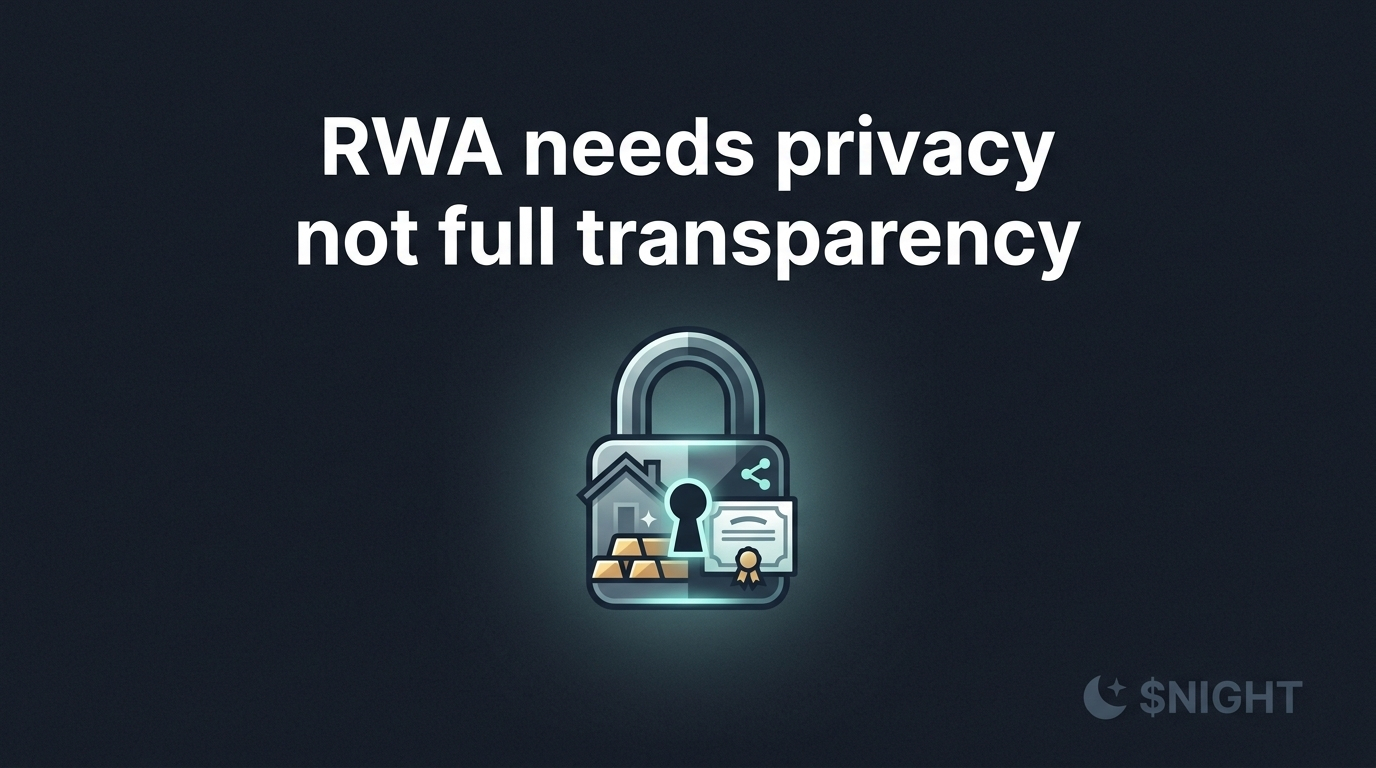
And the selective disclosure piece is critical for populations who have legitimate reasons to be cautious about who sees their financial data. In countries where being seen as financially successful can make you a target, where ethnic or religious identity can affect how you are treated by institutions, where gender can determine whether your financial activity is scrutinized differently, the ability to prove specific facts without exposing your full profile is not a luxury feature. It is a safety feature.
I keep thinking about what it would mean for a woman entrepreneur in Afghanistan or Pakistan or even parts of the Gulf to be able to access financial services through credential verification that does not expose her identity or location to anyone beyond what is strictly necessary. Where she can prove she qualifies for a microfinance loan without the loan officer needing to see everything about her. Where her financial activity is private by default and selectively disclosed by choice.
Midnight's white paper talks about eliminating the barriers preventing organizations from leveraging blockchain technology while offering programmable data protection with selective disclosure. That language is focused on organizations. But the underlying technology serves individuals just as powerfully.
I also want to talk about the voting and governance use case because I think it is profound for democracies in fragile states 🗳
Midnight's white paper specifically mentions balloting as a use case. Creating fraud resistant preference reporting systems that can prove eligibility and participation status without disclosing individual choice. In mature democracies this is nice to have. In countries where political affiliation can result in violence, where election fraud is endemic, where people are afraid to vote freely because their vote can be traced back to them, this is potentially transformational.
A voting system built on Midnight ZK proofs can verify that every vote was cast by an eligible voter without recording which candidate that voter chose. Fraud becomes mathematically much harder because you cannot manufacture votes without valid credentials. But individual voters are protected because their specific choice is never publicly associated with their identity.
I find myself getting emotional writing about this honestly. Because I know places where people have been killed for voting a certain way. Where election observers have documented systematic fraud that changed outcomes affecting millions. The idea that cryptographic infrastructure could make this harder is not a small thing.
Now I want to connect this back to the NIGHT token directly because I think the developing world adoption story is actually one of the most underappreciated demand drivers for NIGHT.
Midnight's DUST mechanic means that anyone running applications on the network needs to hold NIGHT to generate transaction fuel. If Midnight infrastructure gets adopted by financial inclusion platforms, microfinance systems, digital identity programs, or governance systems in developing countries, that adoption translates directly into NIGHT demand. Not speculative
demand. Utility demand from organizations running real programs that serve real people.
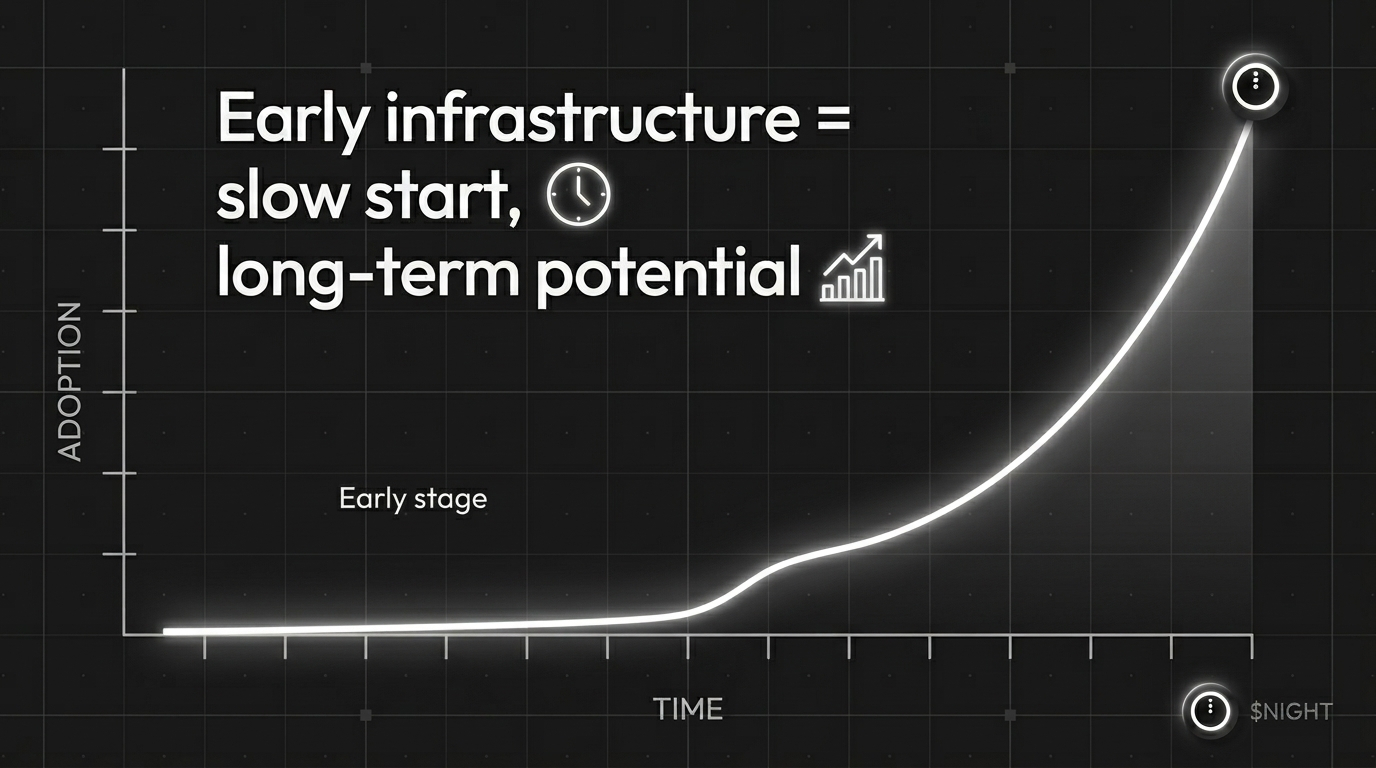
Development organizations, NGOs, and even governments in emerging markets often have access to capital for digital infrastructure that serves clear social purposes. If Midnight positions itself as the privacy preserving infrastructure layer for financial inclusion and digital governance programs, it has a donor funded, development finance backed adoption path that most blockchain projects never access.
I think about this sometimes when I see NIGHT being discussed purely in terms of DeFi narratives or trading setups. The people writing those analyses are thinking about a very small slice of what this technology could mean. The larger story is the billions of people who need data protection not as a luxury but as a basic condition for safely participating in economic and civic life.
I am long $NIGHT not just because I believe in the architecture. I am long because I believe in what the architecture could mean for people who need it most. And I think the market has barely begun to price that story.
