
I started pulling at it immediately.
Not because I was excited… but because I’ve learned to be suspicious first. That’s just how this market trains you. You see enough “next big things” turn into slow-motion collapses, and eventually your default setting shifts from curiosity to pressure-testing.
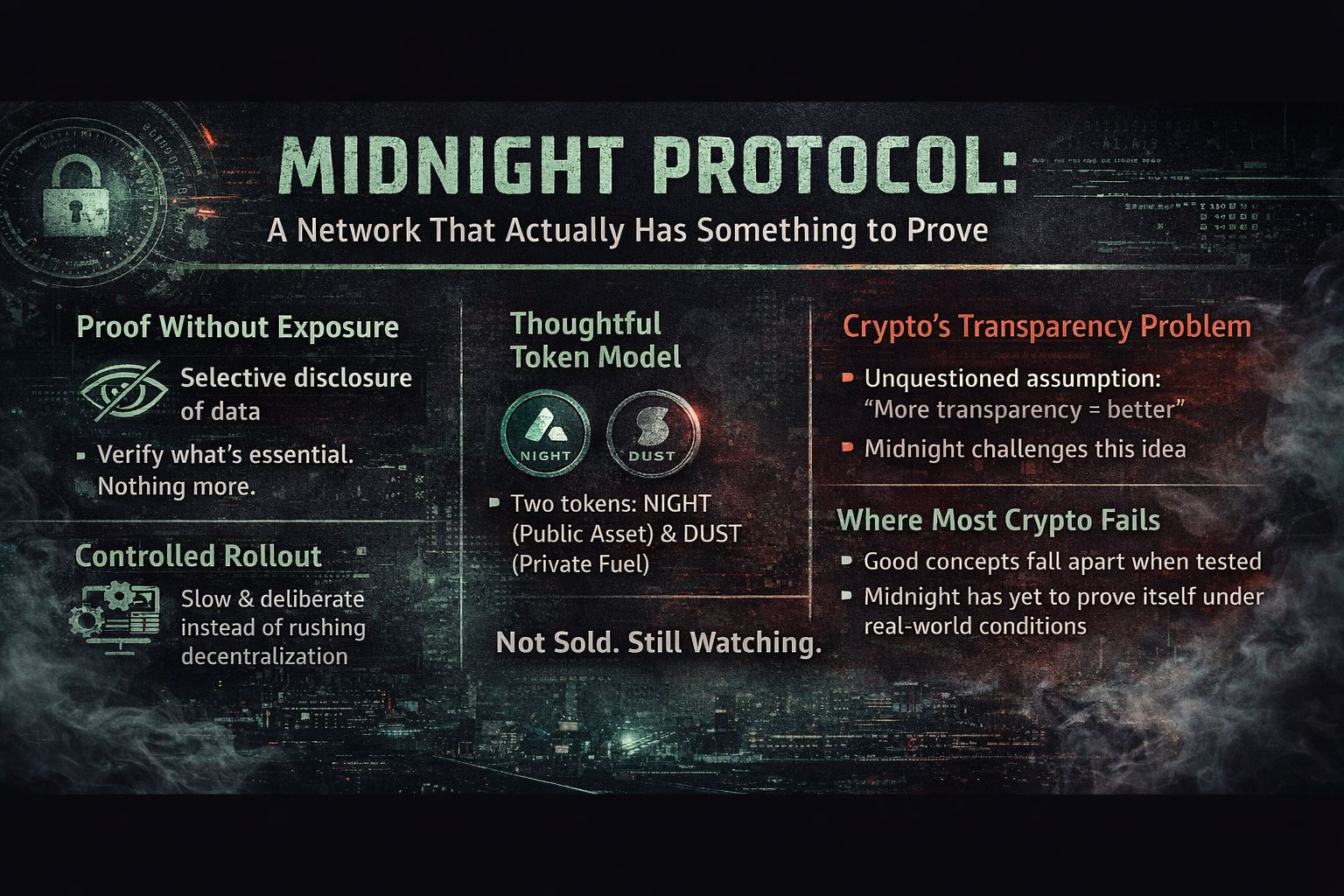
So yeah… Midnight Protocol didn’t get a free pass.
Same Story. Different Packaging… Usually.
I’ve watched this play out too many times.
A project shows up with all the right words privacy, utility, new architecture—and for a moment, it feels fresh. Then you look closer and realize it’s the same old ego trip wearing a cleaner interface. Token first. Narrative second. Real usage… somewhere down the line, maybe.
I remember tracking one project a while back massive hype, aggressive rollout, everyone talking like it was inevitable. Six months later? Liquidity dried up, developers disappeared, and the “community” turned into a ghost town the moment the chart stopped moving.
That’s the normal lifecycle.
That’s why I don’t look at Midnight Protocol and think opportunity.
I look at it and think… where does this break?
The Problem Crypto Still Pretends Isn’t a Problem
Let’s be honest about something.
Crypto didn’t solve transparency.
It overdid it.
Everything became public. Every wallet traceable. Every transaction sitting there forever like digital residue nobody can clean up. At some point, people started calling that accountability… but the longer you sit with it, the more it just looks like leakage.
I’ve had moments where I followed a wallet trail just out of curiosity… and it didn’t take long before the picture started forming. Behavior patterns. Timing. Counterparties. You don’t need names when you’ve got enough context.
That’s when it stopped feeling like transparency.
And started feeling like exposure.
Midnight Protocol Doesn’t Pretend That’s Fine
This is where Midnight Protocol separates itself… at least in intent.
It doesn’t treat full visibility like some sacred rule that can’t be questioned. It treats it like a design choice that maybe… just maybe… wasn’t the right one for everything.
That alone is enough to get my attention.
Because instead of asking how do we make everything transparent?
It asks something more grounded:
How much actually needs to be public for this system to work?
That’s a different starting point.
Less ideological. More practical.
And honestly… more aligned with how the real world operates.
Proof Without the Theater
What I see in Midnight Protocol isn’t a project trying to hide everything.
That would be easy to dismiss.
What I see is a project trying to separate proof from exposure.
And that sounds simple until you realize how rarely it happens.
Most systems still force the same tradeoff if you want to verify something, you reveal everything. Full data. Full context. No nuance. It’s clumsy, but it’s been normalized to the point where people don’t question it anymore.
Midnight Protocol does.
Selective disclosure sits at the center of it.
You prove what matters. That’s it.
The rest stays contained.
Not hidden in some dramatic, “dark web” sense… just not unnecessarily exposed.
I’ve had moments where I wished this model existed earlier situations where sharing less data would’ve been the obvious move, but the system didn’t allow for it. So you either overshare… or you don’t participate at all.
That’s a bad design.
Midnight Protocol seems to be trying to fix that.
The Token Model… Surprisingly Thoughtful
Now let’s talk about something I usually roll my eyes at.
Token structures.
Because most of the time, they’re a mess. Too many roles crammed into one asset. Governance, fees, speculation—all fighting for space until the whole thing becomes… unusable.
Midnight Protocol splits this into NIGHT and DUST.
And I’ll admit… I didn’t hate it.
NIGHT sits as the public-facing asset.
DUST operates as the private resource powering activity.
Two different roles. Two different pressures.
That separation matters more than people think.
Because I’ve seen what happens when everything gets forced into one token. Fees spike. Usage drops. Speculation distorts behavior. And suddenly the network isn’t frictionless it’s frustrating.
This setup at least tries to avoid that.
Does it solve everything?
No.
But it tells me someone actually studied how these systems fail… instead of just copying what worked temporarily for someone else.
Where This Could Still Go Wrong
Let’s not get carried away.
Design is one thing. Reality is another.
I’ve seen beautifully structured systems collapse the second real users showed up. Not because the idea was bad… but because the handling was off. Too complex. Too slow. Too many assumptions about how people behave.
That’s the risk here too.
Because privacy systems especially ones built like Midnight Protocol—have a tendency to introduce friction in subtle ways.
Extra steps. Extra logic. Extra mental load.
And users? They don’t care about architecture.
They care about whether something feels smooth… or like paperwork.
If Midnight Protocol feels like paperwork… it’s over.
Simple as that.
The Controlled Approach (And Why It Matters More Than People Admit)
Here’s something I actually respect.
Midnight Protocol isn’t pretending to be fully formed from day one.
It’s rolling out in a more controlled way.
Slower. More deliberate. Less theatrical.
That’s rare.
Because most projects rush to decentralize on paper… while quietly holding everything together behind the scenes. It’s a performance. And everyone knows it.
I’ve seen that ego trip play out too many times.
Midnight Protocol seems more honest about the fact that building something like this takes structure… and structure comes with tradeoffs.
That doesn’t make it perfect.
But it makes it more believable.
Why It Still Holds My Attention
There’s something about Midnight Protocol that feels… internally consistent.
And that’s not something I say lightly.
A lot of projects fall apart because the pieces never aligned in the first place. The branding says one thing. The token says another. The product doesn’t say anything at all.
Here… the story matches the design.
Privacy thesis → architecture → token model → rollout strategy.
It all lines up.
That doesn’t guarantee success.
But it reduces the number of ways this can fail.
And in crypto… that matters.
The Only Part That Actually Counts
None of this matters if it doesn’t hold under pressure.
That’s the part people like to skip.
I don’t care how clean the narrative is. I don’t care how sharp the documentation looks. I’m waiting for the moment when Midnight Protocol gets stress-tested by reality.
Developers building on it.
Users interacting with it.
Markets losing interest and moving on to something louder.
That’s when the truth shows up.
I’ve had moments where I thought a project had it figured out… only to watch it unravel when things stopped being theoretical and started becoming operational.
That’s the phase Midnight Protocol is heading into now.
The uncomfortable one.
Still Watching. Not Sold.
I’ll give it this.
Midnight Protocol doesn’t feel like recycled noise.
It feels like someone actually took a hard look at what’s broken and tried to design around it instead of pretending it wasn’t there.
That’s rare.
But I’ve been around long enough to know that good ideas don’t survive on intent alone.
Execution matters. Handling matters. Adoption matters.
And most importantly… resilience under pressure matters.
So I’m watching.
Not hyped. Not dismissive.
Just… watching.
Because sooner or later, the system hits that moment where clean ideas stop protecting it… and all that’s left is what actually works.
And when that moment hits Midnight Protocol…
what’s still standing?