
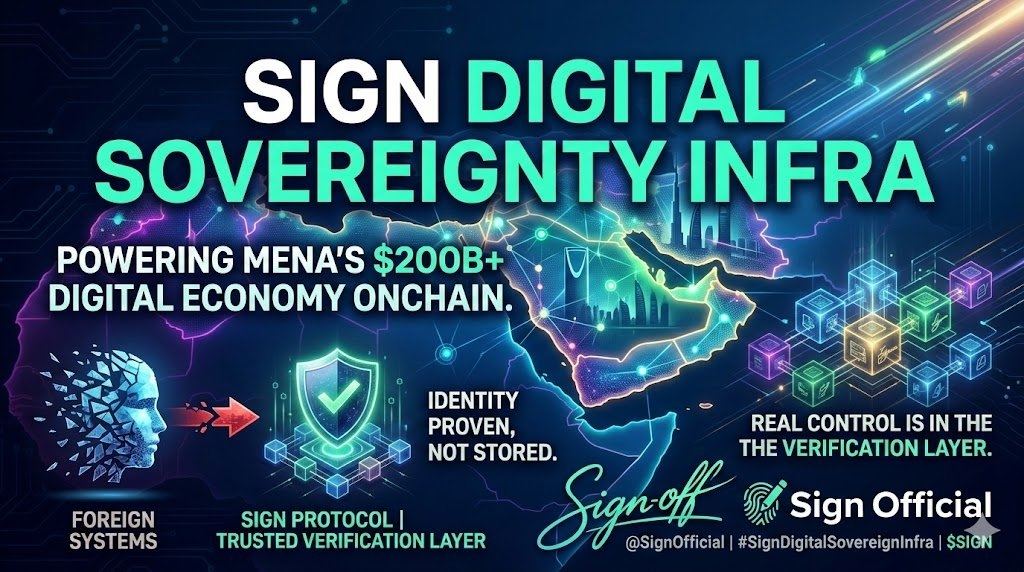
In a world increasingly defined by fragmented geopolitics and reconfigured capital flows, the architecture of trust is being rewritten. The old model—centralized platforms, jurisdiction-bound systems, and opaque intermediaries—is showing strain under the weight of competing sovereignties. Capital is not merely moving; it is recalibrating its expectations. It seeks systems that are resilient, programmable, and—above all—sovereign.
Against this backdrop, the emerging partnership between regional actors in the Middle East and Sign’s digital infrastructure signals more than a technical deployment. It reflects a deeper shift: from dependency on globalized digital rails toward the construction of sovereign, interoperable systems of value. If the 20th century was about controlling territory, the 21st may well be about controlling the protocols that govern identity, capital, and coordination.
At the center of this transformation lies a deceptively simple question: who owns the infrastructure of trust?
The End of Neutral Infrastructure
For decades, digital infrastructure was framed as neutral. Cloud providers, payment networks, and identity systems presented themselves as invisible scaffolding—tools rather than actors. But neutrality has proven to be conditional. Access can be restricted. Data can be surveilled. Transactions can be halted. The infrastructure itself has become a geopolitical instrument.
This realization has accelerated a global pivot toward what might be called digital sovereignty: the capacity for states, institutions, and even individuals to control their own data, capital flows, and identity systems without reliance on external authorities.
The Middle East, with its unique convergence of capital abundance, strategic ambition, and historical sensitivity to external dependency, is particularly attuned to this shift. Sovereign wealth funds are not just investing in assets; they are investing in infrastructure—digital railways that can underpin future economies.
Sign emerges within this context not merely as a protocol, but as a proposition: that trust can be modularized, verified, and distributed without surrendering sovereignty.
The Architecture of Sign
At its core, Sign is building a credential and verification layer designed to operate across a mesh of chains. Rather than competing with existing blockchains, it federates them—creating a system where identity, credentials, and attestations can move fluidly across ecosystems.
This is not a trivial innovation. In traditional systems, identity is siloed. Credentials are issued by centralized authorities and verified through opaque processes. In decentralized systems, identity often becomes fragmented, pseudonymous, and difficult to reconcile with real-world requirements.
Sign attempts to bridge this divide. It introduces a framework where credentials can be cryptographically issued, independently verified, and selectively disclosed. In doing so, it transforms identity into a programmable asset—one that can be composed, transferred, and validated without exposing unnecessary information.
The implications are far-reaching. Financial institutions can verify counterparties without relying on centralized databases. Governments can issue digital credentials that remain under their control. Individuals can carry their reputational capital across platforms without surrendering privacy.
In essence, Sign is constructing a trust layer—a foundational protocol upon which other systems can be built.
Capital Flight and the Search for Trust
The phrase “capital is fleeing” is often interpreted narrowly, as a reaction to economic instability. But in the current moment, capital flight is as much about infrastructure as it is about policy. Investors are increasingly sensitive to the underlying systems that govern their assets.
Where is data stored? Who controls access? What happens under geopolitical stress?
These questions are no longer abstract. They are central to allocation decisions.
The Middle East’s engagement with Sign can be understood as a response to these concerns. By investing in sovereign digital infrastructure, the region is not merely attracting capital—it is redefining the conditions under which capital operates.
In this model, trust is not outsourced. It is embedded.
This shift mirrors a broader transition from trust in institutions to trust in systems. Where once credibility was derived from reputation and authority, it is now increasingly derived from transparency and verifiability. Code, in this sense, becomes a new form of law—not replacing traditional frameworks, but augmenting them with enforceable logic.
A Federated Future
One of the most compelling aspects of Sign’s approach is its emphasis on federation rather than centralization. Instead of constructing a monolithic platform, it enables a network of interoperable systems—a mesh of chains, credentials, and verification layers that can operate independently yet cohesively.
This architecture aligns closely with the geopolitical realities of the Middle East. The region is not a monolith; it is a constellation of states with distinct priorities and governance models. A federated system allows for coordination without homogenization.
In practical terms, this means that different jurisdictions can maintain control over their own data and policies while still participating in a shared infrastructure. Credentials issued in one country can be verified in another. Financial systems can interoperate without requiring full integration.
This is the digital equivalent of a trade network—flexible, resilient, and adaptable.
Yet federation introduces its own complexities. Interoperability is not merely a technical challenge; it is a governance challenge. Standards must be agreed upon. Disputes must be resolved. Incentives must be aligned.
Sign’s success will depend not only on its technology, but on its ability to navigate these dynamics.
The Skeptical View
While the promise of sovereign digital infrastructure is compelling, it is not without risks.
First, there is the question of adoption. Infrastructure is only as valuable as the systems built upon it. Convincing institutions to transition from entrenched legacy systems to a new paradigm requires not just technical superiority, but cultural and organizational change.
Second, there is the risk of fragmentation. While federation aims to enable interoperability, it can also lead to a proliferation of incompatible standards if not carefully managed. The very sovereignty that empowers participants can also hinder coordination.
Third, there is the tension between privacy and control. Systems that enable selective disclosure and cryptographic verification offer powerful tools for protecting user data. But they can also be used to enforce new forms of surveillance if governance frameworks are not robust.
Finally, there is the broader question of whether blockchain-based systems can truly deliver on their promises at scale. Issues of performance, security, and usability remain significant challenges.
In this sense, Sign represents not a finished solution, but an evolving experiment—one that must prove itself in real-world conditions.
The Middle East as a Laboratory
What makes the Middle East particularly significant in this narrative is its willingness to experiment. Unlike more mature economies, where legacy systems create inertia, the region has the flexibility to adopt new technologies more rapidly.
This has been evident in areas such as fintech, digital identity, and smart city initiatives. Governments are not merely regulators; they are active participants in the construction of digital infrastructure.
By engaging with Sign, the region positions itself as a laboratory for the next generation of trust systems. Success here could serve as a blueprint for other parts of the world—a demonstration that sovereign, interoperable infrastructure is not just theoretical, but practical.
At the same time, the stakes are high. Failure would not only undermine confidence in specific projects, but in the broader vision of decentralized infrastructure.
Beyond Infrastructure: The Philosophy of Trust
Ultimately, the significance of Sign’s trajectory lies not just in its technology, but in its philosophy.
Trust has always been a social construct, mediated by institutions, norms, and relationships. Technology does not eliminate this reality; it reshapes it. By embedding trust into code, systems like Sign attempt to reduce reliance on intermediaries and increase transparency.
But code itself is not neutral. It reflects the assumptions, values, and incentives of its creators. The question, then, is not whether we can build trustless systems, but what kind of trust we are encoding.
In a federated model, trust becomes pluralistic. Different actors can define their own parameters, yet still participate in a shared network. This mirrors the complexity of human societies, where trust is not uniform, but contextual.
The challenge is to ensure that this plurality does not devolve into fragmentation—that the mesh holds, even as its nodes remain sovereign.
A Blueprint for the Internet of Value
If the internet transformed the flow of information, the next frontier is the flow of value. This requires more than faster transactions or lower fees. It requires a rethinking of the underlying infrastructure—how identity is verified, how credentials are issued, how trust is established.
Sign offers a glimpse of what this future might look like: a blueprint for an internet of value where sovereignty and interoperability coexist.
In this vision, individuals are not just users, but participants. Institutions are not just gatekeepers, but nodes in a network. Trust is not assumed, but verified.
Yet blueprints are not buildings. The transition from concept to reality is fraught with challenges, both technical and social.
@SignOfficial $SIGN #SignDigitalSovereignInfra