
Verification in Web3 today operates on the principle of "stripping down": to prove one fact, you must reveal the entire history of your wallet. Every time a dApp asks me to confirm my status, I feel discomfort. It's like showing a bank statement to buy coffee — I am forced to disclose all my expenses for five years. In the real world, we tolerate this due to a lack of alternatives, but in blockchain, we have elevated this excessive openness to the rank of a main virtue, ignoring the consequences.
This illusion of “transparency as security” is the main barrier to mass adoption. We have built a system where the right to trust is purchased at the price of complete abandonment of financial secrecy.
I first thought about this when one dApp asked to confirm a balance. And at that moment, it became strange: to prove one fact, I am exposing my entire history. It is here that the design of the Sign Protocol looks like an attempt to find a way out of this panopticon through Schema Registry. Instead of allowing each protocol to “dig” into your transactions, the system allows providing only the final result of the verification — the attestation. Thanks to Hybrid Storage (on-chain verification + Arweave), Sign creates proofs that are immutable but do not require public disclosure of every step you take.
But alongside this, another problem emerges: reputation is no longer tied to a single chain. Your reputation can be transferred between networks, not forcing you to start from scratch every time. And this is where trust begins to create vulnerability.
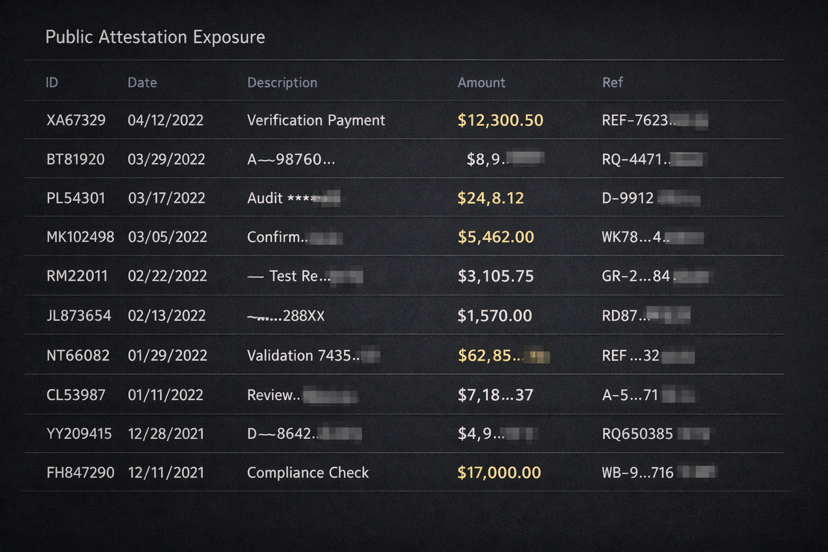
But here we face a hard trade-off. Fully private attestations are difficult to implement, so most developers take the path of least resistance — they simply scan the public blockchain. We face the risk of Data Overexposure. Every attestation created in the public field becomes part of the puzzle for a professional fraudster.
If your status as a “major investor” or owner of a specific asset is recorded through Sign, you automatically become a priority target for attacks. The more confirmations of “reliability” you have, the more transparent and vulnerable you become to those who can analyze connections in the network.
I am more concerned about another scenario — the gradual transformation of Web3 into an environment where transparency becomes a requirement rather than a choice. If the industry does not make privacy the default standard, we will end up with a divided market. On one side, there will be “transparent” users whose lives are completely open to algorithms in exchange for bonuses, and on the other — anonymous outcasts, whom no protocol trusts.
If trust requires too much data — it is no longer security, but vulnerability. And here arises the paradox: decentralization promises freedom, but transparency creates vulnerability, where a person should own their data, not be its defenseless carrier.
The idea is to create a more secure system, but we risk ending up with an environment where complete transparency becomes the default standard. The key question for the Sign Protocol is not how much data it helps to make public, but how much personal information it allows us to keep to ourselves.
The question arises whether we are building a tool for financial freedom or just certifying our own signature on a voluntary search order.
#SignDigitalSovereignInfra $SIGN @SignOfficial
