
A few weeks ago I was watching someone argue with a bank over a fairly simple issue. Not a huge transaction, nothing suspicious on the surface. But it stalled anyway. The delay wasn’t about moving money. It was about proving what the money represented. That part dragged on. Emails, documents, back and forth. It felt oddly familiar.
That’s usually the part people ignore when they talk about global finance. Movement gets all the attention. Trust sits underneath, slow and awkward, mostly invisible until something breaks.
When I look at $SIGN, I don’t really see a retail product first. I tried to, at the beginning. You check the chart, maybe glance at exchange listings, see how the market is treating it. But it doesn’t quite line up. The more you dig into what Sign is actually doing, the less it feels like something built for that layer.
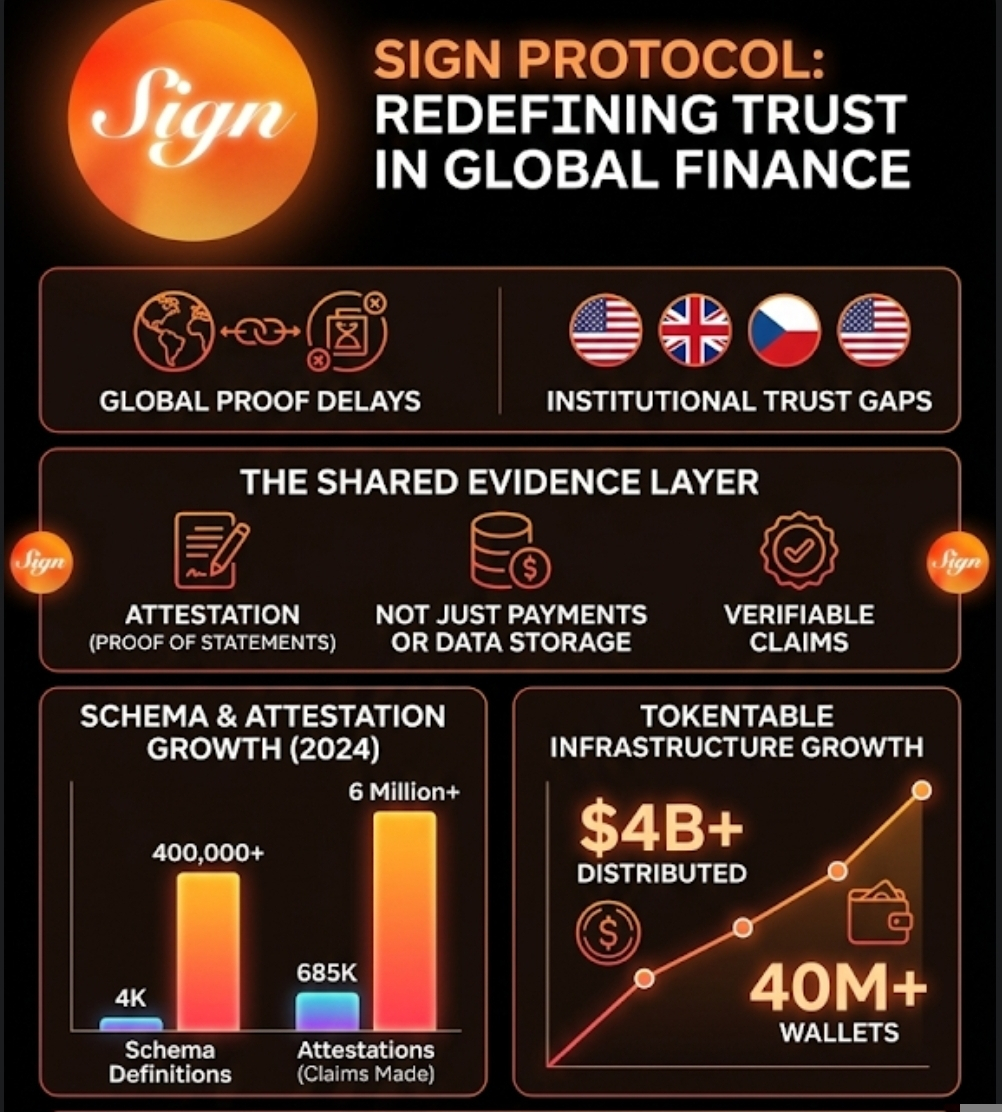
Sign Protocol is basically an attestation system. That sounds abstract, but it’s simple in practice. It creates records that others can verify without needing to trust the source directly. Not data storage, not payments. More like… proof that a statement was made and can be checked later. Who said what, and whether it holds up.
That becomes more interesting when you stop thinking about individuals and start thinking about institutions that don’t fully trust each other. Especially across borders. The Middle East is a good example because there’s a mix of fast-moving digital adoption and very different regulatory environments sitting next to each other. Coordination happens, but it’s rarely seamless.
A shared evidence layer starts to make sense there. Not as a replacement for existing systems, but as something that sits between them. Instead of sending documents back and forth and asking, “can you confirm this is real,” the idea is that the proof is already structured in a way that both sides can check. Less interpretation. Or at least less repeated verification.
Some of the numbers around Sign look strong on the surface. Schema adoption reportedly went from about 4,000 to 400,000 in 2024. That basically means developers are defining more types of verifiable claims inside the system. At the same time, attestations grew from around 685,000 to over 6 million. These are actual recorded claims, not just templates. And TokenTable has distributed more than $4 billion to over 40 million wallets, which suggests the infrastructure isn’t just theoretical.
But I’m always a bit cautious with these kinds of metrics. They tell you activity is happening, sure. They don’t always tell you how deep that activity goes. There’s a difference between people trying a system and depending on it. Crypto has a long history of confusing the two.
What’s slightly uncomfortable here is how disconnected this kind of product is from how the market usually prices things. On Binance Square, for example, visibility comes from engagement. Posts that are easy to understand, quick to react to price, or tied to narratives tend to perform better. There’s a feedback loop. Creators adapt, content shifts, and suddenly certain types of projects look more important than others.
Sign doesn’t fit neatly into that loop. It’s not obvious. It doesn’t produce daily signals you can track. Even if the underlying system is growing, it doesn’t translate cleanly into something you can post about every day. That creates this strange gap where the infrastructure might be moving forward quietly, while attention moves somewhere else entirely.
I’ve started to think that if Sign works, it probably won’t look like success in the way most crypto users expect. It won’t feel like a retail-driven rally or a sudden narrative shift. It would look more like institutions slowly relying on it without making a big deal out of it. Governments, compliance systems, cross-border workflows. Things that don’t trend.
And that’s where the token question gets tricky. Does $SIGN become essential in that process, or does it stay on the edge of it? Because institutions don’t always like depending on publicly traded assets for critical infrastructure. They might use the system but avoid the token, or abstract it away entirely.
There’s also the time factor. Systems like this don’t scale quickly. Integration alone can take years. And during that time, the market keeps moving. New narratives, new tokens, new attention cycles. It’s very possible for something like Sign to be early in the right direction but still struggle to hold market interest.
I keep circling back to that original frustration with proving simple things across borders. It hasn’t really gone away, even with all the new technology layered on top. If anything, it’s just been hidden better.
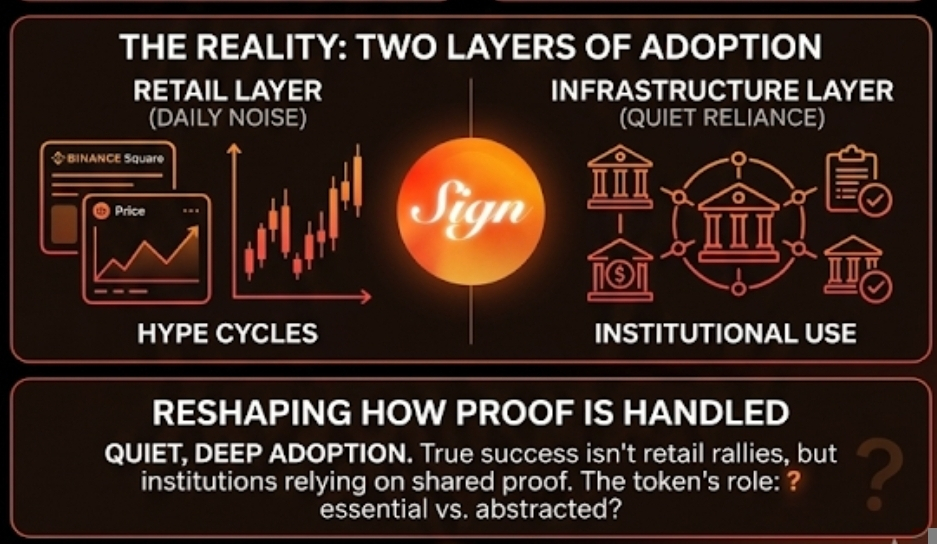
Maybe that’s the angle here. Not replacing financial systems, not competing for retail users, but quietly reshaping how proof itself is handled between institutions that don’t fully trust each other.
If that actually happens, it probably won’t be obvious at first. It rarely is.