
Imagine this: a fake identity silently sneaks in, and in the blink of an eye, millions of dollars evaporate from the DeFi protocol. This is not a movie plot, but rather an all-too-common "Tuesday" in Web3.
We are always taught that blockchain makes everything "valid." But the harsh truth is: valid does not equal meaningful. A signature may technically pass, but it doesn't tell you who is really behind it. Valid ≠ Meaningful—this is the true hidden breaking point of the entire system.
What about the results? The entire ecosystem is shrouded in mist. Is this user really a real person? Are those credentials real or fake? When is a token airdrop considered fair? Developers spend a lot of time on endless KYC, while ordinary users lose sleep, fearing that the next scam will target them, and institutions simply throw up their hands: "Sorry, we still can't fully trust this world."
Many people still cling to that old fantasy: "Blockchain is enough on its own" or "Just find a big centralized player to help us verify." Neither of these paths will work. Blockchain excels at recording data but cannot turn that data into truly trustworthy proof; as for centralized solutions? They simply import Web2's old problems into our decentralized dreams unchanged.
This is the key to SIGN's emergence. It fills the most fundamental gap in Web3—we need a truly decentralized, fully available evidence layer: any declaration (identity, education, asset ownership...) can be easily created, verified, and stored here, and in a way that is clear and indisputable. SIGN is not just another tool; it is the sovereign verification infrastructure that Web3 has been missing.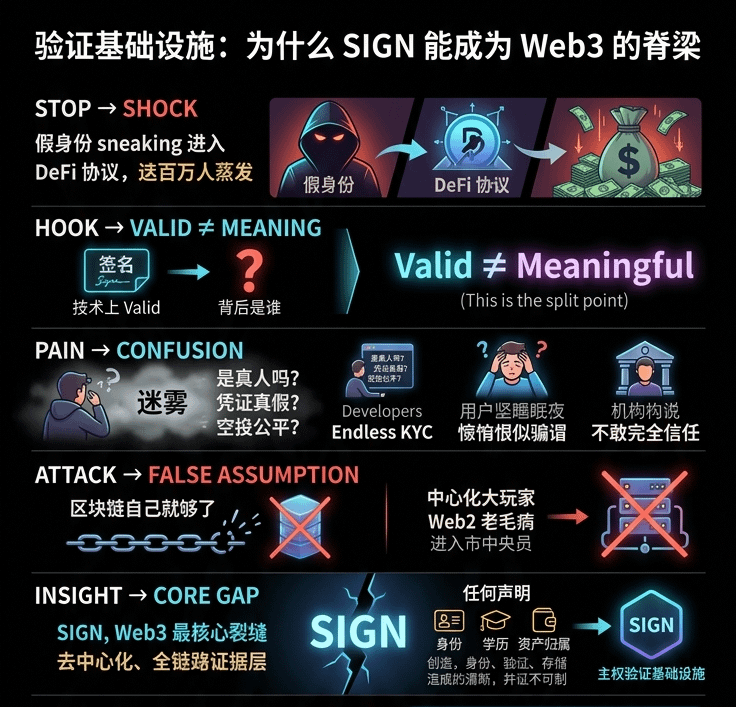
The best part is its extreme simplicity: SIGN has only two states—Attested or Not Attested. Regardless of whether you are on Ethereum, Solana, TON, or any other chain, the result is always the same: a cryptographic trust that you can truly rely on.
"SIGN not only verifies data, it verifies the soul of Web3—trust without intermediaries."
But the dangerous cycle has already begun: the larger Web3 gets, the more users there are, the more declarations there are, and everything is stacking up crazily. Without a solid verification infrastructure, this cycle will only continue to reinforce itself—more scams, slower adoption, and everyone sliding back to the old path of 'Bro, trust me'.
Now picture this: like building with Lego, you stack real proofs piece by piece—passports verified, degrees verified, token allocation proofs verified. With SIGN's schema registry, full chain support, and flexible storage options (on-chain, Arweave, or hybrid), everything naturally fits together. A clean chain of evidence, infinite confidence.
When I first opened the SIGN document, I felt a 'click' in my heart. It turned out to be not just another protocol, but the missing piece of the puzzle I had been searching for. In an instant, the entire picture of Web3 became clear—this is the backbone we have been eagerly waiting for.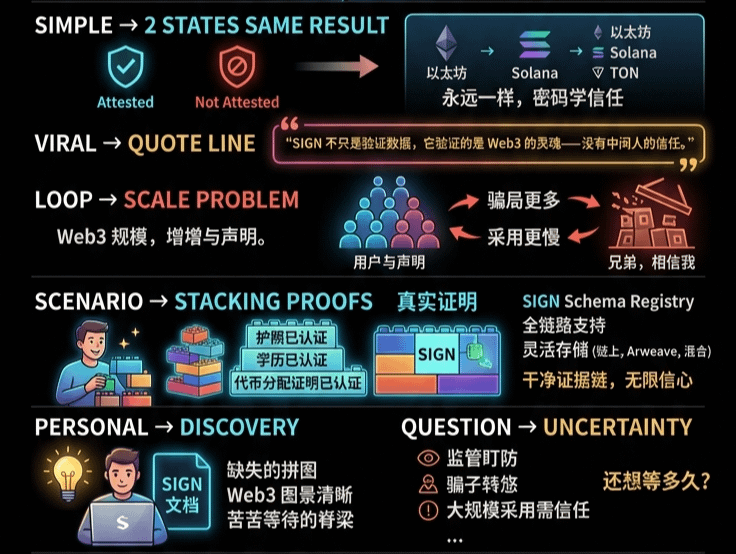
So the question is actually very simple: regulators are watching, scammers are lurking, and true mass adoption requires real trust. How much longer do you want to wait?
Ignoring SIGN means Web3 will forever remain in the Wild West—fragmented, untrustworthy, and ultimately destined to stagnate. Verification infrastructure is no longer optional; it is the survival baseline. Those who treat SIGN as the backbone today will lead the wave of the next decade. The rest? They can only stand on the shore, watching others go far away, and silently regret what they missed.
The time has come. Trust is no longer just the three words 'trust me', but a genuine verify. SIGN is ready.
What about you?