Have you ever seen a project founder personally intervene to stop a DAO vote?
On the night of March 15th, the Cardano ecosystem group exploded. Charles Hoskinson directly demanded during a live stream that the Liqwid protocol people "avoid voting," his attitude was much tougher than the usually smiling mathematician. The cause was a distribution issue with 18 million NIGHT tokens worth $1 million—these tokens were originally for participants in the Glacier Drop event, but ended up caught in the tug-of-war of DAO governance, where stakeholders voted for themselves; this action would be called undisclosed related-party transactions in traditional finance.
At that moment, I stared at the screen and wondered if this person was overstepping their bounds.
Later, after finishing m-9's white paper, I realized he wasn't protecting his own; he was upholding the rules. Midnight fundamentally emphasizes 'selective disclosure'—you can prove you are qualified but do not need to reveal your entire assets. This rational privacy design philosophy, in turn, demands extremely high standards for governance: if even basic trust like token distribution can be manipulated by stakeholders, why should people trust smart contracts built on zero-knowledge proofs? Charles's involvement essentially maintains this trust mechanism from being undermined by insiders.
When it comes to NIGHT, many people think it is just an ordinary governance token, but it is not.
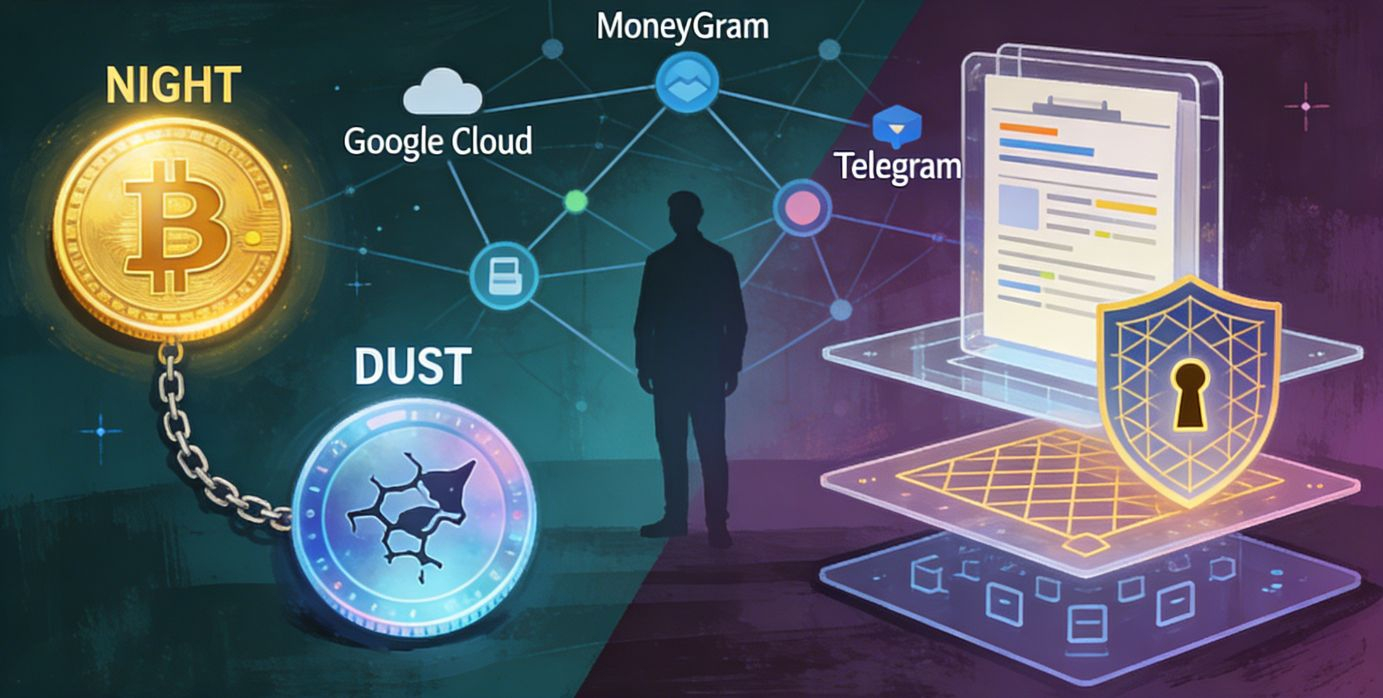
Midnight played hardball: a dual-token model, where NIGHT is a public, tradable, and capital asset that can generate offspring, while DUST is the privacy fuel doing the dirty work. DUST cannot be transferred, will decay, and can only be generated by holding NIGHT, which eliminates the ghost stories of people hoarding gas fees for speculation. Just think about Ethereum—when the price of ETH rises, small retail investors can't even afford to transfer, but Midnight separates these two roles, clarifying the distinction between 'means of production' and 'consumer goods'—holding c-26 is like holding mining machines, continuously producing DUST for you to use, but you can't resell DUST to the neighbor Old Wang.
The brilliance of this design lies in its combination of privacy protection and commercial compliance.
Why were traditional privacy coins delisted by exchanges? Because they couldn't do KYC, and regulators couldn't understand what you were doing. Midnight's dual ledger logic is: the on-chain public ledger can be audited and compliant, while the off-chain private ledger uses ZK proofs to protect details. You can prove to institutions that you have money without needing to throw out balance screenshots; you can prove that you are over 18 without needing to pull out a photo of your ID. MoneyGram announced at the end of February that it would join the Midnight mainnet nodes, and Google Cloud and Telegram are also on the list of first operators. These traditional giants are not fools—they are precisely interested in how Midnight can make privacy 'controllable' instead of a black box.
Back to Charles's live stream. After he exploded, the voting for Liqwid was halted and restarted, and the distribution of NIGHT returned to a transparent process.
This matter has a significant impact on me. The crypto world is not short of technically impressive projects; what it lacks is someone willing to hit the brakes in the face of interests. Midnight's mainnet just launched at the end of March and is still in the federated node phase, setting checkpoints daily and opening applications in batches. This 'slow launch' attitude is actually rare in a restless market. The technology selection chose Kachina dedicated circuits instead of general ZK, cutting the verification time in half by switching the proof system from Pluto-Eris to BLS12-381. Every step is about making trade-offs, not just painting a big picture.
Some people asked me if NIGHT can be bought, and I couldn't clarify how the price would move. But I can be sure of one thing: in a community where the founder can be pushed to live stream and slam the table in anger, governance is genuinely being done, not just a trick written in a white paper. How the final distribution of these 18 million tokens will be decided is still uncertain, but I remember clearly what Charles said—he told the internal staff to 'avoid' the issue, stating that the original DAO vote could no longer be considered due to potential conflicts of interest.
This seriousness is worth more than any roadmap. t-32