


I keep noticing something about verification that doesn’t feel right.
It often asks for more than it actually needs.
You try to prove something simple and suddenly you’re sharing everything behind it.
You want to show eligibility.
You end up exposing full activity.
You want to confirm identity.
You upload documents that have nothing to do with the actual check.
At some point it stops feeling like verification
and starts feeling like overexposure.
For a while this seemed normal.
If a system needs to verify something it needs the data. That’s how it’s always worked. The more important the claim the more information you’re expected to give.
But that logic doesn’t hold up very well as systems scale.
Because the issue isn’t verification.
It’s what gets exposed in the process.
Every time data is shared it doesn’t just disappear after the check. It gets stored somewhere processed somewhere sometimes copied across systems. Over time the same information ends up existing in too many places.
And that’s where things start to feel off.
Not immediately.
But gradually.
Users get more cautious.
Platforms start limiting what they collect.
Regulators step in.
Not because verification is wrong.
But because the way it’s done creates risk.
So you end up with this quiet tension.
Systems need verification to function.
Users don’t want to give up more data than necessary.
And if that gap isn’t solved things slow down.
What’s interesting is that the assumption behind all this isn’t actually true.
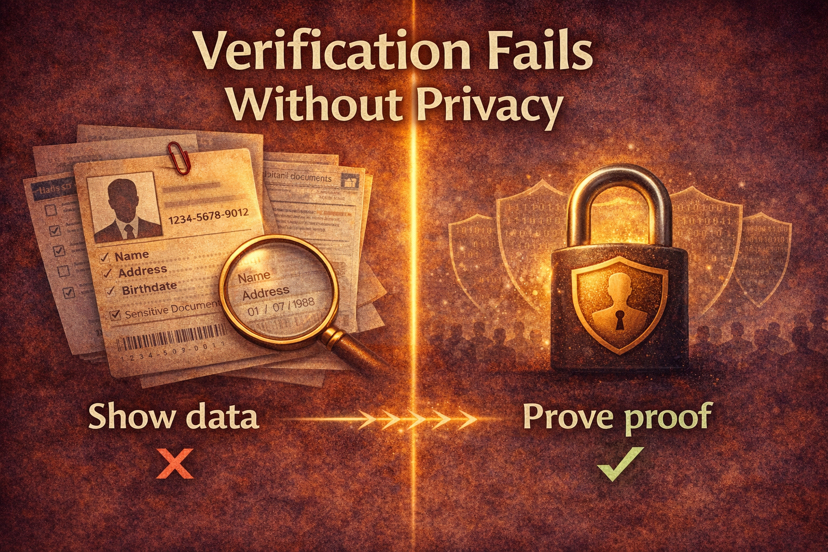
Verification doesn’t require full data exposure.
It requires proof.
And those are not the same thing.
To prove something you don’t always need to show everything behind it. You just need to show that a condition is met.
That’s a smaller requirement than most systems assume.
Instead of asking for full identity you could just prove a specific attribute.
Instead of exposing entire records you could confirm a single condition.
That shift sounds small but it changes how the system behaves.
It moves from
show me everything
to
prove what matters
And once you see it that way a lot of current systems start to feel inefficient.
There are already ways to do this differently.
Selective disclosure lets you reveal only part of a claim instead of the whole thing.
And in some cases you don’t even need to reveal anything at all.
With zero knowledge proofs you can prove something is true without exposing the underlying data.
The system gets the answer.
But not the details.
That’s a very different interaction.
Verification still happens.
But exposure is reduced to almost nothing.
And that changes the experience.
It feels lighter.
Safer.
You’re not handing over everything just to pass a check.
You’re only proving what’s needed.
This matters more than it seems.
Because verification is moving into areas where data is sensitive by default identity, finance access systems.
These aren’t places where over sharing works long term.
If every verification requires full disclosure, users will push back. Systems will become harder to use. Risk will keep increasing.
But if verification can happen without unnecessary exposure things start to align.
Users don’t feel like they’re giving something up every time.
Systems don’t need to store more than they should.
Verification becomes something that fits naturally into the process instead of interrupting it.
And that’s the difference.
Not whether something can be verified.
But how much needs to be revealed to verify it.
Because in the end good systems don’t ask for everything.
They ask for just enough.