

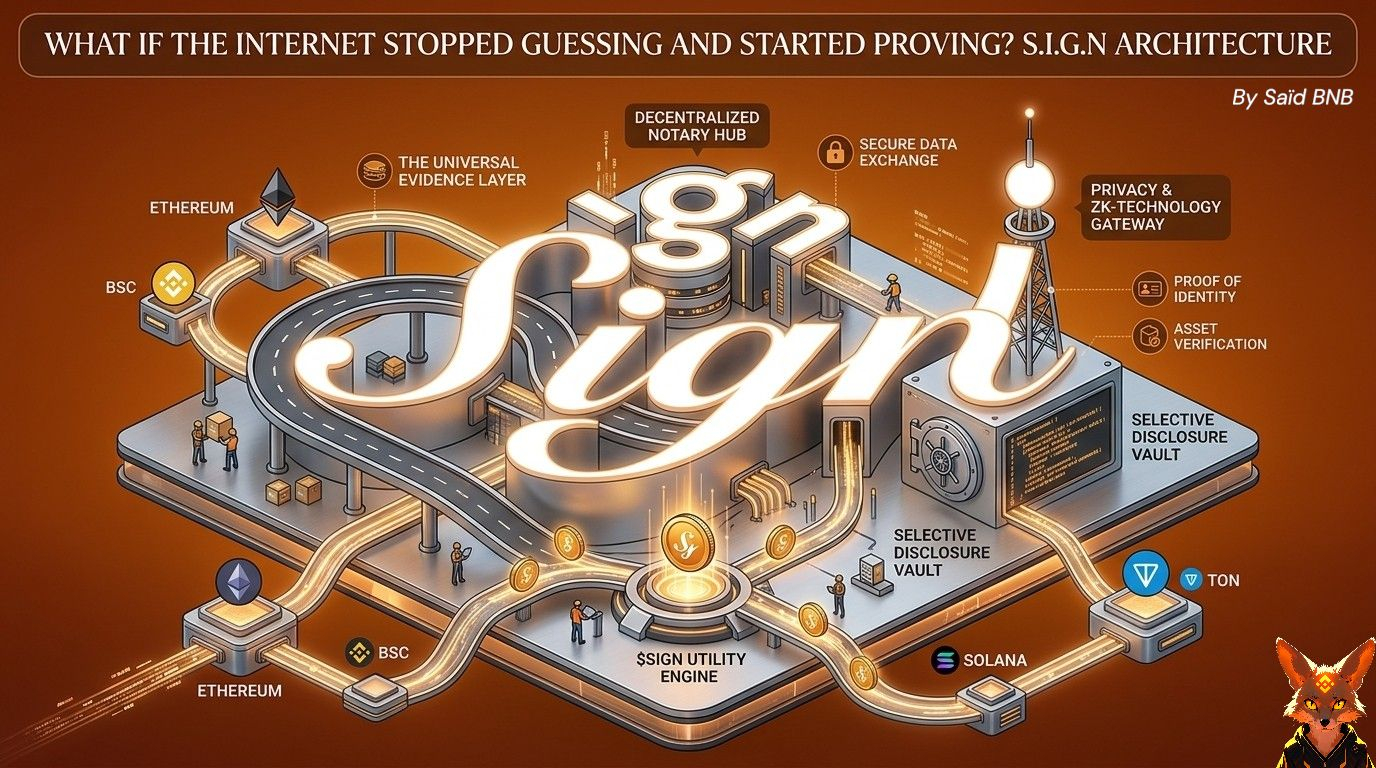
Let’s sit down and look at the biggest invisible crack in the foundation of our digital lives.
Right now, almost everything we do online relies on a digital "pinky promise."
Every time you interact with a platform, claim an airdrop, or verify a real-world asset, you’re trusting that a closed database somewhere checked a box and told the truth.
But as we rapidly transition into an era dominated by Real-World Asset (RWA) tokenization, Payment Finance (PayFi), and complex Machine-to-Machine (M2M) economies, these fragile promises simply don’t hold up.
If an automated agent is executing a high-stakes financial settlement with another network, it can’t afford to just assume the conditions were met.
It requires indisputable, cryptographic proof.
This is exactly where @SignOfficial (S.I.G.N) and its native token, $SIGN , change the game.
They aren't just deploying another standard protocol, they are actively constructing the internet's universal "Evidence Layer."
Think of the Sign Protocol as the ultimate, decentralized notary public for the Web3 space.
Instead of relying on isolated data silos, Sign enables anyone—from independent developers to sovereign national governments—to issue, store, and verify what are known as "attestations."
An attestation is simply a mathematically proven fact that can travel across different blockchains.
This wallet passed compliance.
This user legally owns that tokenized real estate.
This specific contract was successfully audited.
What makes this blueprint particularly brilliant is its approach to confidentiality.
As we've seen with other privacy-centric networks, absolute transparency isn't always viable for mass adoption.
You might need to prove you are eligible for a financial service without broadcasting your entire financial history to the public ledger. By leveraging advanced zero-knowledge cryptography, S.I.G.N allows for "selective disclosure." It perfectly balances the need for public, trustless verifiability with the absolute necessity of private execution.
The practical application of this tech is already live and thriving.
You might have interacted with TokenTable, their massive token distribution platform that has successfully managed billions of dollars in airdrops and vesting schedules for major projects. Beyond that, they’ve deployed EthSign, bringing legally binding agreements on-chain, and SignPass, an elegant solution bridging real-world credentials with decentralized identities.
So, where does the $SIGN token fit into all of this? It serves as the economic engine and universal utility across the entire omni-chain ecosystem.
Whether the infrastructure is operating on Ethereum, BNB Smart Chain, Solana, or TON, $SIGN is utilized to power the attestations, incentivize the network participants, and drive the governance of the protocol itself.
We are officially leaving the era where we have to blindly trust centralized authorities, and we are stepping into a future where every claim is backed by verifiable data.
For anyone keeping an eye on the infrastructure that will power the next decade of decentralized finance, Sign Global is undeniably a project worth understanding.