
As I stared at the fragmented news about the Middle East situation on the screen, a chilling absurdity washed over me. As a seasoned investor who jumped on the bandwagon in 2017 and spent five years working on Web3, I'm used to looking at code and on-chain data. But this recent information warfare tactic has made me realize that our current internet is nothing more than a leaky, poorly constructed database.
Everyone's scrolling through Middle Eastern news, with all sorts of twists and turns, all sorts of so-called inside stories, and nobody can tell who's spreading rumors. That's when I suddenly remembered @SignOfficial , which I've been keeping an eye on lately. Many people think that projects using on-chain attestation aren't exciting enough in a bull market, not as fast as those Meme coins that double in value, but I have to say, in this era of completely collapsed trust, what Sign is doing might be far more sophisticated than simply pumping the price. #Sign地缘政治基建
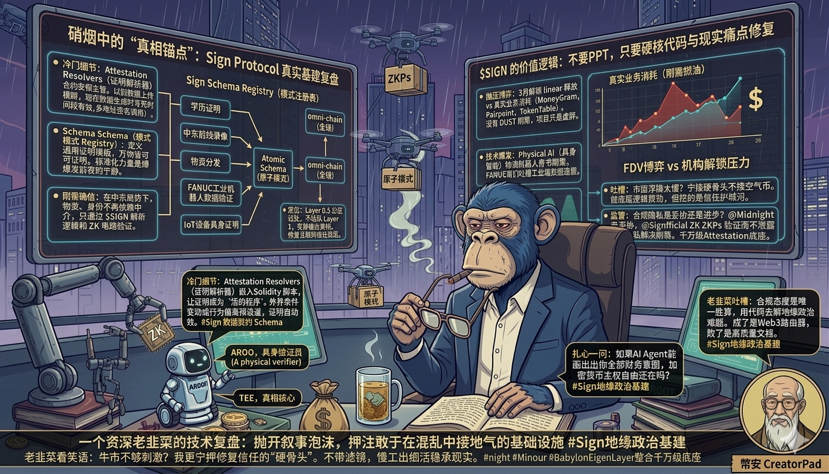
Let me start with a point many people haven't noticed. Most people reading the white paper focus on how to decentralizedly prove data. But I discovered a very interesting technical detail called Attestation Resolvers. This is hidden deep within the white paper, and the official Twitter account hasn't really touted it. Simply put, it's like a "security manager" in a smart contract. Previously, when we did on-chain proofs, we just uploaded the data and that was it; how that data would be used afterwards, whether it could be modified, was very vague. But this resolver allows you to hardcode a set of logic at the moment the proof is generated: for example, the data can only be valid for a specific time period, or it must be signed by at least three specific addresses to be used by downstream contracts. $SIGN
This is incredibly robust. Take the distribution of supplies or identity verification in the Middle East as an example. If it's just simple blockchain data, the information can still be tampered with. But with this underlying parser logic, every piece of proof about aid supplies or the geographical location of personnel comes with its own set of inviolable physical rules. My friend who works on industrial robots at FANUC once complained to me that the biggest fear in the industrial sector is the falsification of sensor data. If you embed this Sign parser logic into hardware identity, you've truly taken the business of "trust" to its very core.
Let's discuss the potential for growth amidst this geopolitical turmoil. Many people ask me if this coin has any potential. I'm not promoting it; I'm just analyzing it from the perspective of a veteran developer. There's a bad habit in the crypto world now: they like to create projects that are all talk and no action, with huge slogans but very little actual code. Sign takes a different approach; it's building a foundational layer of truth. In the Middle East, local organizations, volunteers, and even multinational corporations don't lack money; they lack "confidence." Confidence that the supplies have indeed reached their destination, confidence that the digital identity isn't espionage. When this confidence becomes a necessity, the token ceases to be a speculator's bargaining chip and becomes the fuel that keeps this system of truth running.
I attended several workshops on Physical AI (embodied AI) in Tokyo these past few days and saw robots being tested on the streets of Shibuya. I kept thinking: if robots take over logistics in the future, who will endorse their behavior? The answer lies in this Attestation protocol. Sign's brilliance lies in the fact that it didn't compete with Layer 1 blockchains for market share, but instead quietly acts as a "notary office" usable by all blockchains. This positioning is very clever because it doesn't take sides; it only focuses on outputting the truth.
Of course, I also have to complain. The current market environment is too volatile. When people see these kinds of hard-core infrastructure projects, their first reaction is often "too slow." Indeed, doing this kind of work based on fundamental logic is much more difficult than marketing some dubious cryptocurrency. But as a seasoned investor, I'd rather bet on these "hard nuts to crack" that solve real-world problems than take on those ephemeral, worthless cryptocurrencies.
From another perspective, Sign's Schema Registry is actually a huge innovation. It allows anyone to define their own proof templates. This is like providing the world with an open-source template library; whether you need to prove your academic qualifications or a real video from the Middle East front, you can find a corresponding digital template. This power of standardization is often the calm before the storm.
This brings me to a higher level. The very reason we need blockchain is because the real world is so deceptive, isn't it? Especially during times of war and rampant rumors, the truth is often more valuable than gold. What Sign does is essentially price and solidify the "truth." It allows those lies that were previously floating in mid-air to be exposed or recorded the moment they collide with on-chain proof.
This is not merely a technological contest, but a defensive battle for trust and consensus among human civilizations. In this chaotic world, we don't need more slogans; what we need is an anchor that can light a torch in the darkness and help us see each other's identities clearly.
I believe that instead of getting anxious amidst the chaotic flow of information, we should focus on projects that genuinely attempt to repair the foundation of trust on the internet. After all, when the dust settles, what remains are the traces etched into the chain that stand the test of time. That's where the value lies in my eyes.