
When I started this series, I knew exactly what I would be writing about. ZK-proof technology, the dual model $NIGHT and DUST, comparisons with Monero and ZCash, risks for newcomers. All of this matched the content plan and corresponds to reality. But there is one thing I did not plan to uncover - and which surprised me the most. @MidnightNetwork - this is not a privacy project in the sense in which that word is used in crypto. It is an attempt to solve a problem that is not purely technical.
Let me explain what I mean. Privacy in blockchain usually means "how to hide a transaction from an observer". This is a technical task - and it has been solved in various ways with different trade-offs. But the more pressing issue is another: why in 2026 can companies and ordinary people not use blockchain for real tasks? Not because of a lack of technologies. But because public blockchain is inherently incompatible with how most real relationships operate - economic, legal, medical, social. Trade secrets, medical confidentiality, bank secrecy - these are not whims, but functional requirements, without which certain types of relationships are simply impossible. Midnight is trying to make blockchain compatible with these requirements. Not to bypass them, but to embed them into the protocol.
Over the fourteen articles in this series, we, my dear readers, have moved from concept to specifics. From the question "why privacy in Web3 is critical" - to the analysis of ZK technology based on Halo2, the mechanics of $NIGHT and DUST, tokenomics from Glacier Drop and Scavenger Mine, comparisons with Monero and ZCash, real cases for DeFi and business, metadata and Chainalysis, the Compact language and the talent barrier, risks of early-stage protocols, community structure through Aliit Fellowship. Each topic opened the next. And together they form a picture not of a separate project, but of a new approach to what blockchain can do in general.
Three things turned out to be the most important for me - and I did not plan for them to be:
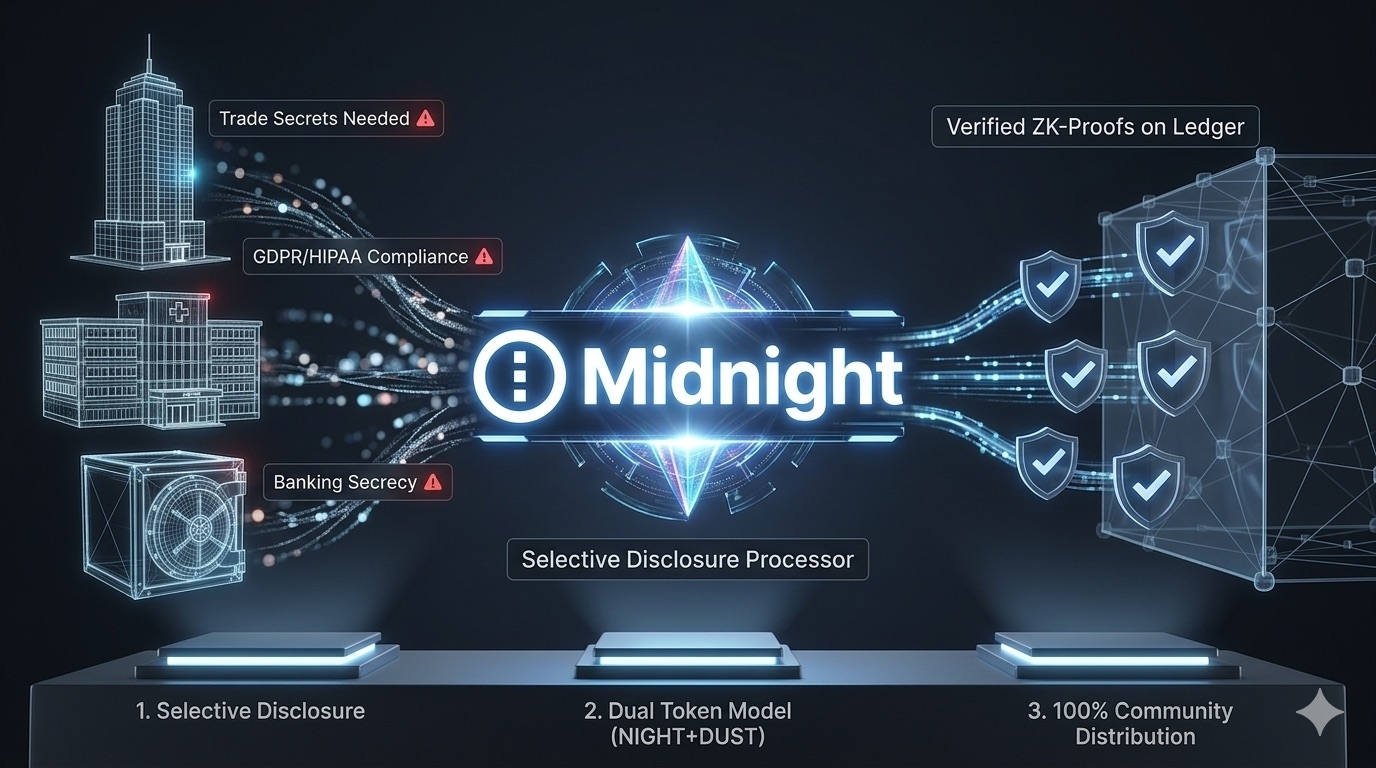
First: selective disclosure as a concept is more important than specific technology. Not "encrypt everything" and not "show everything" - but "show only what is needed, to whom it is needed, when it is needed". This is a banal idea in real life. In blockchain, it is revolutionary. Second: the dual model of NIGHT and DUST is a more elegant solution than it seems at first glance. The distinction between a governance token and a resource for transactions solves several problems at once: regulatory, economic, and technical. Third: the absence of pre-sales and full distribution among the community is not a marketing statement, but a structural solution that complicates manipulation at the start.
What remains unresolved after the entire series - and what probably will not be resolved in the near future. The regulatory question: whether MiCA, FATF, and national regulators will recognize ZK proofs as a sufficient form of AML compliance - depends not on the quality of the code, but on the decisions of people in Brussels, Washington, London, and Beijing. The personnel question: Compact needs developers, of which there are currently few, and most of them came from the Cardano ecosystem. Scaling beyond this audience is a separate task. The adoption question: between "the technology exists" and "companies use it in production" - the distance that is difficult to overcome even with perfect architecture.
Now I will try to answer the question I posed at the beginning. What exactly will change if Midnight works? For developers: the ability to build applications with privacy by default through regular TypeScript tools, without needing to become a ZK mathematician. For companies: the ability to use blockchain for sensitive operations without the risk of exposing commercial data to competitors. For end-users: interaction with DeFi and Web3 services without the public address turning into a financial dossier open to everyone. For the Cardano ecosystem: a privacy layer that makes the entire stack significantly broader than current user cases.
There is a broader context that goes beyond a single project. Privacy in Web3 is not a niche topic for paranoids or people with "nothing to hide". It's a question of how much of our digital and financial lives we are willing to make permanently visible to everyone. In traditional systems, there are institutions, laws, and norms that regulate this visibility. Blockchain currently exists in a space where by default - there is complete transparency. Midnight is one of the few projects trying to embed the possibility of controlled opacity into this space. If this is achieved technically and regulatorily - it will change not only the Cardano ecosystem. It will change the fundamental expectations of what blockchain can and should do.
👉 The series has concluded. The project - not yet.
Mainnet with decentralization of block production ahead in Q2. Hybrid DApps in Q3. The first real business cases - unknown when, but the question of "will there be" is gradually replaced by "when and how many". For me personally, the most interesting observation from this series is this: projects that try to solve a fundamental structural problem - rather than just doing something faster or cheaper - usually either completely fail or change the industry forever. There is almost never a middle result in them. @MidnightNetwork of that category.