
Sometimes the digital world feels like a place where we keep running but never really leave footprints. We join platforms we participate in events we complete tasks we contribute time and energy, but later it all starts to blur together. It can feel like your effort existed for a moment and then quietly disappeared 😶. That feeling of being unseen is more common than people admit. This is where the idea behind SIGN starts to feel emotionally relevant because it is trying to solve something deeply human, not just technical.
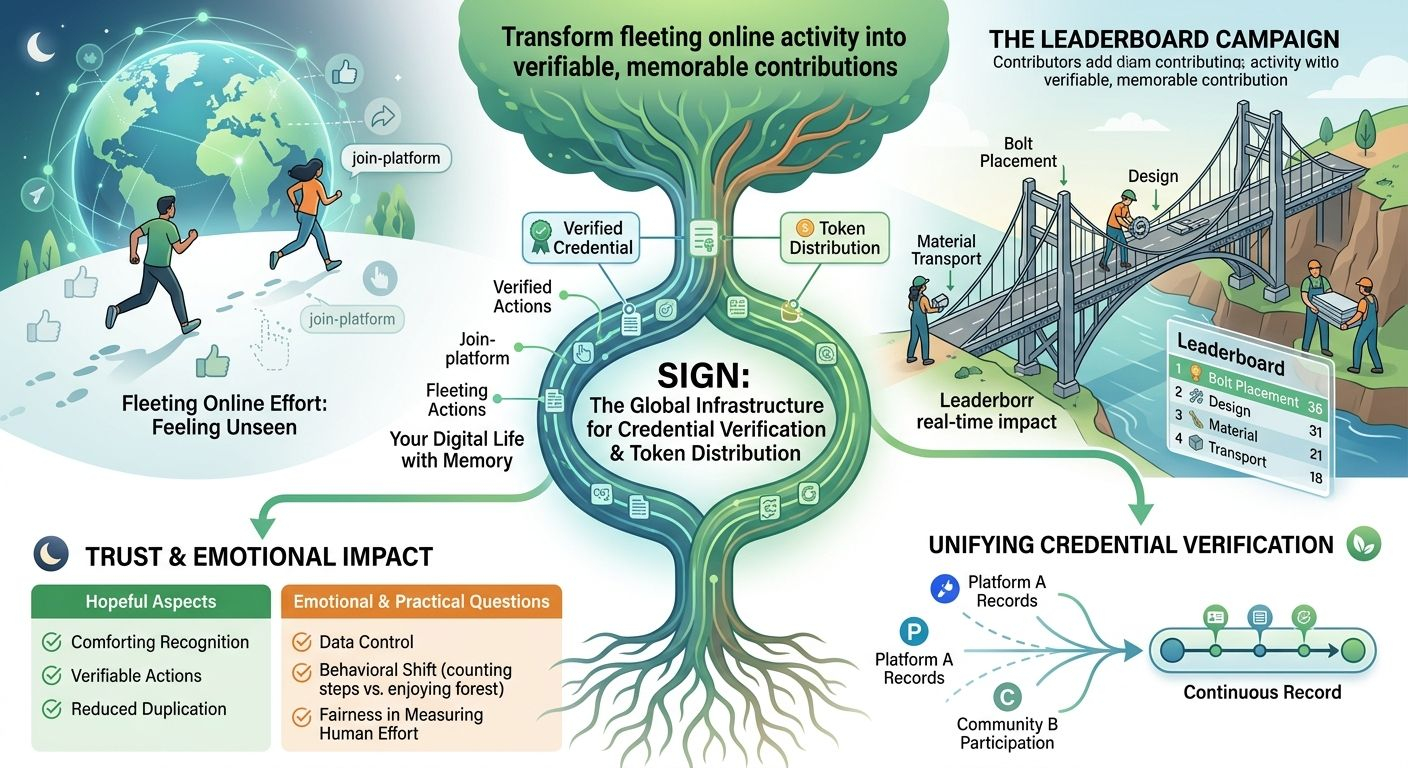
At its foundation SIGN is building a global infrastructure for credential verification and token distribution. In simple words it is trying to create a system where what you do online can be proven in a clear and trustworthy way. Instead of relying on screenshots or verbal claims or platform specific records that can disappear, your actions can be recorded in a shared structure that is verifiable and portable. It is like giving your digital life a kind of memory that does not easily fade. That idea alone feels powerful 🌿 because it touches something we all want, which is recognition for what we actually do.
The Leaderboard Campaign adds another layer to this system by making participation visible in real time. Imagine being part of a huge global room where thousands of people are contributing in different ways. Normally you would never see your impact clearly. You would just hope it matters. But in this system your activity begins to appear in a structured way where progress is slowly reflected. It is not only about competition. It is about awareness. It is about seeing that your presence is part of something larger.
To understand it better think of a long bridge being built by many people at the same time. Each person is adding small pieces. Some are placing bolts. Some are carrying materials. Some are designing parts of the structure. Individually it might not feel significant. But when you step back and look at the bridge forming across the distance, every contribution suddenly matters. The Leaderboard works in a similar emotional way. It makes invisible effort visible without necessarily turning it into something harsh or mechanical.
There is also the concept of credential verification which sits at the core of SIGN. In everyday life we constantly prove ourselves. We prove experience when we apply for jobs. We prove participation when we join communities. We prove identity when entering systems. Online this process becomes fragmented. Each platform keeps its own version of truth. SIGN tries to unify that by creating a verifiable layer where contributions and participation can be confirmed in a consistent way. It feels like replacing scattered memories with a single continuous record.
But while this sounds promising it also brings emotional and practical questions 😟. Whenever human activity becomes trackable there is always concern about how that information might be used. Even if the intention is fairness and transparency, people naturally wonder who controls the system. Can records be changed. Can they be misunderstood. Can they be used in ways that were not originally intended. These are not small concerns because trust is not something you can code into existence. It has to be earned slowly over time.
Another important layer is how people emotionally react to being measured. Some users feel motivated when they see their progress reflected clearly. It gives them direction and a sense of achievement. But others may feel pressure. When everything becomes visible there is a subtle shift in behavior. People might start optimizing for numbers instead of meaning. It is like walking through a forest and instead of enjoying the trees you start counting steps. That change can slowly affect the experience of participation.
There is also the question of fairness in digital systems like this. Not all contributions are equal in effort even if they appear similar on a leaderboard. Some actions take more time thought and emotional energy than others. If a system does not capture that nuance it can unintentionally flatten human effort into simple metrics. That is one of the challenges SIGN will need to think about as it evolves.
Still there is something genuinely hopeful about what it is trying to build 🌙. In a world where online contribution often disappears too quickly having a system that preserves effort can feel comforting. It can help people who quietly contribute behind the scenes feel seen. It can reduce the constant need to re prove identity across different platforms. It can make digital participation feel more continuous rather than fragmented.
In practical use cases systems like this could help communities track real engagement more accurately. It could support builders contributors and participants who move across ecosystems. It could also reduce fake or inflated activity by focusing on verifiable actions rather than surface level impressions. For people who value clarity this kind of structure can feel like a relief.
But even with all its potential it must remain careful. Because the moment a system becomes too focused on ranking or visibility it risks losing the human softness that makes participation meaningful in the first place. Recognition should feel like encouragement not pressure. Structure should feel like support not surveillance.
When I step back and look at SIGN and its Leaderboard Campaign as a whole I do not see a finished product. I see a developing idea trying to understand something very human. It is asking how we remember effort how we recognize contribution and how we build trust in digital spaces that often forget too quickly.
There is hope in that question 🌿
And there is also responsibility.
Because in the end any system that measures human effort must never forget the human feeling behind it.