
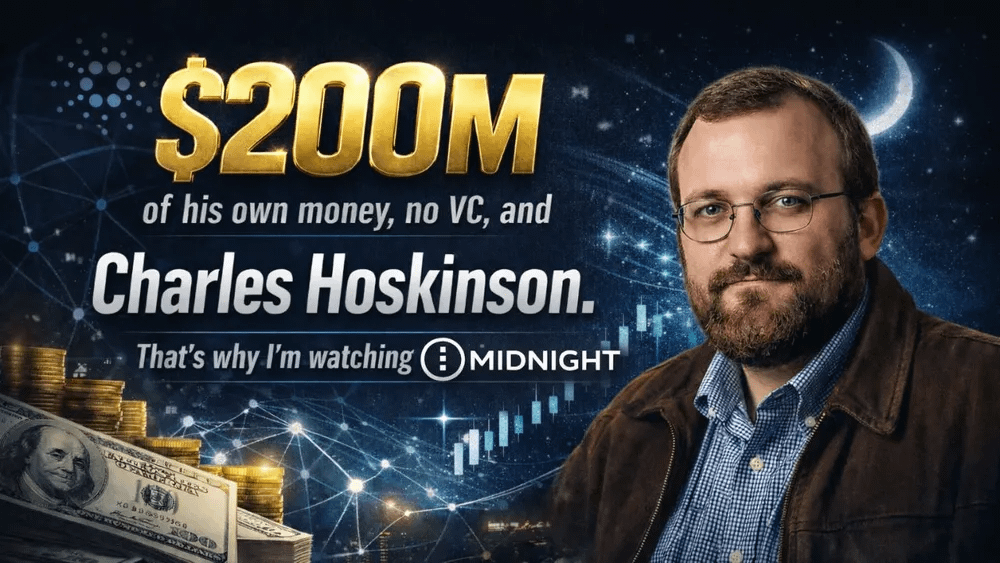
I have been following Midnight from the beginning, and this is one of the very few blockchains launching in 2026 that did not raise from any VCs. No a16z, no Paradigm, no Multicoin. Tokens are distributed through Glacier Drop for the Cardano, Bitcoin, and six other ecosystem communities, with no private sale, no discounted allocation for investors. Charles Hoskinson personally invested 200 million USD to fund the development process.
Regarding philosophy, I see this as the right decision. No VC means no cliff vesting, no group of investors holding tokens at low prices waiting to dump on retail. Tokens are widely distributed from day one, not concentrated in the hands of a small group. This is why the crypto community considers Midnight to be one of the most genuine fair launches in this cycle. I feel this has established real trust within the community, not trust inflated by marketing.
But this is also when I start to see the problem. VCs do not just bring money. They bring networks, deal flow, and the ability to open doors that a project struggling on its own finds hard to access. When Arbitrum wanted to onboard large financial institutions, Offchain Labs, backed by Lightspeed and Polychain, made calls ahead of time. Those kinds of calls cannot be bought with a whitepaper or excellent technology. I wonder: can Midnight go the distance without this?
Technically, Midnight must maintain and develop the Kachina protocol, optimize the ZK circuit for Compact, and retain cryptographers who have a deep understanding of ZK proof. Compact is based on TypeScript, but the ZK circuit layer beneath it requires rare talent. Aztec raised 100 million USD from a16z in 2023. Aleo raised 200 million USD. I look at that amount of money and see an advantage: they can pay talent for many years, regardless of how the market is. Meanwhile, Midnight relies on DUST fees, staking rewards $NIGHT and a capacity marketplace. In theory, that should be enough. But that theory depends on sufficient adoption to create stable cash flow, and adoption depends on developers. I wonder if the team of talent has enough patience and motivation while waiting for adoption to happen?
In terms of narrative, a fair launch is a clear advantage in the crypto community. But I am skeptical when looking at traditional businesses: they do not assess blockchain based on whether the tokenomics is fair or not. They look at who is behind it and who is responsible. VC backing for them is not centralization, but credibility. Hoskinson's 200 million USD is a large number, but it is a limited resource, not a long-term commitment from a fund with a clear mandate.
I am not saying that a fair launch is wrong. In terms of core values, Midnight is doing exactly what they claim. A truly decentralized privacy blockchain cannot start by handing control to a small group of investors. But the real issue is: does a philosophically correct model have enough resources to compete in a race where the opponents play by different rules?
I will closely monitor the next 18–24 months, when the thawing schedule is completed and the ecosystem must stand on its own. This is when the answers will emerge: philosophy alone won’t pay the engineers, adoption will.
$NIGHT #night @MidnightNetwork