

Two or three years ago, they built a road in my hometown village.
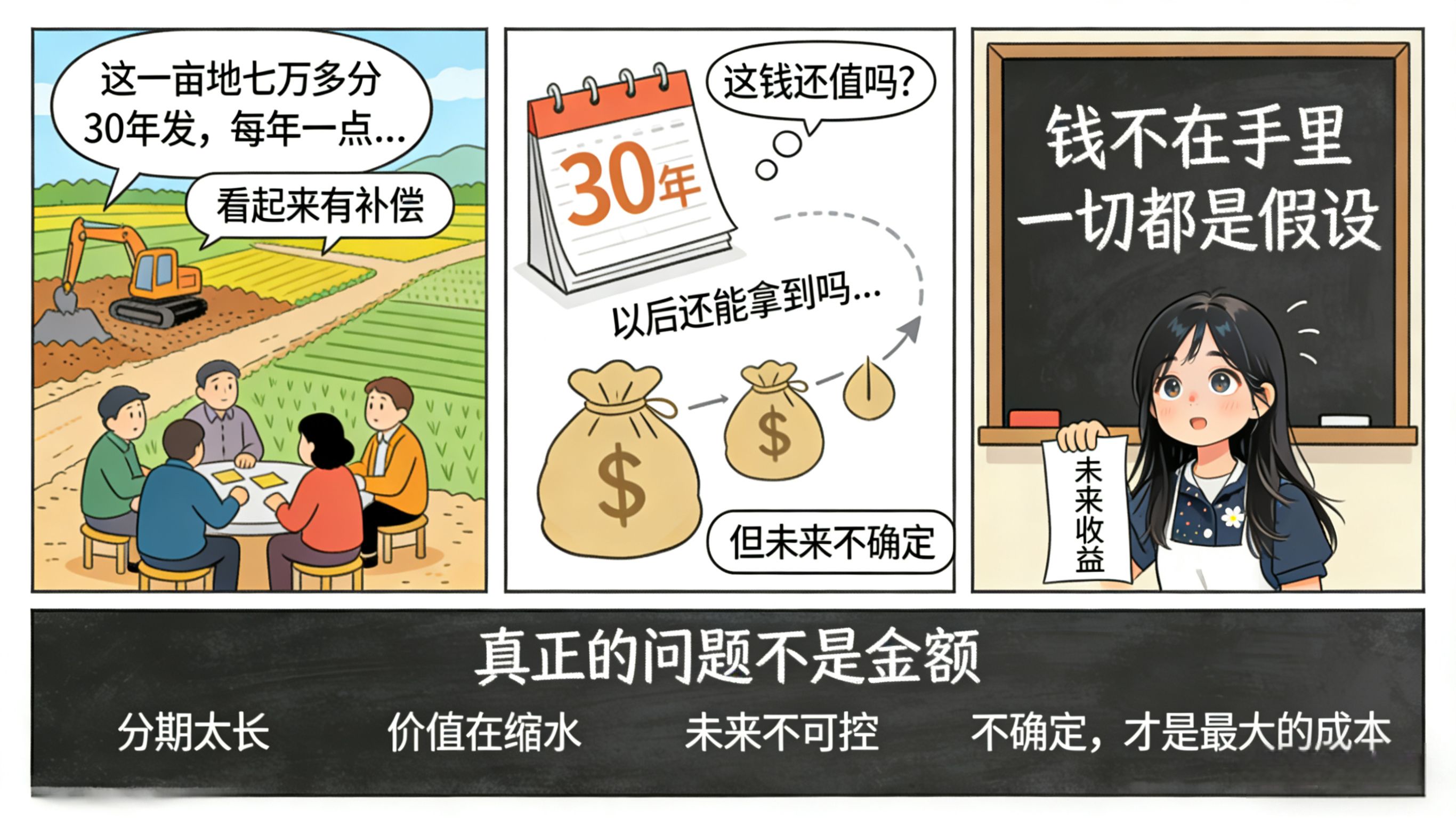
The piece of land in our family was occupied, and everyone initially thought it was a good thing—after all, there would be compensation.
Calculating it, one mu of land is over seventy thousand, not too much to say, but not too little either.
But the plan given later made many people feel uncomfortable.
It's not a one-time payment, but spread over 30 years.
Getting a little each year seems 'stable', but the problem is—will the money devalue over these 30 years? Will policies change? Will it still be paid on time?
No one can say for sure.
My dad just said one thing back then:
"If the money is not in hand, it’s useless to say anything."
At that moment, I actually felt quite touched.
It's not about less compensation, but—too much uncertainty.
This matter suddenly added a layer of judgment when I later looked at projects.
Especially recently, many people are talking about @MidnightNetwork and $NIGHT.
I initially viewed it as a 'privacy narrative',
But slowly realizing, it is actually more about solving a neglected issue: certainty.
Now most chains look lively, but fundamentally there is a problem:
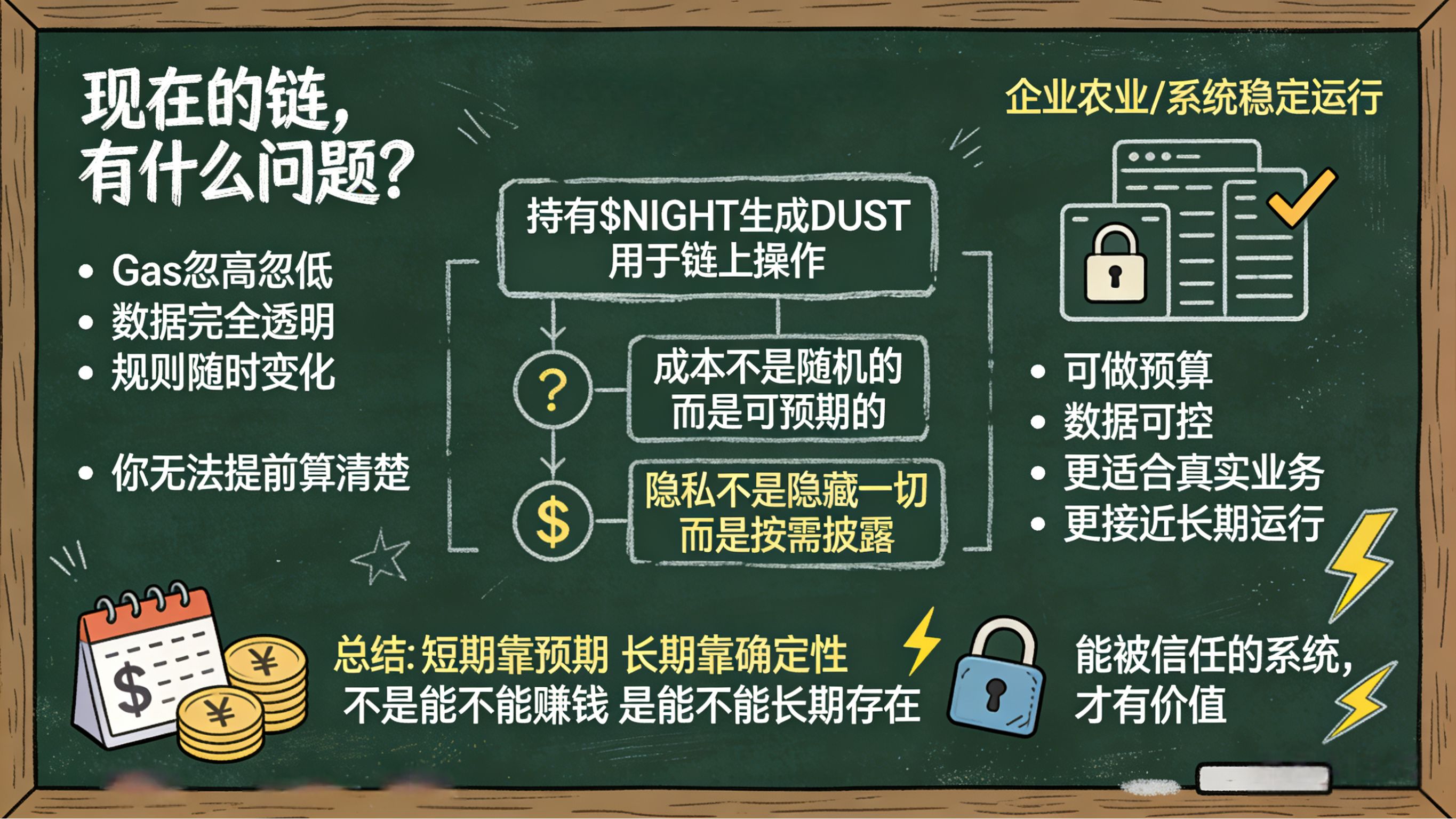
You can't 'calculate everything in advance.'
Transaction fees fluctuate greatly,
All data is public,
Rules are constantly adjusted with ecological changes.
It might still be acceptable for retail investors,
But for enterprises, this is almost fatal.
If you want to budget, plan, or even just run a business stably—it's very difficult.
This is just like the land back in my hometown:
It seems to have returns, but you don't know what the future will be like.
And the design of NIGHT, I find interesting in this aspect:
It’s not just talking about privacy, but trying to establish a 'controllable operating environment.'
First, let's talk about its privacy logic:
Not completely hidden, but 'selectively disclosed.'
You can prove your compliance,
But there is no need to lay all the data bare.
The significance of this matter is to allow the chain to be 'normally used,' rather than just 'observed.'
Let's talk about its mechanism design.
Most chains:
Use it once, pay a fee once.
And NIGHT:
Hold → Generate DUST → Use DUST for operations.
This sounds like just a change in form, but the difference behind it is significant:
Costs become predictable.
You can estimate future usage costs in advance,
Just like companies budgeting, rather than settling 'last minute' every time.
This point is particularly similar to what my dad said:
"Money must be in hand to count."
But I still want to make a more realistic point.
Now the market looks at NIGHT, and most people's focus is still:
When to launch the mainnet,
Are there any benefits,
Can the price rise?
This is fine, but it also easily overlooks one thing:
These all belong to 'short-term certainty,' not 'long-term certainty.'
Short-term is something that emotions can create,
The long term needs to be developed slowly.
So now when I look at such projects, I'm not easily swayed by the rhythm.
What I care more about is another feeling:
Is there anyone starting to use it as a tool?
After using it for a while, has there been a dependency formed?
Is this usage slowly becoming a kind of 'basic behavior'?
If it's just a discussion among everyone, that's popularity;
If someone starts to be unable to live without it, then that is value.
Back to that piece of land.
Many people actually do not refuse installment payments,
But rather worry—future uncertainty will gradually erode current value.
This is actually the same as many projects.
It seems to have space, a story, and expectations,
But if these cannot be fulfilled,
Time is the greatest cost.
So I am increasingly inclined towards a simpler judgment method:
It's not about how well it's being talked about now,
But rather to see if it can 'exist stably' in the future.
Can it be reused repeatedly?
Can it run smoothly in different environments?
Can it allow people to safely put things in?
These are much more important than short-term fluctuations.
To put it bluntly, when I look at $NIGHT now, I'm not looking at it as a candlestick.
But rather when a 'system' is observing.
If it can really balance privacy, compliance, and costs well,
Then its value will not only be reflected in the price.
But if it can't be done,
Then it is actually not much different from the money distributed over 30 years:
It seems valuable, but you can't hold it steady.
This time, I don't really want to gamble on 'whether it will get better in the future',
What I want to see more is—starting now, something is happening.
@MidnightNetwork #night $NIGHT
