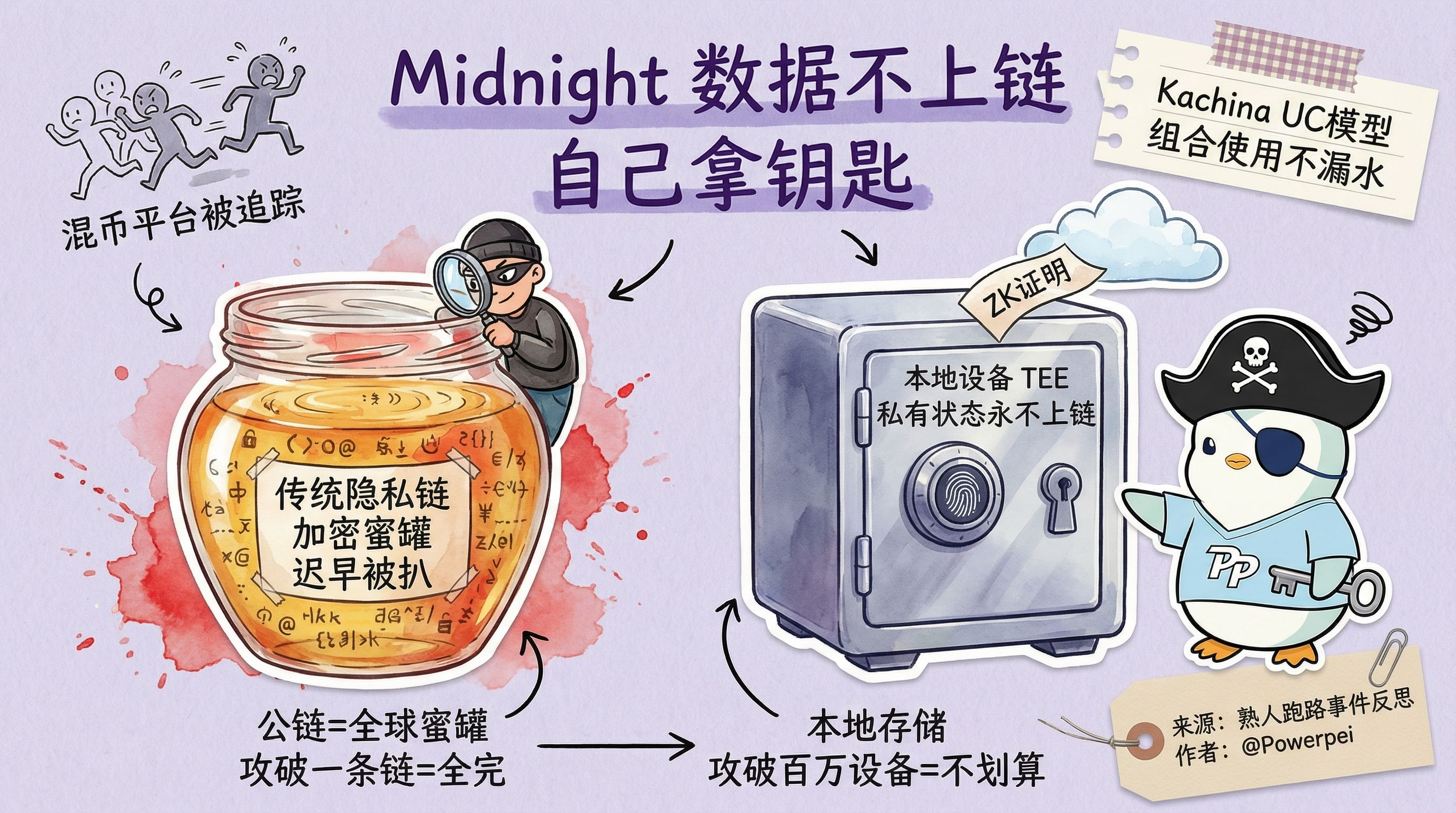
Yesterday, a familiar person made a transaction on a supposedly fully anonymous mixing platform
As a result, the tracing company found several of his main associated addresses, clearing his assets overnight and fleeing
After being in this circle for a long time, you will discover a cruel truth:
The so-called on-chain privacy is mostly just self-deception
As long as your data (even if encrypted) remains on the public ledger, it’s only a matter of time before someone strips you bare with the improvement of computing power and the evolution of AI analysis tools
This forced me to reevaluate @MidnightNetwork the Nightpaper that was thrown out
The Local Private Data Storage model they developed is extremely bold in thought.
➢➢➢
In short, they think that current privacy chains are just being rogue.
Encrypt everyone's privacy data and pile it on a public chain.
This is not called protecting privacy; this is called building the world's largest 'encrypted honey pot.'
Once there's a vulnerability in cryptography, or a centralized node is breached, everyone's bottom line will be exposed instantly.
Midnight's solution is extremely radical but also very reasonable: sensitive data must not go on-chain.
➢➢➢
Look at how they designed it. They split the state of the smart contract into two halves.
Public State
Private State
Public State: these are the harmless things that everyone can see in the browser, such as the rules of this smart contract.
Private State: your transaction amount, your identity information, who your counterparty is—these things are never, absolutely never uploaded to the network.
They are only stored on your own devices (phones, computers) or in trusted execution environments (TEE).
➢➢➢
Key question: without going on-chain, how to complete the transaction?
When you initiate a transaction, it is your own device that silently calculates locally.
After the device completes the calculation, it generates an extremely lightweight ZK-SNARKs proof.
What you send to the chain is only this cold mathematical proof.
miners (nodes) can only verify that 'your transaction complies with the rules and you haven't double spent.'
But they can never see how much money you actually transferred.
This is the true data sovereignty belonging to users.
In the past, hackers only needed to breach one chain to steal data.
Now, they have to break through millions of users' personal phones in physics.
The cost is so high that even national-level hackers find it unprofitable.
➢➢➢
Core advantage: UC security model, breaking through the deadlock of composability.
Moreover, their underlying Kachina protocol uses the highest standard of cryptography, the Universal Composition (UC) security model.
The value of this thing lies in:
No matter how many other random DeFi protocols you combine this privacy contract with (like lending or settling RWA assets), its privacy and security will not be compromised.
This solves the deadlock of traditional privacy chains leaking when they try to achieve composability.
➢➢➢
Rational reflection: the price of extreme security is an inhumane user experience.
But as an old hand, I have to say some unpleasant things.
Keeping data local is secure, but the user experience is absolutely inhumane.
What if you change your phone? How do you recover a private state if the device is lost? The friction of cross-device synchronization, combined with the extremely high audit threshold of this UC proof.
It will deter many developers who are used to one-click authorization.
So, this is not meant for retail investors to trade meme coins.
It is prepared for those compliance institutions, multinational companies, and high-net-worth individuals who have severe paranoia about data leaks.
When the regulatory stick of 2026 forces all institutions to go on-chain, they will find that
Rather than throwing financial data into that public honey pot which might be cracked at any time, it's better to hold the key yourself.
Only a mathematical proof is shown to the regulators.
This might be the infrastructure that the next generation of institutional-grade dApps truly dares to use.#night $NIGHT