
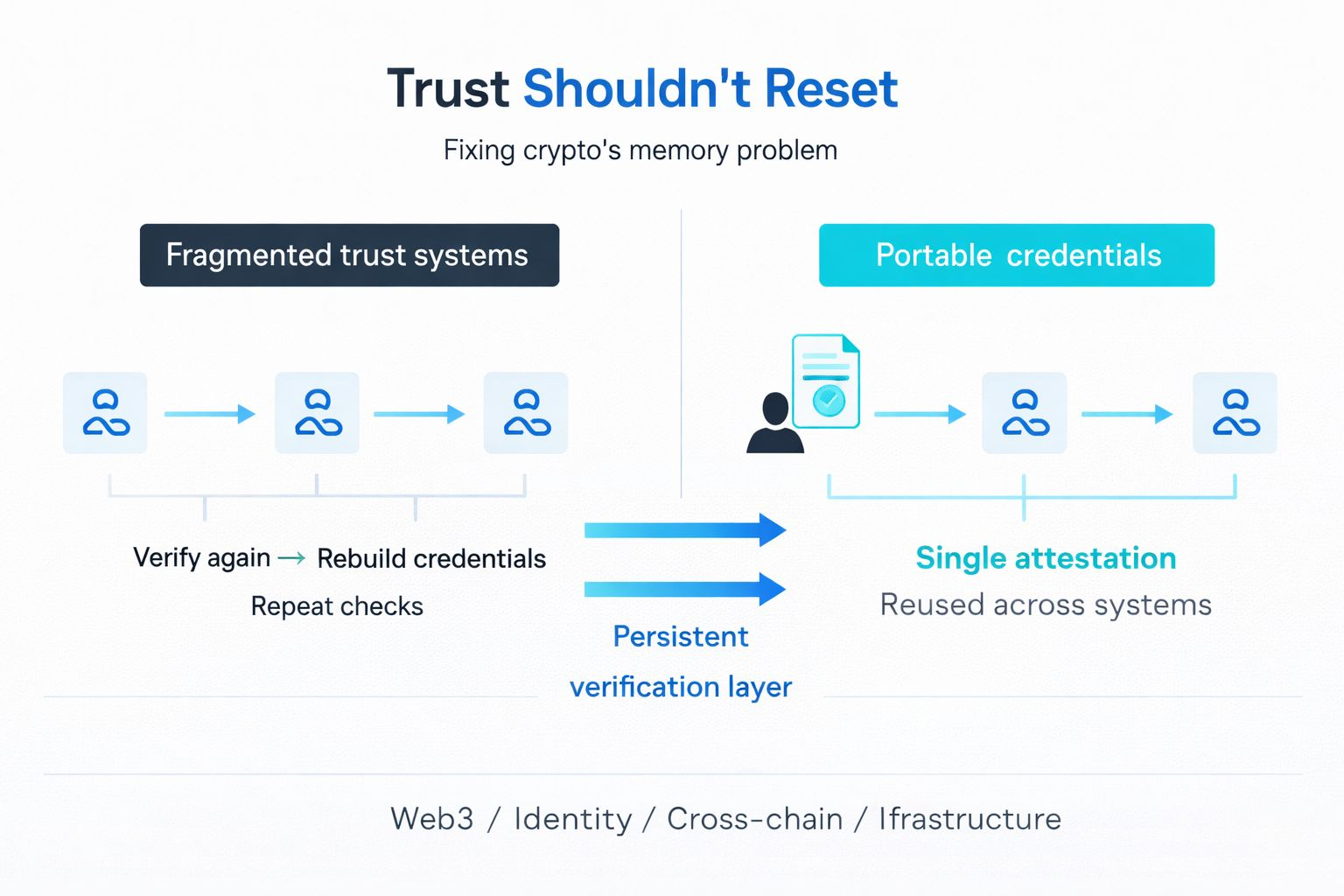
The more I look at crypto, the more I feel like people keep circling around the same “important” topics while skipping over the stuff that actually breaks in practice. Scaling, UX, regulation… all valid, but somehow the basic experience still feels strangely inefficient.
What keeps bothering me is how badly trust travels.
You prove something in one place, then move somewhere else, and it’s like starting from zero again. Same person, same history, same credentials… but the system just resets and asks you to do it all over again. For something that calls itself programmable, that feels kind of ridiculous.
That’s probably why $SIGN keeps pulling my attention.
It’s not trying to reinvent everything. It’s focusing on something much simpler, and honestly more annoying. How do you make claims, credentials, and verification actually move across systems instead of getting stuck inside one app or one chain?
Because right now, everything is fragmented. A credential exists, but only where it was issued. A claim is valid, but only in that specific context. The moment you step outside, it’s gone. Or at least, it has to be rebuilt again.
And that creates this constant low-level friction.
Nothing dramatic, just repeated checks, duplicated logic, scattered records. It adds up. The system feels heavier than it should be, even when everything is technically “working.”
Sign’s idea, at least how I see it, is almost too obvious. What if trust didn’t expire every time you moved? What if proof could actually persist across environments?
It sounds simple. Which is probably why it’s not getting the same attention as louder narratives.
But I also don’t think it’s easy.
This kind of thing only looks clean on paper. Once you get into real-world use, things get messy fast. Different standards, conflicting data, permissions, compliance… all the parts that tend to slow everything down. And crypto is not exactly known for smooth coordination at scale.
So yeah, this could still fail.
Not because the idea is weak, but because it’s dealing with something real enough to be difficult.
And I think that’s exactly why it’s interesting. If SIGN actually works, it won’t be because it created hype. It’ll be because it quietly becomes useful. Something that sits underneath everything else and makes the system feel less repetitive, less fragmented.
I keep coming back to this thought that crypto doesn’t just have a scaling problem.
It has a memory problem.
And maybe that’s the part projects like SIGN are trying to fix.
Not flashy. But probably more important than it looks at first.