
Recently, I have been studying Midnight for a long time. This time, I had a chat with an old player in the cryptocurrency world who has been coding for nearly ten years. He started from early PHP website development to later solidity smart contracts, and so on. I estimate he has seen more chains than I have eaten salt, haha. I have gained a lot from him as well. This time, I will analyze from a technical perspective whether the Midnight project is reliable or not? Is it worth diving into?
✍🏻 From a purely technical developer's perspective, I will chat openly with everyone about Midnight. No flattery, no criticism, just discussing code, architecture, and those pitfalls that are not mentioned in the documentation.
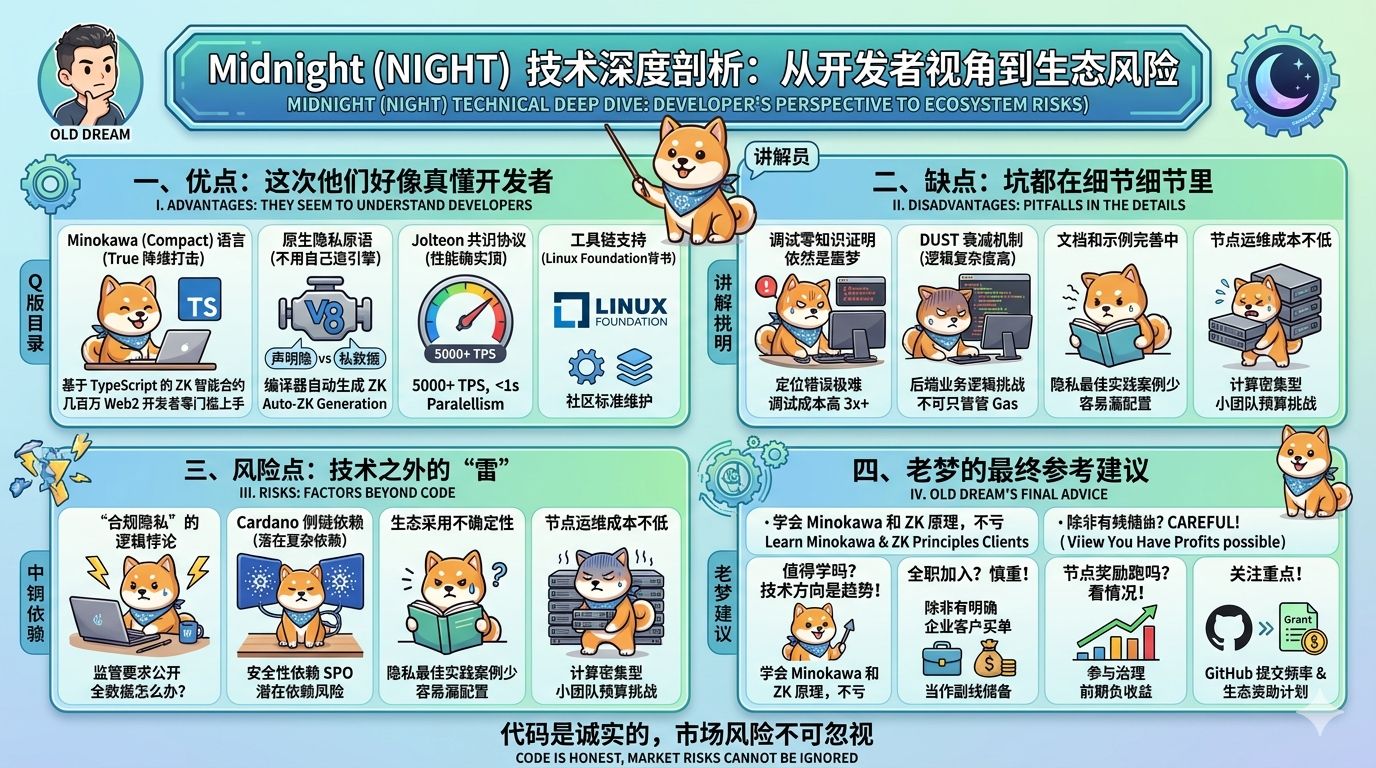
1. Advantages: This time they seem to truly understand developers.
To be honest, when Old Dream first looked at the Midnight white paper, I was resistant internally. Privacy and zero-knowledge usually imply a very high development threshold and a poor debugging experience. But after delving into their technology stack, I have to admit that they indeed have something this time.
1. Minokawa (Compact) Language: This is a true dimensionality reduction strike.
Previously, working with privacy chains required learning Circom, understanding circuit constraints, and struggling with those inhumane syntaxes. Even if you lost all your hair, you might not be able to run a proof successfully.
But Midnight has created Minokawa (formerly called Compact), which is directly based on TypeScript.
Old Dream's Comments: This point is very critical. What does it mean? It means that millions of Web2 frontend and Node.js developers worldwide can write privacy smart contracts without learning a new language. I tried to write a simple privacy transfer demo, and the familiar syntax made me uneasy. This is a huge advantage for the early construction of the ecosystem. There’s no need to hire those million-dollar cryptography experts; ordinary full-stack developers can get started, which significantly reduces costs.
2. Native privacy primitives: No need to build your own engine.
When dealing with privacy on Ethereum, you have to integrate mixers like Tornado yourself or write ZK circuits, and security vulnerabilities are numerous.
Midnight has made privacy a native primitive. You directly declare which data is private in the code, and the compiler automatically helps you generate zero-knowledge proofs.
Old Dream's Comments: This is like if previously you built your own engine to drive, now you are directly provided with a V8 engine. For application layer developers, security is greatly enhanced, and there is no need to worry about the security issues of underlying proof generation.
3. Jolteon Consensus: Performance is indeed top-notch.
I looked at the testnet data, and the Jolteon consensus protocol is indeed not to be underestimated. The TPS is claimed to be over 5000, with block times under 1 second.
Old Dream's Comments: For developers, this means a good user experience. The DApp you write won't have to wait ten minutes for confirmation. Especially for gaming or high-frequency trading applications, this performance is a hard indicator. Moreover, it supports parallel processing, which is stronger than many serial executing EVM chains.
4. Toolchain support: Backed by the Linux Foundation.
The Minokawa language has already been donated to the Linux Foundation Decentralized Trust.
Old Dream's Comments: This means that this is not the private property of a certain company, and there will be more standardized community maintenance in the future. For developers, there’s no need to worry about the project party running away without language supervision; long-term maintainability is guaranteed.
2. Disadvantages: The pitfalls are in the details.
The advantages have been mentioned, and Old Dream must talk about some practical risks with the brothers. During a conversation with an old player in the crypto space, I found that Midnight is not perfect; some designs may be quite troublesome.
1. Debugging zero-knowledge proofs is still a nightmare.
Although the language is TypeScript, the underlying still relies on ZK circuits.
Old Dream's Comments: When there's a logical error in your code, the error messages are sometimes very obscure. For instance, if the proof verification fails, it's hard to pinpoint whether the data is wrong or the circuit constraints are wrong. Although it's slightly better than Circom, the debugging cost is still at least 3 times higher than that of ordinary smart contracts. You need to understand some cryptographic principles; otherwise, you won't even be able to understand the bugs.
2. DUST Decay Mechanism: High logical complexity
In Midnight's dual-token model, DUST will decay.
Old Dream's Comments: This poses a challenge for backend logic. When writing contracts, you not only have to consider business logic, but also whether the user's DUST is sufficient and whether it will expire. You need to add a lot of logic in the code to remind users to "recharge" or "generate DUST". This increases friction in user experience and adds complexity to the developer's code. You can no longer just focus on business without worrying about Gas.
3. Documentation and examples are still being improved.
Although the language is simple, there aren’t enough documents on best practices for privacy.
Old Dream's Comments: For example, how to use 'selective disclosure' safely? What data should be public, and what should be private? There are no standard answers. Developers can easily cause privacy leaks due to configuration errors. Currently, there are still too few best practice cases in the community, most of the time one has to explore on their own.
4. Node operation and maintenance costs are not low.
Running a Midnight node requires higher hardware requirements than ordinary EVM chains.
Old Dream's Comments: Due to the need to generate and verify zero-knowledge proofs, there are many compute-intensive tasks. If you want to run a node as a validator, server costs are significantly higher than those of ordinary chains. For small team developers, this expense must be included in the budget.
3. Risk Points: 'Thunder' outside of technology.
As developers, they often focus only on code, but sometimes, it's not the bugs that kill the project, but external factors.
1. The Logical Paradox of 'Compliant Privacy'
Midnight focuses on compliance and supports selective disclosure.
Old Dream's Risk Assessment: This has been technically realized, but there’s a huge pitfall logically. If regulations require you to 'disclose all data', does your selective disclosure still make sense? At that time, will you compromise by changing the code, or will you stand firm? If you compromise, then your privacy features are gone, and all the privacy contracts written by developers before may become invalid. This kind of policy dependency risk cannot be solved by code.
2. Dependency on Cardano sidechains.
Midnight is a Partner Chain of Cardano, and its security aspect relies on Cardano's SPO.
Old Dream's Risk Assessment: It's like building a house with a foundation borrowed from others. If the Cardano ecosystem itself slows down or if there are disagreements between the teams, Midnight's independence will be affected. As a developer, you need to consider: if one day the two chains separate, how high will the cost of migrating your DApp data be?
3. Uncertainty in ecological adoption.
Good technology does not mean there will be users.
Old Dream's Risk Assessment: Currently, most DApps are still in DeFi and NFT. The speed of enterprise applications that truly need privacy (such as healthcare, supply chain) going on-chain is very slow. If there are no real users in the ecosystem, no matter how good your code is, you can only enjoy the testnet. For teams that rely on development for income, without traffic, there is no revenue; this is the most realistic risk.
4. Token Unlocking and Ecological Funding
Although the technology is good, the pressure of token unlocking is significant.
Old Dream's Risk Assessment: If $NIGHT the coin price remains low for a long time, the value of the ecological funding plan (Grant) will shrink, developer subsidies will decrease, community contributors will leave, ultimately slowing down technological iteration. This is a vicious cycle. Developers also need to make a living; if the coin price is poor, who has the heart to maintain open-source code?
4. Old Dream's Personal Reference Suggestions
So is it worth learning for those coding brothers? Definitely worth it. Even if the Midnight project doesn't turn out to be a big success, the direction of technology with TypeScript + ZK may be the future under the development trend in the crypto space. Learning the principles of Minokawa and zero-knowledge proofs will give you a certain technical accumulation in the Web3 circle, which is not a loss.
Is it worth a personal programmer to join full-time? Be cautious. Unless you already have clear enterprise clients willing to pay for privacy, don't easily resign to focus on Midnight development. The ecosystem is still too slow in its early stages, which may not support the team. It is recommended to treat it as a secondary technology stack reserve.
So can node rewards be run? It depends. If you have the capacity, running a node to participate in governance and earn some rewards is possible. But don't expect to become rich solely from node rewards; after deducting electricity and hardware wear, the initial phase may yield negative returns.
Focus Points: Don’t just pay attention to coin prices, but closely watch their GitHub commit frequency and ecological funding plans. If code updates slow down, or if grants are not being issued, Old Dream suggests considering retreating to reduce losses.
🐶 Old Dream's Final Conclusion:
@MidnightNetwork Technically, it is an excellent student, especially with the significant innovations made in developer experience. However, it faces considerable challenges in compliance risks and ecological implementation.
As a developer, you can embrace its technology and learn its architecture, but don't stake your life savings on its narrative. Code is honest, but market risks are not.