The challenge of data interaction between smart contracts and the real world has always been a highly challenging engineering problem in the system architecture design of blockchain. We all know that blockchain is essentially a closed deterministic state machine, and smart contracts themselves cannot actively obtain any information outside the chain. To give Web3 real commercial financial value—such as settling derivatives based on real-time exchange rates or insurance claims based on flight delay data—we must introduce the middleware system of oracles (Oracle).#night
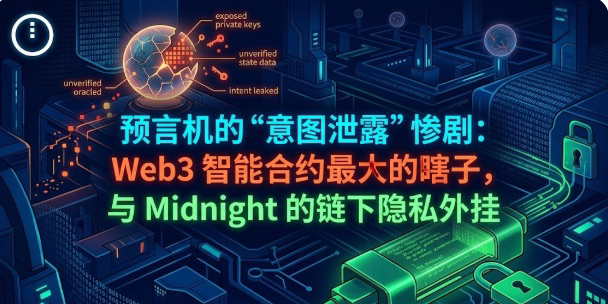
However, for the quantitative institutions and corporate IT departments that truly manage large funds, the current oracle interaction model based on traditional transparent EVM (Ethereum Virtual Machine) architecture has a critically fatal yet seldom publicly discussed systemic security exposure: "Oracle Intent Leakage." Let's break down this issue from the actual business link. Suppose a top decentralized asset management platform has its smart contract set to automatically execute a hedge adjustment of several tens of millions of dollars when the price of a specific niche asset (such as certain types of RWA real-world assets or specific commodity futures) reaches a certain threshold.
Under the operational mechanism of transparent public chains, smart contracts cannot complete data verification in secrecy. They must publicly throw an event (Event) on-chain or initiate a calling transaction: 'Request the latest quote for X asset from the oracle node.' The moment this data request is broadcast to the public memory pool (Mempool), the commercial bottom line of this asset management platform has already been thoroughly exposed. High-frequency quantitative robots and competitors deployed in the dark forest can instantly deduce the platform's next trading intentions by real-time monitoring of such oracle requests. They are acutely aware that once the oracle feeds the data back to the chain, it will trigger a multi-million level rebalancing. Therefore, these arbitrageurs will use higher Gas fees to front-run, establishing mouse warehouses in advance on related assets or laying precise traps in liquidity pools.
The enterprise originally designed an extremely tight quantitative strategy but was forced to broadcast a trading signal across the network due to the action of 'querying data,' which must be executed on the public ledger. This loss of information asymmetry caused by architectural flaws makes traditional financial institutions extremely resistant to migrating complex real-world business logic to existing smart contract platforms. It wasn't until I deeply analyzed the 'Hybrid Architecture' and 'Off-chain Computation' models in the m-22 white paper that I saw an industrial-grade solution capable of perfectly stitching this security gap. The system architects of Midnight broke the mindset of 'everything must be on-chain consensus' and performed an extremely clever decoupling of the oracle's interaction lifecycle.
In the Midnight application ecosystem, if a privacy-protecting DApp needs to acquire off-chain data, this request action is no longer publicly triggered by the smart contract on-chain. Instead, the responsibility for data acquisition is transferred to the user's local client-side or the enterprise's own trusted execution environment. The specific engineering implementation path is as follows: The enterprise's local application directly queries the off-chain trusted oracle network through an encrypted API channel. The oracle returns the result to the enterprise's local setup, accompanied by a cryptographically valid digital signature to ensure the authenticity of the data.
Next, the most critical dimensionality reduction strike occurred. The enterprise's local device calls Midnight's underlying compiler engine, using this set of 'data with oracle signatures' along with the enterprise's own 'secret business logic' as input parameters, sending them into the local zero-knowledge proof circuit for computation. After the computation is completed, the enterprise only submits the final generated ZK proof to the Midnight mainnet. The consensus nodes of the mainnet are only responsible for verifying one thing: 'The submitter did indeed obtain the legally issued data from the oracle, and based on its internal logical operations, the current on-chain state transition request is legitimate.'
Throughout the entire process, all network nodes and potential eavesdroppers were completely unaware of the following three core pieces of information: What data asset did the enterprise actually query from the oracle? What specific value did the oracle return? What kind of triggering logic did the enterprise execute based on that value? Midnight effectively equips smart contracts, which are originally at an absolute disadvantage in a transparent environment, with an off-chain privacy radar that possesses 'absolute silence' capabilities. It allows enterprises to securely draw on trillion-level data flows from the real world for complex decision-making while not stirring any reverse-trackable ripples in the public ledger.
When we discuss how Web3 can truly take over the massive business volume of traditional NASDAQ or the Chicago Mercantile Exchange, solving the issue of oracle intent leakage is an essential underlying leap. The hybrid architecture built by c-33, which integrates off-chain secure data acquisition and on-chain zero-knowledge verification, is the ultimate shield for traditional capital to safely construct complex financial models in the digital world.