
When capital flees, sovereignty rises.
Geopolitical turbulence has a way of revealing what's fragile. Right now, the Middle East is feeling that pressure. Capital is moving. Trust in traditional financial rails is being tested. And in the midst of this, a clear pattern is emerging: nations in the region aren't just looking for stability they're building it themselves
That's where digital sovereignty comes in. And that's exactly what @SignOfficial was built to deliver.
For years, crypto has focused on replacing systems But for governments the real priority isn't replacement it's resilience. A parallel layer that doesn't fail when everything else does. A digital infrastructure that stays sovereign, secure, and operational regardless of external shocks.
Sign's approach is fundamentally different. It's not a white paper chasing retail hype. It's a B2G proprietary technology company with real deployments. Backed by Circle, Sequoia, and YZi Labs Sign is already working with nations across the Middle East and Central Asia—securing strategic cooperation in Abu Dhabi, helping countries implement CBDCs and digital ID systems.
Why Sign? Because governments don't move fast on their own. They need partners who have done it before. Sign's track record speaks for itself: $3 billion in token distribution, 55 million wallets processed through TokenTable, and a compliance framework that bridges traditional banking with crypto infrastructure.
The Middle East is moving toward a future where money and identity are digital, sovereign, and programmable. That shift won't be led by hype. It will be led by infrastructure.
Sign is building that infrastructure right now.
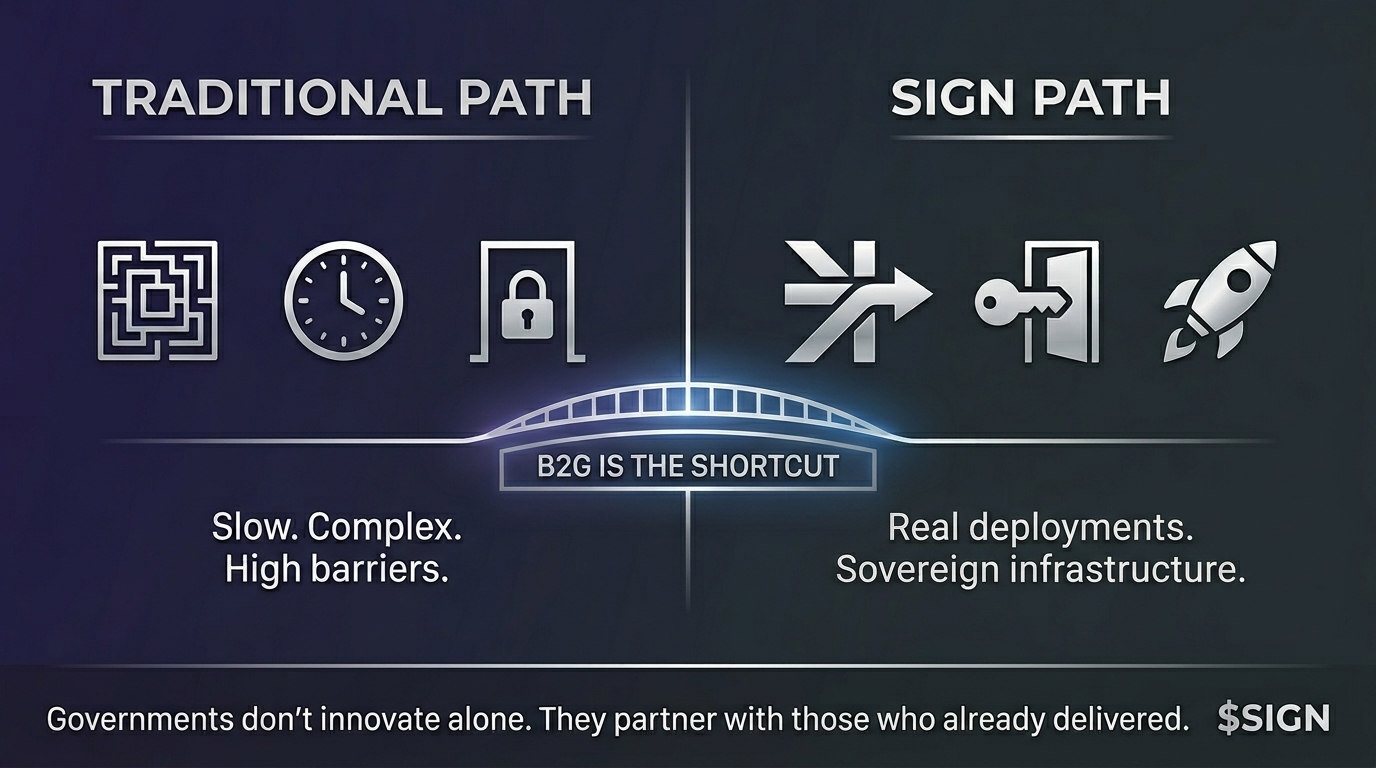
Governments don't innovate alone. They partner with those who already delivered. The traditional path is slow, complex, and built on high barriers. @SignOfficial chose a different route: trusted partner, real deployments, sovereign infrastructure. B2G isn't just a category. It's the shortcut to real adoption.