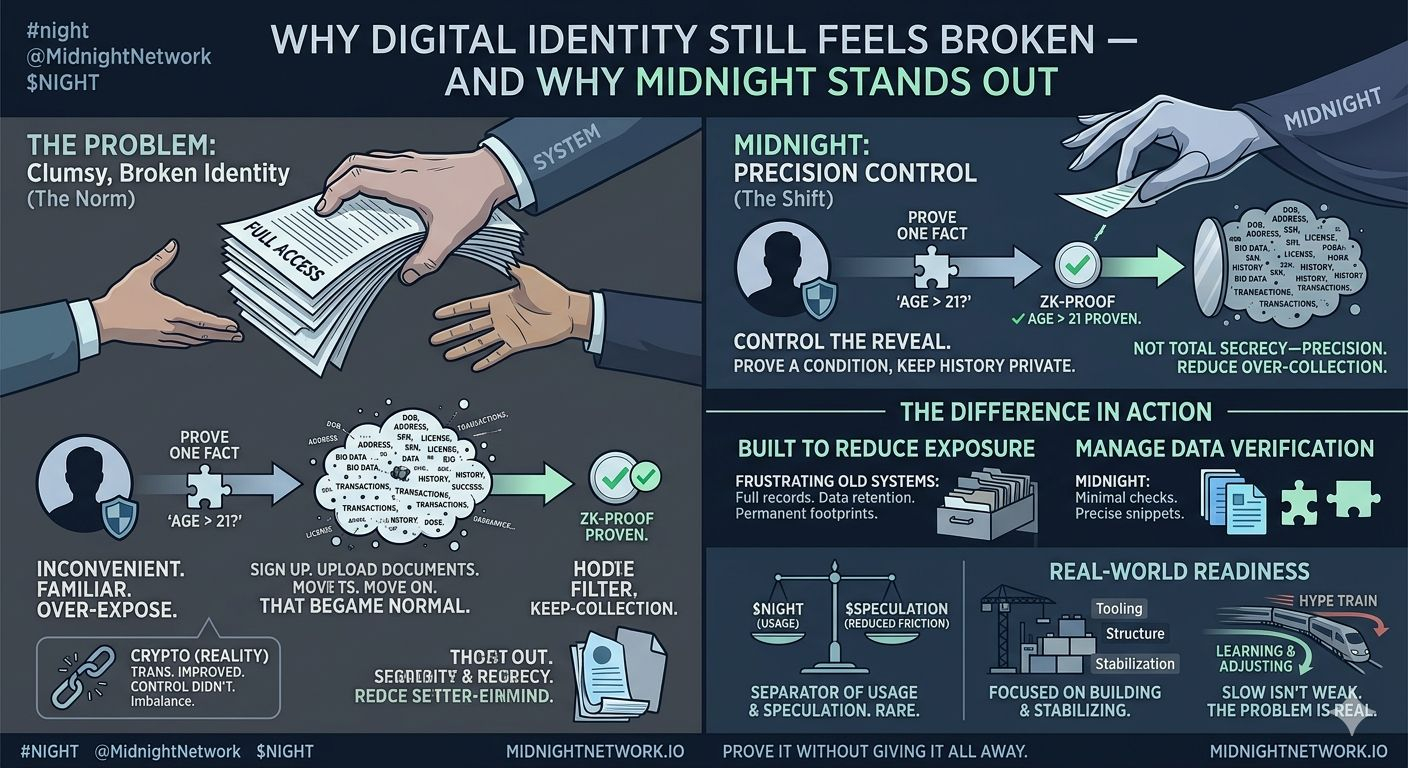
I didn’t expect to revisit digital identity this deeply.
It’s one of those problems everyone knows exists, yet most of us quietly accept. Sign up somewhere upload documents share more than necessary move on. It’s inconvenient but familiar.
That’s the problem.
For years proving something simple like who you are or whether you meet a requirement has meant exposing far more than needed. One small check turns into full access. Somehow, that became normal.
Crypto promised a fix. But in reality, it didn’t. Often, it made things worse: more visibility, more permanence, easier traceability. Transparency improved, but control didn’t. That imbalance never sat right with me.
Enter Midnight Network.
Not another “privacy project.” That label has lost meaning. Every cycle promises privacy, most fade under real-world usage. What feels different here is the approach: it’s not about hiding everything it’s about controlling what gets revealed. That small shift changes everything.
Most real-world systems don’t need total secrecy they need precision. You should prove one fact without exposing your full history. Confirm a condition without handing over everything behind it. Simple in theory, rare in practice. Most systems over-collect, over-store overexpose. Midnight seems built to reduce that.
It’s not about making data disappear it’s about managing what’s shared during verification. That’s a problem ignored for years. And it’s frustrating.
Identity systems today still operate bluntly: requesting complete records when only a snippet is needed, retaining data too long, turning routine checks into permanent footprints. People tolerate it. Midnight doesn’t just tolerate it- it addresses it.
Even the token structure caught my attention. Separating usage from speculation is rare. Most networks mix the two, creating friction between users and traders. Midnight recognizes that tension. Whether it solves it remains to be seen.
Here’s the key: ideas rarely fail in theory-they fail when used repeatedly, in messy, real-world conditions. That’s the stage that matters. So far Midnight seems focused on building and stabilizing rather than chasing hype. Tooling, structure readiness boring but essential. That’s where real systems succeed or fail.
Privacy-first development requires a different mindset. Old patterns don’t always work. Learning, adjusting, slowing down markets may not love it, but slower doesn’t mean weaker. Sometimes it just means the problem is real.
Digital identity remains clumsy: too much exposure too little control too much trust placed in systems that demand more than necessary. Midnight confronts this directly, without dressing it up.
It may or may not succeed. But it’s tackling a real problem, and in a space full of recycled ideas, that alone is enough to keep me watching.
Because if it works even partially it could change something fundamental: proving something wouldn’t require giving everything away.
#night @MidnightNetwork $NIGHT