
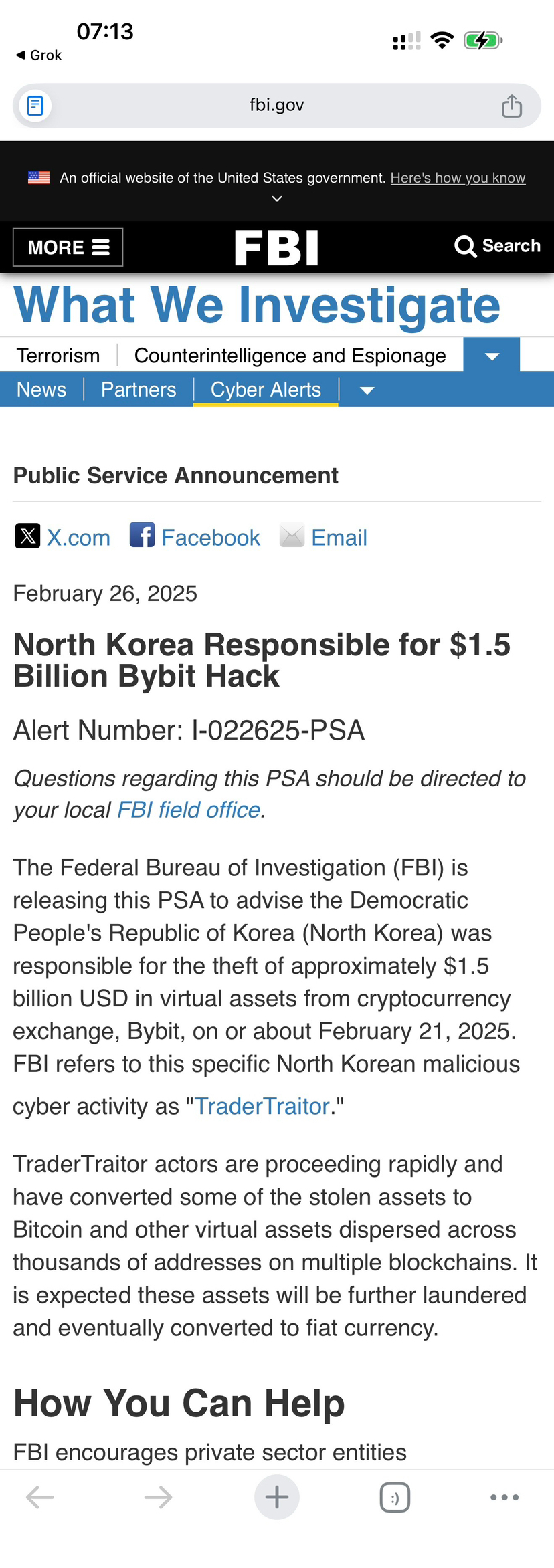
Recently, Chainalysis' latest report has been trending, stating that the total amount of cryptocurrency theft will exceed 3.4 billion by 2025, with a certain exchange ending in T being robbed of approximately 1.5 billion in a single incident. I originally planned to transfer a small amount of RWA to the chain for a simple exchange, but seeing those public transaction records being tracked so clearly made my hands go cold.
Every day we buy and sell assets on the chain and make cross-chain transfers, yet we increasingly feel that the on-chain claim of 'this is mine' is actually the biggest vulnerability and illusion. Hackers do not need to spend effort cracking passwords; they can accurately pinpoint targets and implement precise strikes just by monitoring public footprints on the chain. The major robbery exposed not only funds but also the systemic pain points in asset ownership across the entire industry. Transparency equals vulnerability, and ownership equals exposure.
And Midnight's Zswap protocol provides a completely different answer at this juncture. It allows on-chain asset ownership to truly return to the users themselves, no longer a public transparent ledger, but a provable yet non-revealing private sovereignty.
I have recently spent several days immersed in the official documentation of @MidnightNetwork , and the more I look, the more I feel this project has captured the industry's most painful points. This is not just a simple upgrade of privacy coins but fundamentally redefines asset ownership and transaction methods on the blockchain. Midnight is built by the IOG team, personally driven by Charles Hoskinson. It adopts a dual-state ledger architecture, embedding ZK proofs directly into the protocol layer. Users can enjoy the flexibility of DeFi without worrying about transaction data being exposed to the entire network. Zswap is the core engine within this architecture.
The warning from the exchange disaster: why self-custody has become a necessity.
In recent years, security incidents at centralized exchanges have been frequent. Users deposit assets, appearing convenient for trading, but in reality, they hand over control of their private keys. Once the platform encounters hackers, internal operations, or regulatory freezes, assets instantaneously lose sovereignty. The $1.5 billion evaporation case has sounded the alarm again: even top exchanges cannot guarantee 100% fund safety. More importantly, traditional exchange transaction records mean any large orders could be sensed in advance, triggering a chain reaction.
The emergence of Midnight is a direct response to this pain point. Don't treat it as just another Layer 1 narrative; it is a fourth-generation blockchain specifically designed for data protection. The protocol layer has built-in privacy mechanisms, and from the first transaction, users place their assets under the umbrella of zero-knowledge protection. The Zswap protocol further reinforces this: it allows users to swap multiple assets on-chain while leaving only a "disbalanced mapping" on the blockchain, with specific amounts, participants, and asset types all hidden. Imagine this: when you exchange a stablecoin for some emerging token, the counterparty doesn't even know who you are or how much you exchanged; this is not just privacy but also true self-sovereignty.
Midnight Blockchain: A perfect balance between privacy and utility.
The core innovation of Midnight lies in its dual-state ledger design. One part is public for verification; the other part is private, protected by ZK proofs. This architecture enables developers to build truly private DeFi applications without sacrificing composability like traditional privacy coins. $NIGHT is the native token of the network, responsible for generating DUST resources for transaction fees, while incentivizing block producers. The design of NIGHT breaks the shackles of traditional tokenomics, allowing users to operate across chains without sacrificing privacy.
I particularly appreciate Midnight's consideration of enterprise applications. Traditional blockchains deter institutions due to the high risk of data leakage. Midnight protects commercial data, user privacy, and transaction metadata while still allowing verifiable results. This means that supply chain finance, medical record sharing, and even institutional-level dark pool trading can all operate securely on-chain. Zswap plays a bridging role here: it makes asset swaps in these applications atomic and confidential, avoiding any intermediary risks.
Zswap Protocol: A privacy-enhanced version of atomic swaps.
Zswap is directly derived from the Zerocash protocol but has made significant expansions. It supports multiple asset types and has built-in non-interactive atomic swap capabilities. In simple terms, when two users want to swap assets, they prepare their trading intentions and then merge the transactions into one atomic operation through zero-knowledge proofs. The entire process does not require multi-party computation, and either party cannot withdraw midway without exposing details.
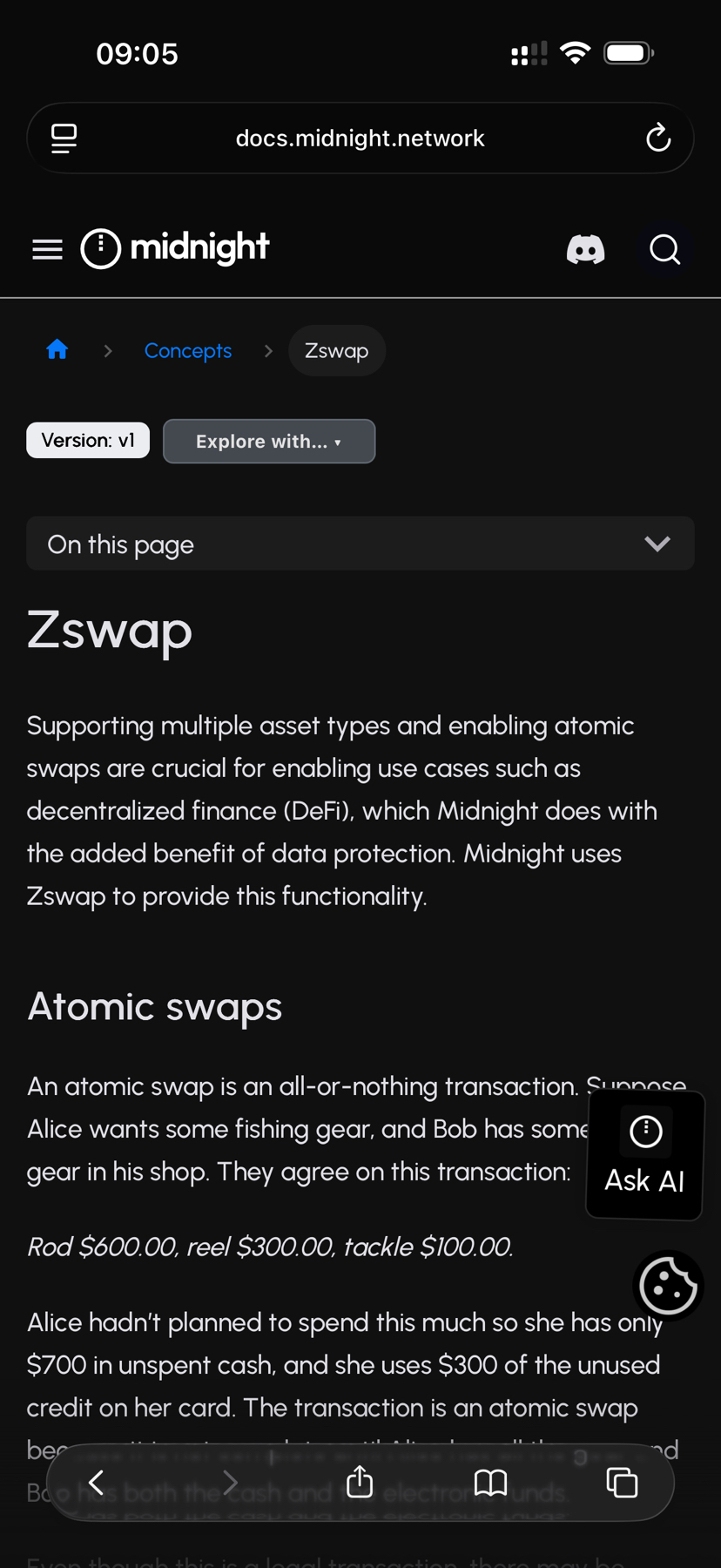
The official documentation clearly states that Zswap uses sparse homomorphic commitments and aggregated open randomness, significantly reducing proof size and computational overhead. Transactions only display the input and output imbalance for each asset, while specific values and participant identities remain completely confidential. This is several orders of magnitude lower in transparency than traditional AMM or order books, yet with higher security. For example: Alice wants to exchange $3 for €5, and Bob wants to do the reverse. After their trades are merged and put on-chain, the blockchain only sees that the asset imbalance has been balanced, while outsiders know nothing about who exchanged what or how much.
This design directly addresses the long-standing issues in DeFi—front-running and MEV risks. Miners or observers can no longer manipulate public orders in advance since they cannot see the order contents. Zswap turns swaps into private matches; users can send quotes in local markets and, after successful matching, merge and submit, making the entire process efficient and low-cost.
In-depth technical analysis: The innovative leap from Zerocash to Midnight.
To truly understand Zswap, one must return to its mathematical foundations. It inherits the signature separation and homomorphic commitments of the Zcash Sapling framework, but removes authorized signatures and blind signatures, simplifying it into a purely ZK-SNARK driven system. The research paper (Zswap: zk-SNARK Based Non-Interactive Multi-Asset Swaps) provides a detailed proof of the security of this simplification: as long as the commitment's perfect hiding and binding hold, the entire protocol is secure.
The core of the protocol is the One-Time Account (OTA) system, abstracting a private UTXO mechanism similar to nullifiers. Each Zswap token is shielded, and users can choose to issue it as a shielded form or a regular UTXO. During atomic swaps, transactions are extensible, with data and signatures separated, allowing non-interactive merging between unknown participants to be possible. The merged transaction only retains the imbalance mapping, and any excess zero-imbalance asset types are automatically discarded, with the remainder packaged and put on-chain.
Midnight's ZK execution engine is based on the Kachina research framework, using the Pluto-Eris curve to generate BLS-like proofs for scalable composable privacy. Compared to earlier privacy schemes, Zswap has minimal performance overhead, high merging efficiency, and overall performance close to deployed privacy cryptocurrencies. This is not just theoretical; the IOG team has directly reused code and implementation experience from Zcash Sapling, ensuring practical applicability.
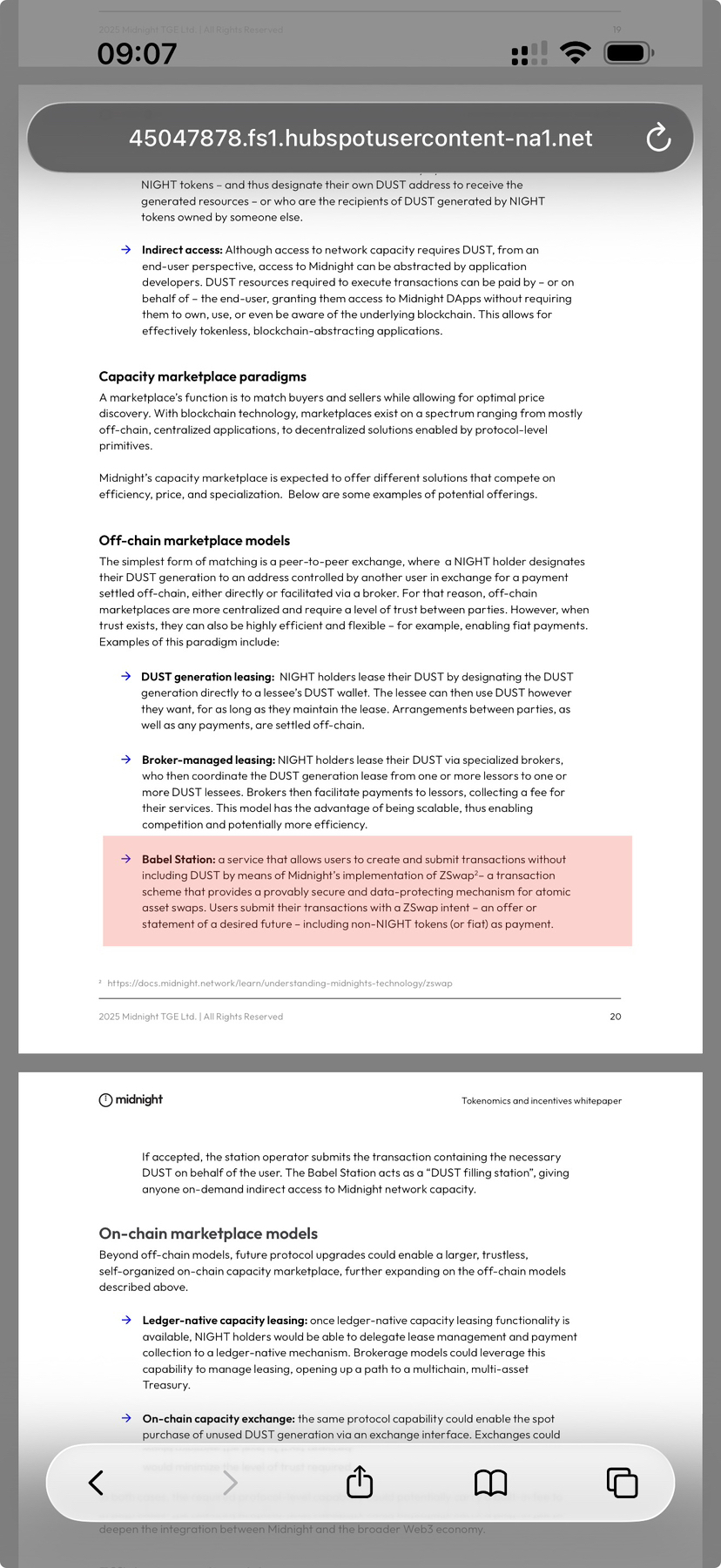
While reviewing the white paper, I found that Midnight has also planned further iterations for Zswap 2, including allowing users to submit transactions without DUST through Babel Station. This detail reflects the team's extreme pursuit of user experience.
Real Value: How on-chain assets truly "belong to oneself"
Returning to the earlier $1.5 billion disaster. If the assets had been on Midnight at that time, completing the swap through Zswap, hackers would not have been able to see specific holdings and could not launch targeted attacks. Because everything is in a private state, the ownership of the assets is controlled only by the user's private key, with no intermediary platform to be invaded. Self-custody here is no longer an empty talk, but a true sovereignty with a privacy shield.
Developers can use Zswap to build confidential DEXs, dark pool trading, and even institutional-level asset management tools. Users do not need to worry about KYC leaks or transaction histories being tracked when trading on-chain. NIGHT token holders can also participate in governance through network incentive mechanisms, jointly maintaining this privacy ecosystem.
A rational perspective of coexistence of risks and opportunities.
Any new technology has its duality. Zswap's privacy strength is very high, but this also means that regulatory compliance requires extra design. The Midnight team explicitly emphasizes verifiability in the white paper, allowing users to selectively disclose proofs without exposing all data. This leaves room for institutional adoption.
In terms of performance, although ZK proof computation is intensive, Midnight's optimizations keep costs within a reasonable range. In the future, with hardware acceleration and proof system upgrades, the barriers will be further lowered. Personally, I believe the greatest opportunity lies in its ability to combine the compliance needs of traditional finance with the decentralized advantages of blockchain, opening the door to enterprise-level blockchain.
Future Outlook: Midnight's positioning in the wave of privacy DeFi.
The mainnet is about to be fully launched, the Glacier Drop airdrop has been completed, and the NIGHT ecosystem is rapidly growing. Zswap is not just a swapping protocol; it is the key for Midnight to unlock large-scale privacy applications. Imagine this: the future of DeFi is no longer a transparent coliseum, but a fair arena where everyone wears a privacy mask. Institutions can confidently put real assets on-chain, and retail investors can truly control their wealth.
I believe Midnight Zswap will become the next milestone. It proves that blockchains do not need to choose between privacy and utility; they can achieve both. When the next exchange incident occurs, users will no longer just lament "self-custody sooner," but can confidently say: my assets, on Midnight, truly belong to me.